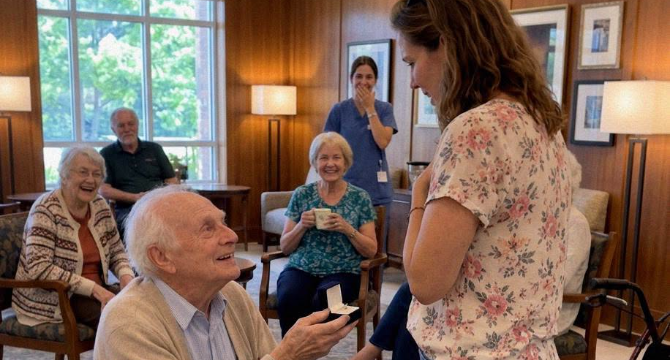
My 89-year-old friend at the retirement home suddenly got down on one knee and asked me to marry him. Everyone stared as I froze in shock, convinced he was joking. Then he looked me in the eyes and said, “There’s a reason I chose you.” What he revealed changed my life forever.
My husband died suddenly of a heart attack.
Afterward, my house seemed to hold its breath, waiting for footsteps that would never come again.
So I started volunteering at the local retirement home a few months later.
Everyone assumed I came to give back, to help lonely people reconnect with the world.
That was partly true.
I started volunteering at the local retirement home.
But the honest truth was simpler and sadder.
I was the one who needed someone to talk to.
That was where I met Albert.
He was eighty-nine years old, sharp as a tack, and somehow the funniest man in the building.
Every Wednesday, we drank tea, played chess, and he told me stories from his long, remarkable life.
That was where I met Albert.
“You know,” he said one afternoon, “you play chess like someone who’s thinking about ten other things.”
“Maybe I am,” I admitted.
“Then you’re a dangerous woman. Distracted people win by accident.”
I laughed.
It surprised me how good it felt.
“Maybe I am,”
“Checkmate,” he added a moment later, grinning like a boy.
“You cheated.”
“I’m eighty-nine. I’ve earned a little cheating.”
We settled into that rhythm week after week.
He never asked about my grief directly, and I appreciated that more than he knew.
One Wednesday, feeling bold, I decided to tease him.
“You cheated.”
“Albert, can I ask you something personal?”
“Only if it’s scandalous.”
“Would you ever get married again?”
He set down his teacup and studied me for a long second.
Then his whole face lit up.
“I’m only eighty-nine,” he laughed, straightening his shoulders. “Give me a little more time. You never know.”
He studied me for a long second.
We both laughed.
For a moment the hollow feeling in my chest lifted.
Nothing in that moment hinted that he’d already made a decision that would change both our lives.
“You should laugh more often,” he said. “It suits you better than that other face you wear.”
I frowned.
“What other face?”
He’d already made a decision that would change both our lives.
“The one you put on when you think nobody’s looking,” he replied gently.
I brushed it off with a shrug and reached for my tea.
“You’re imagining things.”
“Maybe,” he said.
But his eyes lingered on me longer than they should have.
I brushed it off
I gathered my things when our hour ended.
“Same time next Wednesday?” I asked.
“Wouldn’t miss it,” he promised. “Though next week, I might just surprise you.”
“Albert, you surprise me every week.”
He smiled, but there was something quieter underneath it.
Something I couldn’t name.
“Not like this,” he murmured.
“Next week, I might just surprise you.”
I didn’t think much of it at the time.
I assumed he was just being his playful self.
But as I headed toward the door, I glanced back.
Albert was quietly speaking with Nurse Sarah.
The moment they noticed me watching, both of them fell silent.
I didn’t think much of it at the time.
I walked out through the sliding doors and into the parking lot.
The mask I wore for everyone else dropped.
By the time I reached my car, I was the same hollow woman I had been that morning.
The woman who dreaded her empty house and the silence that lived inside it.
I never noticed Albert watching me from the window.
I had no idea that what he had planned for the following Wednesday would change everything I believed about my own life.
We had just finished our usual game of chess when Albert slowly stood.
He reached into his jacket pocket.
Then he carefully lowered himself onto one knee.
Every resident, nurse, and visitor turned to stare at him.
Then Albert looked up at me and asked,
“Will you marry me?”
He carefully lowered himself onto one knee.
I stood there completely frozen.
“There’s a reason I chose you,” Albert said quietly. “And once you hear it, you’ll understand why I had to ask.”
A murmur rippled through the room.
Instead of looking surprised, several of the residents exchanged knowing glances.
Somehow, I was the only person who hadn’t seen this coming.
“There’s a reason I chose you,”
I lowered myself toward him, hands out, ready to pull him up before he hurt himself.
“Albert, please,” I whispered. “Get up. This isn’t funny anymore.”
He gently swatted my hands away.
“I’m not trying to be funny,” he replied. “Sit back down.”
“You’re going to hurt your knees. People are staring.”
“Let them stare,” he said, almost cheerful about it.
I glanced around the room.
“Let them stare,”
Nurse Sarah stood by the doorway, her hand pressed to her mouth.
But she made no move to stop him.
That surprised me more than anything.
A few residents had gathered near the tea table, watching, waiting, as if they already knew something I didn’t.
“Albert, I can’t marry you,” I said, my voice cracking. “You know that. You know why.”
But she made no move to stop him.
“Because of your husband,” he answered softly.
I felt my throat tighten.
“Don’t,” I begged. “Please don’t bring him into this.”
“Sit down. Just listen to an old man for one minute. Then you can walk out that door and never speak to me again if you want.”
I looked toward Nurse Sarah, hoping she’d rescue me from the awkwardness.
Instead, she gave me the smallest nod, as if silently asking me to trust him.
“Just listen to an old man for one minute.”
I sank into the chair across from him.
He finally settled back, no longer kneeling.
But his gaze never left mine.
“When my wife died,” he began, “I made myself a promise. I told myself I would never marry again. Not ever.”
“Then why are you doing this?” I asked.
“I made myself a promise.”
“That’s a good question,” he said. “For forty years, I kept that promise. I buried it with her. I didn’t want anyone to take her place, and no one ever could.”
“So why me?” I whispered.
Albert leaned forward.
“I didn’t propose to you because I want a wife.”
I stared at him, confused.
“You’re not making any sense, Albert.”
“So why me?”
“I know,” he said, and he almost smiled. “Let me try again.”
The room stayed hushed.
“I’ve been watching you,” he continued. “Every Wednesday. You come in here with that bright smile, you pour the tea, you let old Mr. Fletcher cheat at cards, and you make this place feel alive.”
“I like being here,” I admitted. “It helps.”
“It does,” he agreed. “But I’ve seen something else too.”
“I’ve been watching you,”
“What?”
“I’ve seen you when you think no one is looking,” he said. “The way your face changes the moment you walk toward the parking lot. That smile of yours falls right off. Every single time.”
I opened my mouth, but no words came.
“You leave here and walk toward that car like you’re walking into a grave,” he said gently. “I know that walk. I walked it for years.”
“Every single time.”
“Stop,” I said, though it came out weaker than I meant.
“You’re carrying the same loneliness I carried,” he went on. “I recognized it the day I met you. It’s a very particular kind of empty, and only people who’ve felt it can spot it in someone else.”
My eyes stung.
I looked down at the chessboard.
“You don’t understand,” I said. “My life ended when he died. That’s just the truth. I come here so I don’t have to feel it for a few hours.”
My eyes stung.
“I understand better than anyone in this building,” Albert said. “That’s why I chose you. Because someone chose me once, and it saved my life.”
“Albert, a proposal isn’t going to fix that.”
“You still think this is about a wedding,” he said, shaking his head slowly.
“Isn’t it?” I asked, wiping my cheek. “You’re on your knee in front of everyone.”
“This proposal is not real. Not in the way you think it is.”
I froze, staring at him.
“Then what is it?” I whispered.
“Not in the way you think it is.”
“It’s the only way I could get you to sit still and finally listen,” he said. “You never let anyone talk about your grief. You change the subject every time. So I had to do something you couldn’t walk away from.”
Around the room, I noticed the residents nodding, some with tears in their eyes.
Nurse Sarah had stepped closer, holding something behind her back.
“Everyone here has watched you grieve,” Albert said. “We’ve watched long enough.”
He reached into his jacket pocket, and I braced for a ring.
Instead, he pulled out a stuffed manila folder.
“We’ve watched long enough.”
The folder sat in his outstretched hands.
I couldn’t make myself reach for it.
“Whatever’s in there, Albert, it won’t change anything,” I said.
“You don’t know that.”
“I do.” I pressed my palm against my chest, as if I could hold the ache in place. “You’ve said your piece. You’ve made your speech. But you’re asking me to believe something I stopped believing the day he died.”
Albert lowered the folder slowly.
“Whatever’s in there, Albert, it won’t change anything,”
“Say it, then,” he said. “Say the thing you’re afraid to say.”
“I don’t know what you mean.”
“You do.”
I looked away, toward the window where the afternoon light had gone thin and gold.
My hands were shaking again.
“If I let go of the hurt,” I whispered, “I let go of him. That’s what you don’t understand. The grief is all I have left. It’s the last room he still lives in.”
“Say the thing you’re afraid to say.”
“And you’ve locked yourself inside it,” Albert said. “You’ve bolted the door and thrown away the key, and you call it loyalty.”
“It is loyalty.”
“No. It’s a prison. And you’ve mistaken the walls for his arms.”
The words struck somewhere deep.
I shook my head, fast, like I could shake them loose.
“Stop it.”
The words struck somewhere deep.
“You let go of the prison,” he said. “Not the man. Never the man. That’s what you can’t seem to hear. Loving him doesn’t require you to suffer. It never did.”
“You don’t know that. You didn’t know him.”
“No,” Albert agreed. “But I knew my Ruth. And I know what she’d have said if she’d found me grieving her the way you grieve him — hollowing myself out year after year, calling it devotion.”
I wiped at my face, but the tears came faster than my hand could catch them.
“What would she have said?”
“That’s what you can’t seem to hear.”
“She’d have told me I was wasting the life she loved me for.”
He leaned forward.
“The grief isn’t the last room he lives in,” he continued. “You are. You’re the room. As long as you’re breathing, he’s still here, in the way you love, the way you carry people. But you’ve been treating yourself like a mausoleum instead of a house someone still lives in.”
“That’s cruel,” I said.
“It’s true. And I’m too old to lie to you and call it kindness.”
“The grief isn’t the last room he lives in,”
Around us the room had gone completely still.
I’d forgotten they were watching.
Old Mr. Fletcher pressed his handkerchief to his eyes by the window.
Even Nurse Sarah stood frozen in the doorway, one hand over her mouth.
“You think holding on to the pain keeps him alive,” Albert went on. “But every day you spend as a ghost is a day you spend killing the woman he chose. That’s not honoring him. That’s erasing them both.”
“Please,” I begged. “Please stop.”
I’d forgotten they were watching.
“I won’t,” he said. “You’ve had months of people tiptoeing around you, patting your hand, telling you to take all the time you need. Look where it’s gotten you.”
I flinched.
“You nod, you cry, and then you go home and do it all again. So I’ll keep saying it until something breaks loose,” he finished.
“I can’t,” I whispered. “I don’t know how to be anything but this anymore. This is who I am now. The widow. The one who’s just getting through.”
“Look where it’s gotten you.”
“That’s not a person,” Albert said gently. “That’s a headstone with a heartbeat.”
A sound came out of me — half sob, half laugh, ugly and helpless.
“You’re impossible.”
“So Ruth informed me. Forty years running.” His smile flickered, then faded. “I’m not asking you to forget him. I’m asking you to stop dying alongside him. There’s a difference, and you know it. You’ve always known it. You’ve just been too afraid to look.”
“Afraid of what?”
“That’s a headstone with a heartbeat.”
“Of what comes after the grief,” he said. “Because if you set it down, you’ll have to live. And living means the story isn’t finished. And an unfinished story is a terrifying thing when you’ve already written yourself an ending.”
I sat there, undone, my breath ragged in the silence.
“So all of this,” I said, gesturing weakly at the room, at the kneeling that had brought us here, “the spectacle, the folder, embarrassing us both — this was to force me to say that out loud?”
An unfinished story is a terrifying thing
“To make you hear it,” he said. “You could ignore kind words. You couldn’t ignore me making a fool of myself in front of everyone you’d have to face on Wednesday.”
He lifted the folder again, both hands, and held it out to me.
It was stuffed nearly to bursting.
“There’s more than a speech in here,” he said. “You didn’t think I’d stop at words, did you?”
“Albert, I can’t take any more.”
“You can,” he said. “You will.”
He lifted the folder again
His eyes stayed steady on mine.
“Open it,” he said quietly, “and then tell me your life is over.”
The folder trembled in my hands.
I opened it.
And for a moment, I didn’t understand what I was looking at.
Inside were dozens of handwritten letters.
Each one was signed by a resident I had come to know.
The folder trembled in my hands.
“Read one,” Albert whispered. “Any one.”
My eyes fell on the first page.
“You gave me my last friend,” it read.
I picked up another, my hands shaking.
“I started eating again because you made lunch feel worth waiting for.”
Tears spilled down my cheeks before I could stop them.
My eyes fell on the first page.
“Albert,” I choked out, “why would you do all this?”
“Because I watched you,” he replied gently. “Everyone here watched you grieve. And every single day, you thought you were the one being saved.”
He smiled, tired but sure.
“You had it backwards, dear girl.”
“You saw me,” I whispered.
“Why would you do all this?”
“I couldn’t leave this world without making sure someone finally told you what you’ve meant to ours.”
“I thought my life ended with him,” I admitted.
“It didn’t,” Albert said. “It just went quiet for a while. Quiet isn’t the same as over.”
Nurse Sarah stepped forward and helped me to my feet, her own eyes wet.
That evening, I walked toward the parking lot clutching the folder to my chest.
“It just went quiet for a while. Quiet isn’t the same as over.”
For the first time in months, I smiled the whole way.
And I meant it.
My home would still be quiet and empty when I got there.
But Albert had shown me a way to move forward.
I could not wait to return next Wednesday.

 admin
admin