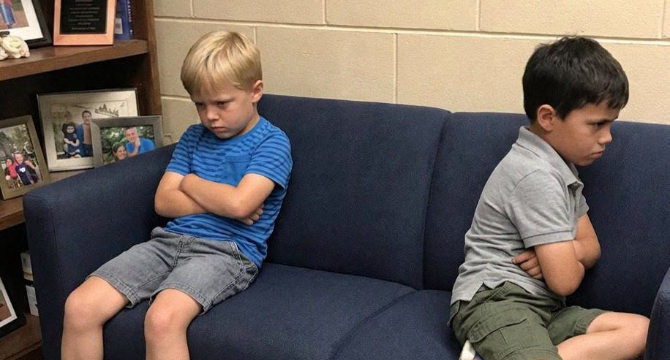
Eight years ago, my husband told me one of my newborn twins had died. Last week, I walked into my son’s school office and saw two identical boys staring back at me.
Eight years ago, I went into labor too early with twin boys. When I woke up two days later, there was one bassinet beside my bed and one sleeping baby inside it.
I turned my head and whispered, “Where’s the other baby?”
Mark lowered his eyes. “He didn’t make it.”
After that, I poured all my love into Cole.
I never saw a body. I never attended a funeral. Mark said he had handled everything while I was unconscious. I believed him because I had no strength left for anything else.
After that, I poured all my love into Cole. He was loud, funny, stubborn, and I told myself grief had an afterlife, and this was mine.
Mark changed after the birth. He became quieter and more careful about what he told me. If I asked about the funeral, he said he could not bear to describe it again. I took his distance for grief because I did not know it was guilt.
“He keeps saying we have the same dad but different moms. It’s so annoying.”
By the time Cole started elementary school, our life looked steady again. Then he came home one evening, threw his backpack on the floor, and snapped, “Stefan called me his brother again.”
I almost smiled. “Maybe he’s teasing you.”
Cole glared at me. “He keeps saying we have the same dad but different moms. It’s so annoying.”
For one second, my stomach tightened. Then I told myself kids said strange things. I told Cole to ignore him. He stormed upstairs, and I tried to forget it.
He pointed behind me.
A week later, the principal called. “Cole got into another fight with Stefan. You need to come immediately.”
By the time I reached the school, I was ready to apologize for my son’s temper. I rushed into the office, saw Cole with a split lip, and asked, “Are you okay?”
He pointed behind me.
The principal told me Stefan had tried to sit beside Cole at lunch.
Another boy sat by the filing cabinet. He had the same gray eyes, the same narrow chin, and the same birthmark near his eyebrow. Cole’s hair was lighter, but otherwise they looked like the same child split in two.
The principal told me Stefan had tried to sit beside Cole at lunch. Cole told him to go away. Stefan said, “You can be mad, but I’m still your brother.” Cole hit him. Stefan hit back. They both ended up crying, which somehow made it worse.
“How is this possible?” I whispered.
I hadn’t spoken to Beth since the weeks after Cole was born.
The principal folded her hands. “We’re waiting for the other parent, and then you’ll understand everything.”
The door opened. I turned and saw my younger sister, Beth, standing there.
“Mom.”
I hadn’t spoken to Beth since the weeks after Cole was born. Mark told me she had stopped answering my calls because she could not bear to be around my baby after learning she could not have children.
Beth asked the principal to send the boys back to class so the adults could talk.
I wrote Beth emails that bounced back. I left voicemails she never returned. Mark held me while I cried and said, “Some people leave when pain gets too close.”
Beth asked the principal to send the boys back to class so the adults could talk. Once the door closed, she looked at me and asked, “Did Mark never tell you?”
I laughed once. “Tell me what?”
Beth should raise one baby so Mark would not be overwhelmed.
She said Mark had come to her while I was unconscious. He told her both babies were alive, but one needed extended care. He claimed I had said that if things went badly, Beth should raise one baby so Mark would not be overwhelmed.
“No,” I said. “No, I never said that.”
Beth nodded through tears. “I didn’t believe him at first. Then he showed me a signed letter that looked like it came from you. He said you trusted me. He said he’d explain once you recovered.”
Beth refused to uproot Stefan again for a lie she still did not fully understand.
I could barely breathe. “And you took him?”
“I took my nephew because I thought his mother had asked me to,” she said. “Then Mark kept telling me you were too fragile to see me, and later that you blamed me and wanted nothing to do with either of us.”
Years passed. Stefan grew. Then he won a place at Cole’s elementary school after Beth moved back for work. Mark told her to choose another school. Beth refused to uproot Stefan again for a lie she still did not fully understand.
She reached into her purse and handed me the letter.
I stared at her. “I called you for months.”
“I know,” she said. “He told me answering would hurt you more.”
She reached into her purse and handed me the letter. The signature looked like mine at first glance, but the wording did not. It called her by the formal childhood nickname only Mark used when he wanted to irritate her.
Stefan had found an old hospital photograph himself.
I looked up.
“This is fake.”
“I know that now,” Beth said.
Stefan had found an old hospital photograph himself. He asked why Mark was holding two babies. Mark told him one was a cousin’s child, then changed the story and said Cole shared the same father but had another mother.
Beth brought old texts and the photograph Stefan had found in a drawer.
Stefan accepted that because children accept whatever shape of truth adults hand them. Then he started following Cole at school, trying to make a connection he could not explain.
We met that weekend and gathered everything we could find. I brought medical forms and hospital paperwork. Beth brought old texts and the photograph Stefan had found in a drawer: Mark sitting in a hospital chair with two newborns wrapped in matching blankets.
That photograph ended every excuse I had left.
We spent that whole Saturday building a paper trail.
Grace, our cousin in accounting, helped us trace the monthly payments Mark had been sending Beth from our joint savings. Beth showed me messages in which he warned her not to contact me.
We spent that whole Saturday building a paper trail. Beth searched her email for old messages from Mark. I called the hospital and requested copies of everything it would release.
We decided not to confront him alone.
Grace checked dates against our account history and found that the transfers had started the same month I came home with Cole. Beth kept staring at the papers as though she wanted one of them to say she had not spent eight years living inside a fraud.
We decided not to confront him alone. Our parents’ anniversary dinner was on Tuesday, and Mark expected Beth to stay away, just as she had for years.
When Beth walked in holding Stefan’s hand, my mother stood so fast her chair scraped against the floor. Cole stared at Stefan as though he were seeing his reflection move on its own.
Mark told the boys to sit down and stop listening.
Mark came back from the hallway, saw Beth, and went white. Then he said, almost calmly, “She’s here to start trouble.”
Beth placed the forged letter on the table. I placed the hospital records beside it. Grace set copies of the transfers down next to them.
Cole looked at me, then at Stefan, then at Mark. “Is he really my brother?” he asked.
Nobody answered fast enough. Stefan’s hand tightened around Beth’s. My mother started crying before she even had the full story. My father kept reading the letter as though the paper itself might change if he stared hard enough.
“He told us you wanted nothing to do with this family, and I believed him.”
Mark told the boys to sit down and stop listening. That was when I finally heard how often he had mistaken command for truth.
My father picked up the letter, turned it over, and frowned. “This paper came from the stationery Mark kept in his old office.”
Nobody spoke.
My mother looked at Beth first. “I’m sorry,” she said. “He told us you wanted nothing to do with this family, and I believed him.”
That was the moment he lost the room.
Then she turned to me.
“We will support both boys and both of you, no matter what Mark wants.”
Mark tried to talk over her. He said he had only been protecting me. He said Beth loved Stefan anyway. He said the arrangement had worked. Beth looked straight at him. “You stole a child and called it help,” she said.
That was the moment he lost the room. My father removed him from the business project he had hoped to join.
By the end of the week, everyone knew some version of what he had done.
His parents refused to fund the legal fight he started talking about the next day. Once the papers were on the table, he could not control the story anymore.
By the end of the week, everyone knew some version of what he had done. The family friends who used to praise his steadiness stopped calling.
The story traveled through cousins, neighbors, and business partners in that ugly, efficient way family scandals do. He hated that most of all. Not the loss. The witnesses.
“I don’t want to take your place.”
The harder part was Beth. She had raised Stefan. She knew what scared him, what made him laugh, and how he liked his sandwiches cut. I had carried him, lost him, and spent eight years believing he was dead. Neither truth erased the other.
When we finally sat alone, I told her, “I don’t want to take your place. I want to know my son, and I want my sister back if that’s still possible.”
Beth looked at me for a long time. Then she said, “Then we start slowly, and we do it honestly.”
So we started slowly.
The first few weeks were awkward and painful. Sometimes Beth would start to tell me a story about Stefan’s first tooth or first fever, then stop because she thought she was hurting me.
Sometimes I asked questions anyway because pretending those years had not happened would have been another lie. Sometimes I went home and cried because I knew his childhood memories by report instead of by touch.
So we started slowly.
Once, Cole accused Stefan of copying his drawing.
The boys began spending Sunday afternoons together at our parents’ house. At first, they competed over everything. Then they began noticing the same things: both hated peas, both slept with one foot outside the blanket, and both drew the same crooked stars.
Once, Cole accused Stefan of copying his drawing. Stefan said, “I did mine first.” Five minutes later, they were both on the floor building the same lopsided block tower without speaking.
Another Sunday, Beth brought sandwiches cut into squares, and I brought sandwiches cut into triangles. Both boys swapped halves before either of us could say anything. They were learning each other faster than we were.
Months later, my mother hung a new family photograph in her hallway.
Cole stopped saying Stefan was annoying. Stefan stopped trying so hard to force the word brother before either of them was ready. Beth and I learned how to trade school updates, doctor notes, and hard feelings without pretending any of it was simple.
Months later, my mother hung a new family photograph in her hallway. Mark was not in it. Beth and I stood on either side of the twins, and each boy held one of our hands.
My mother stood back after hanging the frame and said, “This is how it will be now.”
Something had been stolen, yes, but it was finally visible.
No one argued. The boys leaned into us without thinking about it. For the first time since the delivery, I looked at my family and did not feel as though something was missing.
Something had been stolen, yes, but it was finally visible. And once something is visible, it can be named, challenged, and fought for.
For eight years, Mark convinced us that loyalty meant choosing between two mothers, one child, and one version of the truth.
The truth turned out to be harder than that—and kinder too. Family could grow without erasing anyone.
