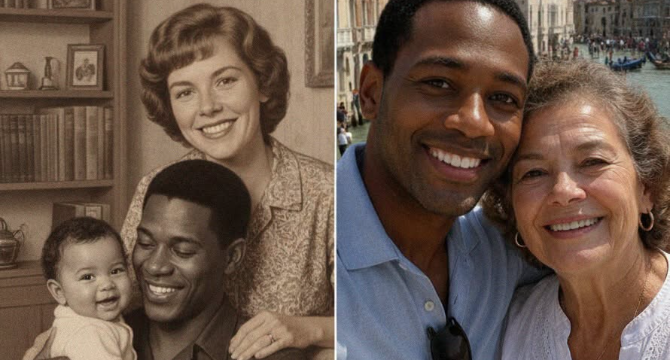
I thought my late dad had planned one last romantic surprise for my mom in Venice. Instead, the letter he left her uncovered a secret she had buried for 50 years.
My dad died three months ago, and I still have not learned how to say that without feeling like I am talking about someone else’s life.
His name was Arthur.
He was the kind of man who remembered how everyone took their coffee, who folded wrapping paper so it could be reused, who never raised his voice unless something truly mattered. He was steady in a way that made you think he would always be there.
Then cancer took him apart piece by piece.
On his last night, I sat beside his bed in hospice pretending there would still be a tomorrow. The room was dim, the machine beside him gave off soft, regular beeps, and the whole place smelled faintly of antiseptic and wilted flowers.
My mom had gone home a few hours earlier because Dad had insisted she sleep in a real bed for once.
He lifted one hand and motioned me closer.
“Jason,” he whispered.
I leaned in. “I’m here.”
He reached under the blanket and pulled out an envelope.
It was old and yellowed, sealed shut, with my mother’s name written on the front in his careful handwriting.
“On your mother’s 70th birthday,” he said, each word taking effort, “take her to St. Mark’s Square in Venice.”
I blinked. “Venice?”
He gave the faintest smile. “Yes.”
Then he pressed the envelope into my hand.
“Give her this there. Not before. Not after.”
I looked at the envelope. “What is it?”
His eyes sharpened for a second. “Do not read it.”
I swallowed. “Okay.”
“Promise me.”
“I promise.”
He relaxed then, like that one promise let him put something down.
As I stood there holding the envelope, he closed his eyes and murmured, “It’s time.”
At the time, I thought he meant it was time for him to go. Now I know he meant much more than that.
My mother’s name is Violet. She turned 70 today.
Making this trip happen was a nightmare. My mom did not want a birthday dinner, a cake, or any kind of celebration. Which made sense. Who wants to turn 70 three months after burying their husband?
But when I suggested a trip, something flickered across her face.
“Your father always wanted me to see Venice again,” she said.
That word again stuck with me, but I did not think much about it then.
So I booked the flights, found a little hotel near the canals, and spent the next several weeks pretending everything was normal while the envelope sat hidden in the back of my dresser drawer like a loaded weapon.
The whole time, I assumed it was some romantic final gesture.
A love letter.
One last gift.
That would have fit my parents.
Their marriage was never flashy, but it was solid in a way that made other people quietly jealous.
They fought sometimes. My mother could be sharp, and my dad had a habit of retreating into silence when he was hurt. But underneath it all was devotion. Real devotion.
The sort built from decades of choosing each other over and over in ordinary ways.
Which is why what happened in St. Mark’s Square hit me like a punch.
The place looked unreal.
Sunlight washed over the old stone. Violin music drifted through the square. Tourists moved in every direction, pigeons strutted like tiny mob bosses, and waiters wove between the tables carrying coffee and pastries like part of some carefully staged performance.
My mother sat across from me at a little outdoor cafe table, stirring sugar into an espresso she clearly had no interest in drinking. She looked fragile, but for the first time in weeks she also looked a little lighter.
“This is beautiful,” she said, glancing around the square. “He would have loved this.”
“Yeah,” I said. “He would’ve.”
For one selfish second, I almost decided not to do it.
I almost let her keep that moment untouched.
But I had promised him.
So I reached into my bag, took out the envelope, and placed it on the table between us.
“Dad wanted you to have this.”
Her reaction was instant.
Every drop of color left her face. She did not just look surprised.
She looked terrified.
Her chair scraped backward. Her hand struck the coffee cup so hard it rattled against the saucer. Her fingers were shaking so badly I thought she might pass out.
“Mom?”
She stared at the envelope like it had crawled out of the grave.
“Where did you get that?” she whispered.
“Dad gave it to me. On his last night.”
She looked at me with raw panic. “Why did he send you here?”
I felt my stomach drop. “What?”
“He wasn’t supposed to know.”
The musicians kept playing. A child nearby laughed as pigeons scattered. Someone at the next table asked for more sugar. The square stayed bright and beautiful while my mother looked like the world had just split open in front of her.
“Mom,” I said, leaning forward, “what are you talking about?”
She pressed both hands to her mouth. Tears welled up so fast it was like something inside her had burst.
“Oh, God,” she whispered. “Arthur.”
I moved to the chair beside her. “Talk to me.”
She shook her head. “No.”
“Yes.”
“You don’t understand.”
“Then tell me.”
For a moment I thought she might get up and leave. Instead, she stared down at the tablecloth and said, in the smallest voice I had ever heard from her, “Before your father, there was someone else.”
I said nothing.
She gave a broken little laugh. “Of course there was. There usually is. But this was not a silly romance. I was 20. I came to Venice with my parents. And I met a young man named Tom.”
She said his name like she had never stopped carrying it.
“I fell in love with him,” she said. “Fast. Completely. He worked with his uncle near the water. He played guitar badly. He had no money, no grand future, no real plan except whatever the next day held. And I loved him for it.”
I listened, barely breathing.
“He asked me to stay. He wanted me to build a life with him here.” Her fingers twisted together. “My family found out, and they were horrified. My father said I was being foolish. My mother cried. They told me love was not enough. That I would ruin my life. That security mattered more.”
She swallowed hard.
“And they won.”
I looked at her. “You left.”
She nodded. “Before sunrise. I did not say goodbye. I did not leave a note. I just disappeared.”
“I never told him.” Her eyes snapped back to the envelope. “At least, I thought I never did. I told myself I had buried it. But now he sends you here, of all places, with this.” Her voice broke. “What else am I supposed to think?”
I stared at her. “You think Dad found out before he died and sent you here to confront you?”
She closed her eyes. “I think he knew. And I think this letter proves it.”
“That doesn’t sound like him.”
“You don’t know what guilt does to a person,” she shot back, then immediately looked ashamed. “I’m sorry.”
I waited.
She let out a shaky breath. “I loved your father. I need you to hear that. I loved him with my whole heart. But there was always this locked room inside me. This unfinished thing. I hated myself for it. I spent 50 years wondering whether keeping that secret made me a fraud.”
I asked quietly, “Did you ever stop loving Tom?”
She looked out across the square, eyes glassy. “I stopped living in that love. I never stopped grieving it.”
Then she turned back to me. “And if Arthur knew that, maybe he died knowing the truth about me.”
I slid the envelope closer to her.
“Then open it.”
She stared at me. “I can’t.”
“You can.”
“What if it ruins everything?”
“It can’t. Whatever it says, Dad wanted you to have it.”
Her hand hovered over the envelope for a long second before she finally touched it. Then, slowly, she broke the seal.
Inside was one folded letter. She opened it with trembling fingers and started to read.
At first her expression stayed frozen, tight with dread. Then it changed. The terror gave way to confusion. Then disbelief. Then something deeper and almost unbearable.
“Mom?” I said.
She looked at me, eyes wide with tears, then started reading aloud.
“Violet, if you are holding this in Venice, then Jason kept his promise, which means I was right to trust him.”
Her voice shook so badly that I had to lean in to catch the words.
“I have known about Tom for most of our marriage.”
She stopped, sucking in a sharp breath.
My whole body went cold.
Then she kept going.
“You did not tell me in some dramatic confession. I learned in fragments, as people do in long marriages. A name in your sleep. A photograph you thought you had thrown away. The look on your face whenever Venice was mentioned. I knew enough. The rest I understood.”
My mother covered her mouth, but she read on.
“I was never angry with you.”
The tears started spilling down her face.
“You were young. You were frightened. You made the choice you thought would save your life. Whatever part of your heart stayed in this city never took away from what you gave me. You loved me faithfully, honestly, and with more tenderness than I deserved. You gave me a family. You gave me Jason. You gave me a life I would choose again without hesitation.”
My mother broke then. Her shoulders shook, and a sob escaped her so suddenly that people at the next table glanced over before politely looking away.
I put a hand on her back and felt her trembling under my palm.
She forced herself to continue.
“If guilt has lived in you all these years, I would like to take it from you now. A dying man should be allowed one or two bold decisions. This is mine. While you were busy loving me, I made some inquiries. It took time, but I found him.”
She froze.
I stared at her. “Found who?”
Her eyes flew over the next lines.
“If he still wishes it, and if you still wish it, then perhaps you may have the goodbye you were denied. Or perhaps something else. That is not for me to decide. Look toward Caffe Florian.”
She lowered the letter.
Then she turned.
I followed her gaze across the square.
At first I saw only tourists and waiters and polished glass catching the light. Then I saw him.
An old man stood just beyond the cafe tables, wearing a dark jacket and holding a single red rose.
He had silver hair and a lined face, and he looked both hopeful and terrified, like someone standing at the edge of a life he had not expected to reopen.
Tom.
My mother made this small, shattered sound and stood so fast her chair tipped backward. I caught it before it hit the ground, but she did not even notice.
She was already moving toward him.
Not running exactly. But moving with a kind of force I had never seen in her, as if 50 years had fallen off her and she was being pulled by something stronger than fear.
Tom took a step forward. Then another.
When they were finally close enough to touch, they both stopped.
I stayed where I was.
It felt private, even in the middle of that crowded square.
My mother lifted one trembling hand toward his face.
“Tom?” she whispered.
He let out a breath that looked trapped inside him for decades.
“Violetta,” he said.
Not Violet. Violetta.
She started crying harder.
“I am so sorry,” she said. “I left without a word. I was a coward. I have been sorry all my life.”
Tom shook his head, though his eyes were wet too. “I thought you were dead.”
She blinked. “What?”
He gave a sad, disbelieving laugh. “Your father came to see me years later. Not your husband. Your actual father. He told me you had become ill after returning home and that I must not contact you. He said I would only make things worse. Then he paid me to disappear from your life.”
My mother looked like the ground had dropped out from under her.
“No,” she whispered.
Tom nodded. “I hated you for a long time. Then I thought perhaps you had truly chosen another life and did not care. Then I tried to forget you.”
My mother clutched the rose when he offered it to her, like it was the only solid thing in the world.
“You mattered,” she said through tears. “You mattered so much I was afraid of what choosing you would cost.”
He smiled then, a tired, gentle smile that somehow still carried the shadow of the young man she had loved.
Across the square, the violin music rose into something bright and aching.
Tourists kept taking pictures. Pigeons kept circling for crumbs. And my mother stood there in the middle of it all, face-to-face with the unfinished love of her youth.
I looked down at my father’s letter still lying open on the table.
There was one last line at the bottom she had not read aloud.
I should not have read it. I had promised.
But my eyes fell there anyway.
“Love should not leave this world carrying shackles.”
That did it. I sat back in my chair and cried in the middle of St. Mark’s Square.
Because all at once, I understood what my father had done.
He had known. Maybe not every detail, but enough. He had lived beside my mother’s hidden sorrow for decades and never once turned it into a weapon. And in the end, with death already at the door, he used his last strength not to punish her, but to set her free.
That kind of love is almost terrifying.
People talk about love as possession. As being chosen over everyone else. As winning. But my father loved my mother in a way that had nothing to do with winning.
He loved her enough to want her peace more than his own pride.
Eventually my mother came back to the table with Tom beside her. Her face was a mess, but she looked lighter than I had seen her since before my dad got sick.
She touched my hand. “Jason, this is Tom.”
Tom held out his hand awkwardly. “Your father was an extraordinary man.”
I shook it. “Yeah. He was.”
My mother sat down, clutching the rose in one hand and the letter in the other.
“I don’t know what happens now,” she said.
Tom gave a soft smile. “Now, perhaps, we have coffee.”
That made her laugh through her tears, and hearing that laugh nearly undid me all over again.
So we sat there, the three of us, in the middle of Venice.
They talked carefully at first, as if one wrong word might break the moment. Then more easily. They spoke about that summer when they were young. About streets that had changed. About people who had died. About lives lived apart. My mother spoke about my father too, and Tom listened with quiet respect, no jealousy in him at all.
At one point, she held up the letter and said, “He gave this to me. Even this.”
Tom nodded. “Then he loved you very much.”
She looked down at the page. “He did.”
Later that night, back at the hotel, my mother knocked softly on my door. When I opened it, she stood in the hallway holding the folded letter in one hand.
“I need you to understand something,” she said.
“Okay.”
“Your father was the great love of my life.”
I nodded.
“And Tom,” she said, voice trembling, “was the great unfinished love of my youth.”
I said nothing, because there was nothing to correct in that. Nothing disloyal in it. Nothing ugly.
She smiled sadly. “I spent years thinking those two truths made me a bad wife. Your father understood that they didn’t.”
Then she touched my cheek the way she used to when I was a kid and whispered, “He gave me one last miracle.”
After she went back to her room, I sat on the edge of my bed for a long time thinking about the kind of man my father had been. I brought my mother to Italy because my dying father asked me to.
I thought I was delivering a letter.
What I was really delivering was absolution.
And somewhere in this city tonight, after 50 years of guilt, my mother is finally breathing like a free woman.
My father is gone.
But somehow, this was still one more way he took care of us.
