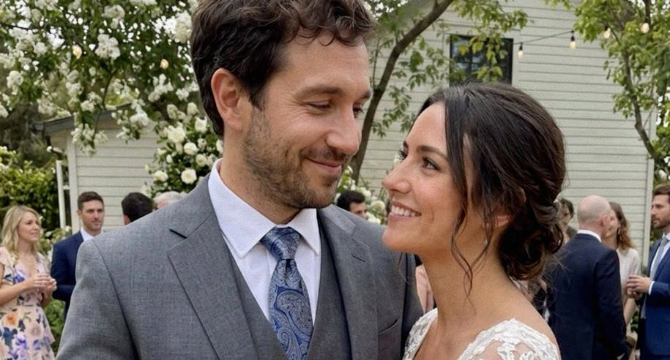
I married Luke despite my family’s belief that a mechanic could never match the future I’d built. After our wedding, he showed me an old metal box filled with proof that their judgment ran deeper than I knew. By morning, I had to decide what loyalty really meant.
Aunt Alison’s fork hit her plate hard enough to make everyone look up.
“You are humiliating this family,” she said.
Letters covered my grandmother’s breakfast table. My mother, Veronica, sat frozen beside my father, Tom. Luke’s hand rested near mine, but he didn’t reach for it.
He was waiting to see what I would do.
“You are humiliating this family.”
Twelve hours earlier, I’d thought the worst thing my family had done was judge the man I loved.
Then my new husband opened an old metal box and showed me that their cruelty had started years before I met him.
The first time I brought Luke home, my parents had decided who he was before dinner reached the table.
My mother noticed the faint grease near his wrist.
My father noticed his work boots.
Twelve hours earlier…
Neither noticed Luke carrying my groceries inside while they watched from the window.
“So, Luke,” Mom said as she poured the wine, “did you ever think about going to college?”
Luke glanced at me, then smiled.
“I thought about a lot of things.”
Dad chuckled. “That usually means no.”
“Did you ever think about going to college?”
“Dad.”
“I’m only asking.” He leaned back. “A man needs direction. A career that can grow.”
“Luke has a career.”
“We know he works hard, Alyssa,” Mom said. “We’re talking about long-term security.”
Luke didn’t argue.
Instead, he looked toward the driveway.
“We know he works hard.”
“Does your car grind when you brake?”
Dad blinked. “How did you know that?”
“I heard it when you pulled in. You should have the rotors checked before they damage anything else.”
Within seconds, Dad was asking what the repair would cost. Luke answered without pointing out that Dad had doubted his future and trusted his judgment in the same breath.
“How did you know that?”
That was Luke. He gave people room to hear themselves.
Aunt Alison arrived halfway through dinner.
She saw Luke and stopped for half a second before smiling.
“You must be the mechanic.”
“His name is Luke,” I said.
“Of course, Alyssa. Relax, darling.”
Aunt Alison arrived halfway through dinner.
She studied his face.
“You look familiar.”
“My mother used to work for families around here,” Luke replied.
The color shifted in my aunt’s cheeks.
She turned to me.
“Your mother tells me the wedding is still happening this summer.”
“You look familiar.”
“It is.”
“Isn’t that a little rushed?”
“We’ve been together for three years.”
Luke’s phone rang. He checked the screen.
“Sorry. I have to take this.”
He stepped into the kitchen.
The moment the door closed, my family leaned toward me.
“Isn’t that a little rushed?”
Mom said love didn’t pay bills.
Dad said a good man could still be the wrong man for my future.
Aunt Alison said people from different backgrounds often became embarrassed by each other.
I looked through the glass door.
Luke caught my eye and gave me a small smile.
He knew exactly what they were doing.
Mom said love didn’t pay bills.
He knew I’d spent years keeping peace in that family, and he loved me enough not to make the evening harder.
On the drive home, I asked about my aunt.
“Have you met her before?”
Luke kept his eyes on the road. “No.”
“She looked like she knew you.”
I asked about my aunt.
“Maybe I remind her of someone.”
His answer came too quickly, but I let it go.
A few weeks later, I visited Luke near closing time.
He was leaning beneath the raised hood of an old car while an older woman stood beside him, twisting her keys between her fingers.
“I can’t afford a new engine,” she said.
“Maybe I remind her of someone.”
“You don’t need one.”
“You said it sounded bad.”
“It does. Bad doesn’t always mean hopeless.”
He separated the urgent repair from what could wait, then quoted barely enough to cover the parts.
The woman frowned. “I don’t want charity, son.”
“It isn’t charity. You taught half this neighborhood how to read.”
“I don’t want charity, son.”
“That was my job.”
“And this is mine.”
After she left, I crossed my arms.
“You’re losing money on that car.”
“Not much.”
“That’s not quite a defense.”
“And this is mine.”
Luke wiped his hands. “She needs it for her appointments, Lys.”
To him, the rest didn’t matter.
My family saw only a mechanic.
I saw a man who could help someone without making her feel small.
Still, as the wedding got closer, my parents pushed harder.
One afternoon, Mom took me shopping and spent twenty minutes avoiding the reason she’d brought me.
To him, the rest didn’t matter.
“Marriage changes people.”
“I know.”
“Love isn’t the same as building a life.”
“Luke and I are building one.”
She put down the fabric in her hand.
“You may spend years making up for what he lacks.”
“Marriage changes people.”
“What does he lack?”
“Alyssa.”
“No. Say it.”
She lowered her voice.
“Education. Social confidence. Ambition.”
“Luke runs a busy garage, supports himself, and treats people with more respect than the men you admire.”
“What does he lack?”
“That’s not what I meant.”
“It’s exactly what you meant.”
She sighed. “One day, you may feel embarrassed when he can’t keep up.”
“You keep talking about the life Luke can give me. You never ask what kind of life we give each other.”
I left without buying anything. It was the first time I’d walked away before Mom approved of me.
“That’s not what I meant.”
When Luke proposed, Dad asked, “Are you really going to throw your future away on a man who’s spent his life under cars?”
“I’m marrying a man who knows what things are worth,” I said. “Ask him how he measures people.”
Our wedding was small and simple.
Luke’s friends moved chairs. His customers brought extra food. Two coworkers argued over who had taught him more.
My family smiled for the photos.
Our wedding was small and simple.
When guests looked away, their faces changed.
Near the cake table, Aunt Alison adjusted a flower that didn’t need touching.
“You may find all this charming today,” she said.
“I do.”
“Give it five years.”
“What happens then?”
“Give it five years.”
“You’ll remember how you were raised.”
I looked at her.
“That’s exactly what I’m afraid of.”
Before she could answer, a server nearby dropped a tray.
Glasses shattered across the floor.
The young man froze.
I looked at her.
Luke crouched at once.
“Don’t touch the small pieces,” he told him. “You’ll cut your hand.”
Aunt Alison watched them.
“Some people simply aren’t trained for better,” she said.
Mom glanced around. “Keep your voice down, Alison.”
“Why?” Aunt Alison replied. “His mother knew how to make herself useful around a house. At least the son learned a trade.”
“Keep your voice down.”
Luke went still.
I stepped toward her.
“What did you say?”
She lifted her chin. “I made an observation.”
“You mentioned his mother.”
Luke rose slowly.
“I made an observation.”
I’d never seen that expression on his face.
It wasn’t surprise.
It was recognition.
“Luke?” I asked.
He looked at me.
“Not here.”
Aunt Alison gave a small shrug. “Some families have always had a certain place in the world.”
It wasn’t surprise.
“And your place is insulting my husband at his wedding?”
“Alyssa,” Mom warned.
“No, Mom.”
Luke touched my arm.
“Please.”
That stopped me. It was his wedding too. I nodded, though something inside me had shifted.
“Please.”
Luke smiled through the rest of the reception, but he was quieter.
When we got home, I expected us to laugh about the cake leaning to one side or collapse on the couch.
Instead, Luke took off his jacket and walked toward the garage.
“Where are you going?”
“I need to show you something.”
He returned carrying an old metal box.
“I need to show you something.”
It was scratched and rusted around the corners.
He set it on the kitchen table and rested both hands on the lid.
“After what Alison said tonight, I knew I couldn’t carry this into our marriage, Alyssa.”
I pulled out a chair.
“Open it.”
Inside were letters, photographs, returned envelopes, and a piece of fabric wrapped around something flat.
“I couldn’t carry this into our marriage.”
Luke handed me the first picture.
A young woman stood in a driveway I recognized.
She had Luke’s eyes.
“That’s your mother.”
He nodded.
“She worked for your grandmother before I was born.”
I looked up. “Why didn’t you tell me?”
She had Luke’s eyes.
“I didn’t want what happened to her to become the first thing you saw when you looked at me.”
“What happened?”
He nodded toward the fabric.
Inside was a photograph of a shattered porcelain vase.
I’d seen it in old family pictures.
“My aunt broke this,” I said slowly.
Luke’s jaw tightened.
“What happened?”
“She took it from a locked cabinet. My mother saw her drop it.”
“And when Grandma found out?”
“Your aunt blamed my mother.”
The first letter denied that she had touched the vase and begged Grandma to reconsider. It warned that losing the job meant losing her reference.
“They fired her.”
“My mother saw her drop it.”
Luke nodded.
“Your grandmother warned several families she knew that my mother couldn’t be trusted. After that, work around here dried up.”
My stomach turned.
“But your aunt knew.”
“She stayed quiet.”
I found several unopened envelopes from Grandma.
My stomach turned.
“What are these?”
Years later, your grandmother wrote that Alison had finally confessed. She sent apologies and checks.”
“Your mother returned them.”
“A private check couldn’t repair a public lie.”
I wiped my face.
“Did my parents know?”
“What are these?”
“I don’t know.”
I grabbed my phone.
Luke covered my hand.
“Not tonight.”
“Alison insulted your mother at our wedding.”
“I know.”
“I don’t know.”
“I’m calling them.”
“This isn’t only your fight.”
“I know that.”
“Do you?”
The question stopped me.
I wanted to storm into my family’s house and punish everyone before they could explain.
But Luke’s mother wasn’t a weapon for me to swing.
“I’m calling them.”
I set down my phone.
“What do you need from me, Luke?”
“For you to hear everything before you decide what happens next.”
“Then we read everything together.”
By dawn, we had sorted the letters by date. One confirmed that Luke’s mother had died two years earlier. Another named the families Grandma had warned against hiring her.
“What do you need from me, Luke?”
“The family breakfast is in an hour.”
Luke closed the box. “I can’t sit across from them, Lys.”
“Then I’ll go alone. I’ll ask questions, but I won’t show these without your permission.”
He studied me.
“No. We go together.”
“I’ll go alone.”
At Grandma’s table, I placed copies beside the coffee cups.
“Did Luke’s mother work for you?”
Grandma’s hand shook.
Aunt Alison leaned forward. “Alyssa, not today.”
“I asked Grandma, not you.”
“Yes,” Grandma whispered.
“Alyssa, not today.”
“Was she blamed for breaking the vase?”
“Yes.”
“Did she break it?”
Grandma began crying. “No.”
Mom stared at her. “Then who did?”
Aunt Alison’s face tightened.
I turned toward her. “You did.”
“Then who did?”
“The vase slipped.”
“And you let Luke’s mother lose her job.”
“I was frightened.”
“For how long?”
Dad reached for the letters. “We can handle this privately.”
I moved them away.
“I was frightened.”
“Private is how the lie survived.”
Grandma wiped her face. “I sent money later.”
Luke finally spoke.
“You sent checks to her house. You never corrected the people who stopped offering her work.”
“I was ashamed.”
“So was my mother,” he said. “She died knowing your family had called her a liar.”
“I sent money later.”
Aunt Alison struck the table.
“You’re humiliating us.”
“No,” I said. “I’m ending what you started.”
Mom looked at me. “Are you risking this family over the past?”
“I’m deciding whether this family deserves a future with me.”
Aunt Alison struck the table.
Dad faced Luke. “I misjudged you. I judged you by your education and your work. I was wrong.”
Luke held his gaze.
“Your apology belongs to me. The truth belongs to my mother’s memory.”
Mom stared at Luke. “Did you know who Alyssa was when you met her?”
Luke’s face tightened.
“No. We met when her car broke down during a storm. I fixed it, she brought me terrible coffee, and we kept talking.”
Luke held his gaze.
Despite everything, I almost smiled.
Luke looked at Mom. “I learned her grandmother’s name months later. By then, I already loved her.”
That mattered. Our marriage hadn’t begun as revenge. The past had found us by accident.
Grandma turned toward my aunt.
“You’ll no longer manage the family’s charitable giving.”
Aunt Alison stood. “That work is my life.”
I almost smiled.
“You liked being seen as generous,” I said. “You weren’t generous when no one was watching.”
She grabbed her bag.
“You’re choosing him over your family.”
“I’m choosing the truth. Whether you remain my family depends on what you do with it.”
She left alone.
Grandma looked at Luke. “What can I do?”
“You liked being seen.”
I wanted to answer for him.
Instead, I asked, “What would honor your mother?”
“A written statement clearing her name,” Luke said. “Send it to everyone who heard the lie. Then create a training fund for adults who had to delay school.”
Aunt Alison stepped away from the family’s charitable work the following week, though she blamed everyone but herself.
Seven months later, Grandma read the statement before the first award was given.
“What would honor your mother?”
Mom and Dad stood quietly at the back. Seven months had taught them that an apology was only a beginning. Alison stayed away.
That evening, I placed a photograph from the ceremony inside the metal box.
Luke closed the lid.
He had opened it to show me who my family had been.
What I did next showed him who I had chosen to become.

 admin
admin