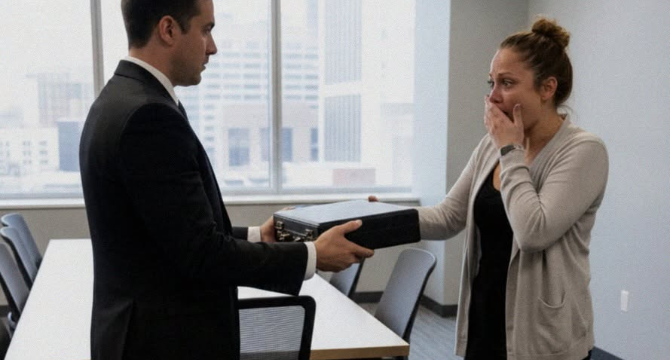
She spent years staying quiet while her boss mocked her accent and took credit for her work. Then, during the company’s biggest client meeting, one unexpected request changed everything and left the entire conference room speechless.
The Chicago office smelled the way it always did on Thursday mornings, like stale coffee left too long in the pot and the faint plastic warmth of fluorescent lights that never quite turned off.
I hung my coat on the hook by my desk and glanced through the glass wall toward the corner office where Mark was already gesturing at someone on speakerphone.
A small, familiar dread settled in my chest, the kind I had learned to breathe through.
I had moved from Bogotá six years earlier, and by now I could draft a technical report faster than most people in the building.
My accent, though, had stayed.
I had made peace with it, mostly.
Priya slid into the chair beside mine, dropping a granola bar on my keyboard.
“Team huddle in five,” she said. “Try to look thrilled.”
“I am thrilled,” I answered. “Look at my face. This is thrilled.”
She laughed under her breath. “Terrifying.”
In the huddle, Mark stood at the whiteboard, capping and uncapping a marker like a drummer warming up. He walked us through Friday’s client notes, then turned to me.
“Elena, the infrastructure section, that’s yours, right?”
“Yes,” I said. “The infra.”
He tilted his head, grinning. “Infra. Infrastructure. Did anybody catch what she just said? In-fra-struc-ture.” He drew the syllables out like a language tape.
A few people chuckled, the tight, uncomfortable kind of laugh you give when you don’t know what else to do.
I felt my cheeks warm.
I smiled the way I always smiled, small and closed, and looked down at my notebook.
Priya rolled her eyes so slightly that only I saw it.
“Anyway,” Mark went on, “solid numbers. We’ll polish the deck this week.”
Back at my desk, I opened the proposal document. The cover page listed Mark as Project Lead. My name sat further down, under Analysis, in a smaller font.
I stared at it longer than I meant to.
“You okay?” Priya asked, leaning across the divider.
“I’m okay.”
“You sure? Because that was gross, even for him.”
“It’s fine.”
“Elena, you literally spoke at the regional modeling conference in April. He couldn’t spell half of what you presented.”
“Priya… it’s fine.”
“I’m just saying.” She lowered her voice. “You’re the smartest person in this room, and he treats you like the intern who brings the donuts.”
“I like donuts,” I said.
She snorted. “Deflection. Noted.”
I turned back to my screen.
She wasn’t wrong, and that was the part that stung.
Months earlier, after the conference, she had leaned over this same divider and said, “That paper is going to open doors for you.”
Mark had overheard and said something like, “Let’s not get ahead of ourselves,” and walked off with his coffee.
I had let it go.
I let a lot of things go.
Every time, I convinced myself the next project would be different. The next meeting would be better.
My calendar chimed. A new invite appeared, bold black letters across next week.
Monday, 9:00 a.m. Client Pitch. Boardroom A.
The biggest account the firm had ever chased. I read the attendee list twice. My name was on it, near the bottom.
A shadow fell across my desk.
Mark stood there with his hands in his pockets, rocking slightly on his heels the way he did when he thought he was being casual.
“Big one on Monday,” he said.
“I know.”
“You’ll be in the room.”
“I saw the invite.”
He nodded, then tapped the edge of my monitor twice with one knuckle.
“Just take notes, okay?”
He walked off before I could answer.
I sat there with my hand still on the mouse, the invite glowing on the screen, and felt something old and tired quietly begin to sharpen.
I arrived at the office 40 minutes earlier than usual that Monday, my heels echoing in the empty hallway as I ran the projections through my head one more time.
The numbers were solid. My hands were not.
Priya was already at her desk, sliding a coffee toward me before I even sat down.
“You’ve got this,” she said quietly. “You wrote the thing.”
“I know.”
“Then why do you look like you’re about to be sentenced?”
I gave her a small smile and opened my laptop. “Because Mark is Mark.”
He appeared in the hallway ten minutes later, coffee in hand, tie already loosened as if he had been at war.
He waved me over before I could pretend not to see him.
“Elena. A word.”
I stood, notebook against my chest, and followed him toward the conference room.
“Try not to do too much talking today,” he said, keeping his voice low but not low enough. “We don’t want to confuse our guests.”
I kept my face still. “I’ll speak if someone asks me something.”
He leaned back against the wall and smirked. “Let’s hope they don’t.”
A couple of junior analysts nearby laughed the way people laugh when they are not sure if it is safe not to.
I felt the old, familiar heat crawl up my neck.
I did not answer him. I walked into the conference room, chose a seat near the end of the table, and opened my notebook to a fresh page.
The client team arrived at 9 a.m. sharp.
There were four of them, led by an older man with silver hair and a calm, unreadable face. He introduced himself as David and shook every hand in the room, including mine.
“Elena,” he said, glancing at the proposal cover as he took his seat. “It’s a pleasure to meet you.”
“Likewise, Mr. Chen.”
His eyes lingered on me for a second longer than they had on anyone else. Then he sat down.
Mark launched into the presentation with the confidence of a man who had rehearsed in the mirror. He clicked through the first slides briskly, gesturing at charts as if he had built them himself.
“Our team ran the initial modeling,” he said, “and we identified three primary risk vectors. Our analysts spent significant hours refining the assumptions.”
Our analysts. Our team. Not one name.
I watched David’s pen tap slowly against his notepad.
“The methodology we developed,” Mark continued, “is really the strength of this proposal.”
I felt my jaw tighten. The methodology he was describing was mine.
I had written it on my kitchen table over three weekends while my mother video-called me from Medellín, worried I was working too hard.
I remembered, suddenly and unwelcomely, the first job interview I ever had in this country.
The hiring manager had asked me to repeat my last answer twice, then turned to his colleague and said, “Cute accent.”
They had both laughed.
I had smiled and thanked them for their time and cried in my car for an hour.
That afternoon, I had promised myself that I would learn to make myself smaller, quieter, and easier to swallow.
Six years later, I was still keeping that promise in this conference room.
David glanced at the proposal cover in front of him, then at me, then at the cover again.
He did it three times in ten minutes.
Mark did not notice.
He was mid-sentence about implementation timelines, gesturing broadly.
“So if we align on scope by the end of Q2, we can have our team,” he paused for effect, “meaning myself and a small support group, ready to.”
David raised a single hand.
“Excuse me.”
Mark stopped, mouth still half-open. “Yes?”
“I noticed something on your proposal,” David said, and his voice was gentle. “That I’d like to discuss with her.”
He turned his head, unhurried, and looked directly at me.
Everyone went quiet.
I did not move.
Priya, seated two chairs down, went perfectly still.
Mark’s smile flickered, then held, and finally thinned.
“Of course,” he said carefully. “But I can walk you through anything Elena worked on. I’ve been across every detail.”
David did not look at him.
He was still looking at me, patient and certain, the way a person looks when they already know the answer to the question they are about to ask.
He set his pen down softly on the table.
“I’d rather hear it from her.”
Mark’s smile flickered at the edges. He recovered quickly, sliding into the smooth voice he used when he wanted to sound in charge.
“I can answer anything she worked on,” he said. “Elena’s role was more supportive. I led the analysis.”
David tilted his head slightly, as if he had misheard something he already knew was wrong. He shook his head.
“No. I’d much rather speak with her.”
The room went so still I could hear the ventilation hum above us.
Every face turned toward me, and for one long second I forgot how to breathe through my own body.
Then, I stood up.
Before I could say a word, David reached into his leather briefcase and pulled out a stapled report.
He slid it across the polished table toward me.
The cover page was familiar. My name sat in the top corner.
“Is this yours?” he asked.
I nodded.
“I thought so,” David said.
He looked around the room, unhurried, as though he was in no rush to spare Mark the silence.
“A few months ago,” he said, “I read this paper on multi-variable load forecasting for distributed systems. It solved a problem my firm has been chewing on for two years. When your proposal came across my desk, and I saw the same name in the analysis section, I told my team we had to meet the person who wrote it.”
He turned back to me.
“Your analysis is the reason we’re considering this company.”
I felt heat rise into my face, but it was not shame this time. It was something older and quieter, finally allowed to breathe.
Mark cleared his throat.
“Well, of course, Elena’s contribution was significant, and as her manager I’ve been—”
David lifted one hand, gentle but final. Mark stopped mid-sentence.
“May I ask her directly?” David said to me. “I have some technical questions.”
“Please,” I answered.
For the next 40 minutes, the meeting reshaped itself around my chair.
David walked me through three scenarios, each one more specific than the last. I answered without rushing.
I heard my own accent the way I always heard it, and this time I did not try to sand it down.
“Your model assumes non-linear demand spikes,” he said. “How does it hold up under regulatory constraints in the Southeast market?”
“It adjusts through the secondary variable set on page 11,” I said. “I built in a compliance floor because the pilot data from Georgia flagged three edge cases. If you turn to the appendix, you’ll see the sensitivity range.”
He turned to the appendix.
He smiled.
Across the table, Priya was studying her notebook with a very careful expression, the corner of her mouth twitching upward. I loved her for that small, contained smile.
Mark tried again.
“If I could add some context on our team’s methodology”
“Later, perhaps,” David said, still looking at me. “Elena, walk me through the assumption on slide 14.”
I did.
He nodded, made a note, and asked another question. Then another.
Mark leaned back in his chair, and I saw the exact moment his face tightened, the small muscle at his jaw pulling in and staying there.
Near the end of the hour, David closed his folder and looked at me thoughtfully.
“I have to say, I’m glad we finally connected in person. When I reached out through LinkedIn a few weeks back to request you be included in this meeting, I was told you were unavailable. I assumed travel, or a competing project.”
My stomach dropped.
“I never received any message,” I said, before I could stop the words.
David’s eyes sharpened, just for an instant, and moved to Mark. He held that look for a long, deliberate beat.
Then he turned back to me, his voice level.
“Then I think the discussion after lunch needs to include your CEO. This isn’t a small thing.”
Mark laughed too quickly.
“There must have been some kind of inbox issue. Our system flags outside messages sometimes. I’ll have IT look into it.”
Nobody responded to him.
David gathered his papers with unhurried hands.
“Elena, I’d like to continue this conversation after lunch. Would your CEO be available to join us? I think there’s a larger discussion to have about how this account should be structured.”
“I’ll make sure she is,” I said.
He nodded, satisfied, and stood.
As the client team filed out, I stayed at the table, the stapled report still in front of me.
Weeks. He had reached out weeks ago.
Mark had known my name mattered before I had.
He had known, and he had buried it.
Priya passed behind my chair on her way out and let her hand rest briefly on my shoulder.
“Susan’s going to want to see you upstairs,” she whispered.
I picked up the report and walked toward the elevator.
Susan’s assistant waved me toward the office before I could even set down my notebook.
My hands were still cold from the conference room.
David was already inside, seated across from the CEO.
“Sit down, Elena,” Susan said.
David didn’t wait. He looked at Susan and spoke plainly.
“If she isn’t leading this account, we’ll reconsider.”
Susan turned to me. “Elena. Tell me what’s been happening.”
I kept my voice steady. “Mark mimics the way I pronounce words in meetings. This morning he told me not to speak. And a message David sent weeks ago, asking for me, never reached my inbox.”
At that point, Priya was called in.
She confirmed everything without flinching.
Susan picked up her phone and asked her assistant to bring Mark to her office. A few minutes passed in silence.
Then he walked in stiffly, his tie already straightened, and his smile too tight to convince anyone.
“Susan, this is a misunderstanding. Office humor. That LinkedIn thing must have slipped through.”
Susan didn’t smile back. “Please wait in HR, Mark.”
His face changed.
He looked at me once, then walked out.
Susan folded her hands. “Elena, I’d like to offer you the account lead role. Principal Analyst. Effective today.”
I took a breath. “I’ll accept. But I want a written policy. No mocking accents. No mocking backgrounds. In the handbook.”
“Done,” Susan said.
A week later, I walked into the same conference room with its familiar fluorescent hum and the smell of stale coffee drifting in from the hallway, but this time I took a different chair.
Priya slid a paper cup across the table.
“Ready?” she asked.
“Ready,” I said.
I opened the meeting with my name. My numbers. My accent, exactly as it had always sounded.
Across the table, David gave a small nod.
The seat Mark used to occupy stayed empty, and no one mentioned it.
I heard myself laugh once, mid-sentence, at my own small joke about margin variance. No one else was laughing at me. They were listening.
And for the first time in six years, I let them.

 admin
admin