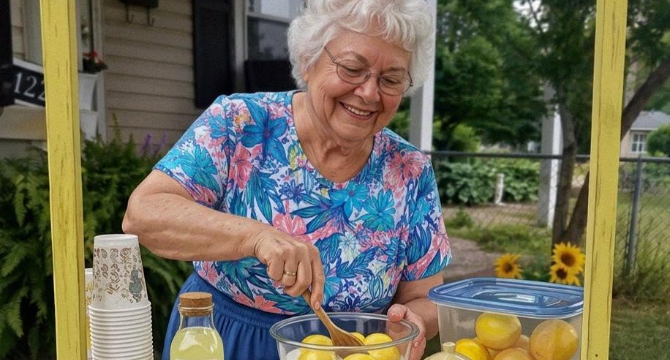
I thought the hardest part of that summer would be keeping my lemonade stand open long enough to cover my granddaughter’s medical bills. Then a stranger pulled up to the curb, looked at me like he knew me, and changed everything I thought I understood about what my husband had left behind.
I’m seventy-one, and the lemonade stand still leans left because Frank built it in 1994 with cheap lumber and more faith than measuring skill. He said a crooked roof would make people remember it. He was right.
People remembered the stand. When our daughter was small, he built the stand for her. Back then, lemonade was only lemonade. Fifty cents. Sticky quarters. Nothing depended on it.
After that, the stand stopped being a family joke and became the only business I could run on my own.
Then Frank died.
Then, years later, my daughter died too.
After that, the stand stopped being a family joke and became the only business I could run on my own. My granddaughter Ellie needed dialysis, medicine, and regular trips to specialists in the city. Every month there was another bill. Every month there was another gap between what was needed and what we had. I could not fix her kidneys, but I could still do something.
So I kept selling lemonade.
This July, the city taped a yellow notice to my front door.
Even when my hands started shaking.
Even when my knees argued with the porch steps.
This July, the city taped a yellow notice to my front door.
SHUT DOWN IN 30 DAYS OR PAY THE FINE.
I read it three times before I brought it inside. The stand had sat in the same patch of shade for thirty years, but now apparently it was an emergency.
He wore shiny shoes and a smile too polished to trust.
Two days later, the developer came by.
He wore shiny shoes and a smile too polished to trust.
“You’re sitting on valuable land, Mrs. Carter,” he said. “You’d be better off leaving sooner rather than later.”
“I’m not leaving,” I said.
His smile stayed where it was.
“These things have a way of changing on their own.”
After he left, I sat at the kitchen table with the yellow notice under the fruit bowl and did the numbers again.
The morning the black SUV rolled to the curb, I was behind the counter stirring sugar into a cloudy pitcher.
There was no version that worked. No one wanted to hire me anymore. The stand was the only thing left that answered to me.
So I kept it open.
The morning the black SUV rolled to the curb, I was behind the counter stirring sugar into a cloudy pitcher and trying not to think about deadlines. I expected another inspector. Or the developer.
Instead, a tall man in a dark suit stepped out. His hair was silver at the temples.
Then he looked at me.
“Is it really you?”
Whatever expression he had arrived with vanished.
“Oh my God,” he said. “Is it really you?”
I stared at him and saw nothing familiar.
“Would you like a glass of lemonade, sir?” I asked.
When he reached me, he said my name.
“Margaret?”
“Yes.”
The paper cup slipped from my hand and hit the grass.
His mouth moved before the words came.
Then he leaned in and whispered, “Frank made me promise to bring you something. I spent years trying to find you.”
My chest clenched so hard I forgot how to breathe.
The paper cup slipped from my hand and hit the grass.
He turned, walked back to the SUV, opened the rear door, and lifted out a small wooden box with both hands.
I knew it before he reached the stand.
He used to keep sketches inside that box.
Frank’s initials carved into the wood by hand.
He used to keep sketches inside that box. Receipts. Hardware. Drawings. All the things he swore would matter one day.
My legs went weak.
I caught the stand’s corner.
“I promised him,” the man said, “that I wouldn’t give this to anyone but you.”
I stared at the initials.
“I was a young engineer at the plant. Frank let me help on one of his side projects.”
F.C.
For one second I was back in the garage, hearing Frank ask for a flashlight while our daughter rode her bike in circles through the driveway.
“Who are you?” I asked.
“Walter,” he said. “I was a young engineer at the plant. Frank let me help on one of his side projects.”
Walter set the box on the stand as carefully as if it were glass.
Inside were snippets from Frank’s old life.
“In 1999,” he said, “Frank was building a low-cost valve that could reduce water waste in industrial cooling systems. He was doing most of the design at home, on his own time. He showed me the prototype because he wanted another set of hands on the first working model.”
“He meant to patent it,” Walter said.
I lifted the lid.
Inside were snippets from Frank’s old life. Drawings. A notebook. A wrapped metal model. Letters. His handwriting across the top page, blocky and impatient and familiar enough to hurt.
Walter saw me looking at it and pulled a photocopied product summary from his folder.
Beneath the notebook was a photograph of Frank holding the prototype in the garage. On the back he had written a project number in blue marker. Walter saw me looking at it and pulled a photocopied product summary from his folder. The same number appeared in the corner.
“The company still sells an updated version,” he said. “I can’t prove everything from this alone. But it’s a start.”
I looked up.
“Why come at all?”
He hesitated, which made me trust him more than certainty would have.
Then his wife got sick.
“Because I nearly didn’t,” he said. “And because that started bothering me.”
He now consulted for the equipment company that had inherited part of the old plant’s files through mergers and buyouts. While reviewing archived technical records, he found references tying a current product line to Frank’s project number. The company lawyers told him not to stir it up.
Then his wife got sick.
He didn’t use that like a speech. He said it plainly.
We spent the next hour going through papers while neighborhood children bought lemonade.
“She needed long-term care before she died,” he said. “I learned how fast a family can lose its footing when illness doesn’t leave. I kept thinking about what Frank said this might do for yours.”
He held out an envelope.
“It’s not money. Copies. Meeting notes. Product histories. Enough to tell a lawyer where to start.”
“Good,” I said. “Because if it had been hush money, I’d have sent you back with it.”
For the next several evenings, we sorted everything.
There was only one lawn chair beside the stand, so he took that and I sat on my stool. We spent the next hour going through papers while neighborhood children bought lemonade.
That evening Walter carried the box into my kitchen. Frank’s papers spread across the table.
For the next several evenings, we sorted everything.
The first retired worker Walter tracked down remembered Frank showing off the prototype and joking that it would either make him a little money or get him laughed out of the building.
Then Walter found an internal project index from years later.
The second remembered Frank refusing to let management list it as plant property before any agreement was signed.
Then Walter found an internal project index from years later. Frank’s project number was still there. His name was not.
Ellie sat with us one night after dialysis, pale and tired but too curious to stay away. She picked up one of Frank’s sketches and studied it.
“He drew so often he constantly had his nose in a notebook,” she said.
“That’s because he thought every idea was urgent,” I told her.
She ran one finger carefully along the paper.
I took the yellow notice to the municipal office and learned what the developer had left out.
“Maybe this one was.”
Meanwhile, the city deadline kept moving.
I took the yellow notice to the municipal office and learned what the developer had left out. The complaints about my stand were tied to a rezoning application covering several nearby parcels.
My lot was the last one blocking vehicle access to the planned commercial entrance. The violations were real enough, but the enforcement had been pushed forward by complaints from a neighborhood business group the developer controlled without disclosing that connection.
The shutdown notice still stood unless I fixed the stand.
He did not want my lemonade stand gone because of lemonade.
He wanted my land.
Walter drove me to a local legal clinic. The attorney they assigned me was young, tired, and exactly the kind of serious I wanted.
The shutdown notice still stood unless I fixed the stand, but now there was a chance to expose why the city had suddenly decided my little business was a public menace.
The company matter took longer.
They questioned whether Frank owned the design.
Long enough for me to nearly give up twice.
They questioned whether Frank owned the design.
They questioned whether the current valve was materially the same.
They questioned whether any claim survived after so many years.
Then Walter told me what he had not told me before.
Their attorney called Frank’s notebook informal personal material.
His consulting work had touched the same product line. He had not stolen from us. He had not written the company’s history. But he had benefited professionally while looking away longer than he should have.
I was angry when he admitted that.
At least now he was something more tangible that I could understand.
Their attorney called Frank’s notebook informal personal material. My lawyer set the company’s own project index beside it. The handwritten number in Frank’s photo matched the number in their files exactly.
My lawyer slid a stack of records forward.
After that, the room became much quieter.
The zoning hearing came first. The developer stood there in a neat suit and talked about traffic, pedestrian safety, and neighborhood concerns.
“This has never been about one woman,” he told the board. “It’s about responsible use.”
My lawyer slid a stack of records forward.
The board denied the rezoning application outright.
“Then perhaps Mr. Dale can explain why the business group filing most of the complaints is registered to his office manager, uses his conference room as its mailing address, and includes three parcels he already controls.”
The room changed after that.
The board denied the rezoning application outright and criticized the selective enforcement trail that followed it.
That saved the property.
It did not save Ellie’s treatments.
Ellie asked once whether I was going to lose the stand.
The company fight dragged another seven weeks.
Ellie asked once whether I was going to lose the stand.
“No,” I told her.
I didn’t know if that was true when I said it.
They stalled. They asked for more time. They suggested Frank’s notes proved interest, not ownership. They suggested the present design had evolved beyond anything he built. Walter kept pressing. The lawyer pressed harder. The worker statements held. The attorney letter held. Frank’s notes held. The internal numbering held.
I used the first part to fund a protected care account for Ellie.
In the end, the company settled.
Not with a confession. Companies dislike plain language almost as much as schools do. But they agreed in writing to acknowledge Frank as the original designer of the first valve prototype, to compensate his estate through a negotiated settlement, and to correct their internal historical records.
It was substantial, though not the kind of money people in movies get when life wants to flatter them.
I used the first part to fund a protected care account for Ellie.
Only after that did I touch the house.
I still could not fix her kidneys. But for the first time, I could stop wondering whether the next treatment would cost us the house.
When I told Ellie the treatments were covered, she looked at me for a long second and said, “Does that mean you can stop counting quarters?”
“Not entirely,” I said. “I like knowing where they are.”
Only after that did I touch the house.
He had kept Frank’s promise late.
I fixed the porch, patched the roof, and brought the stand fully into compliance without replacing it. Walter helped me reinforce the frame, widen the clearance, and rebuild the shelf. He offered once to straighten the roof.
“Absolutely not,” I said.
“Thought I’d ask.”
“Frank built it crooked,” I said. “Crooked stays.”
Walter laughed, then looked at the stand with new understanding, and maybe even a hint of respect mixed in.
Ellie helped me polish the counter. Walter screwed in a small brass plate while I held it steady.
He had kept my husband’s promise late. Late was not the same as on time. But it was not the same as never.
At the end of the summer, I reopened.
Ellie helped me polish the counter. Walter screwed in a small brass plate while I held it steady.
Built, 1994. Preserved and restored, 2025.
By noon the neighborhood had already done the advertising for me. People came for lemonade, curiosity, gossip, and the satisfaction of seeing a developer lose to a woman he had misjudged.
He tried to pay with a bill so large I couldn’t accept it with a straight face.
Walter stood in line like everyone else.
When he reached the front, he smiled and said, “One glass, please.”
I poured it cold and handed it over.
He tried to pay with a bill so large I couldn’t accept it with a straight face.
I took what Frank would have approved, pushed the rest back into Walter’s hand, and closed his fingers around it.
