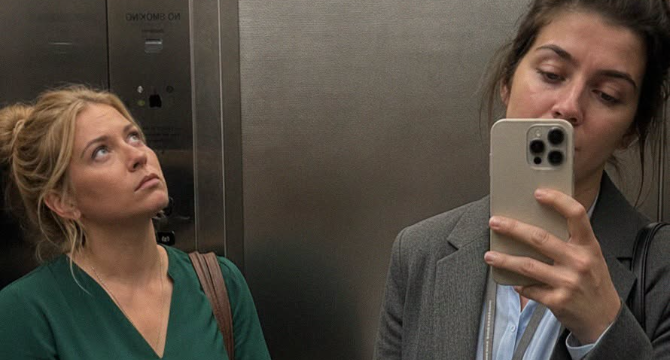
Maya thought she was doing something small and sweet for her husband: bringing him the lunch he had left behind. But one broken elevator, one polished stranger, and one familiar name turn an ordinary afternoon into the beginning of the end.
I used to think there were two kinds of wives in the world.
There were the ones who woke up early, made coffee before the sun came up, packed neat little lunches in matching containers, and kissed their husbands goodbye like they were sending them off to war.
Then there were wives like me.
I loved my husband. I loved Jeremy with the kind of calm, steady love that folded into the background of daily life.
I washed our sheets, remembered when we were almost out of detergent, knew how he liked his eggs, and could tell from his footsteps whether he had a good day or a bad one.
But I had never been the kind of wife who packed lunches every morning.
Not because I did not care. That was important. I cared more than I knew how to say sometimes. I was a stay-at-home mom, and most of my days were built around keeping our house from falling into chaos.
Toys under the couch. Crumbs on the counter. Tiny socks disappearing like they had been swallowed by the washing machine.
Jeremy had a big corporate job in one of those tall glass office buildings downtown, the kind where people spoke quickly into phones and looked important even when they were just buying coffee.
He always told me he had a cafeteria at work.
“The food is fine,” he said the first time I asked if he wanted me to pack something.
“Fine” was one of Jeremy’s favorite words. It meant everything and nothing.
“Are you tired?”
“I’m fine.”
“Was your meeting bad?”
“It was fine.”
“Do you want me to make you lunch?”
“The cafeteria is fine, Maya.”
So I stopped asking.
For three years of marriage, that was how it worked. He went downtown in pressed shirts and polished shoes. I stayed home, managed the house, and tried not to feel like my life had become a loop of dishes, laundry, and grocery lists.
I did not hate it.
Some days, I even loved the quiet rhythm of it. But other days, when Jeremy came home smelling like aftershave and city air, carrying stories about people and projects and deadlines, I felt like I was peeking at a life that had kept moving without me.
Then, a few months ago, “fine” changed.
He came home one evening, dropped his briefcase by the entryway, and stood in the kitchen with a face so grim I thought something terrible had happened.
“What?” I asked, drying my hands on a towel. “Did your boss say something?”
“No,” Jeremy muttered.
“Did the client meeting go badly?”
“No.”
“Then why do you look like someone stole your car?”
He opened the fridge and stared into it like the answer to his misery was sitting behind the milk.
“The cafeteria served something today that I think was supposed to be chicken,” he said. “But I cannot prove it.”
I laughed before I could stop myself.
He looked over his shoulder. “I am serious. It was barely edible.”
“Yesterday, it was fine.”
“Yesterday, fine was still possible,” he said. “Today, fine died.”
That was how it started.
At first, it was casual. A container of pasta because I had made too much the night before. A sandwich wrapped in foil. Leftover chicken with rice and vegetables. Nothing fancy.
Nothing like the glossy meal-prep videos that made ordinary people feel like failures. Just actual food he could eat without looking depressed when he came home.
And honestly, I liked doing it.
It felt sweet in a small married-life kind of way. The kind of tenderness nobody posted about because it was not dramatic enough.
I liked cutting fruit into a little container. I liked writing his name on the lid in black marker so he would not lose it in the office fridge. I liked imagining him opening it at noon and thinking of me.
One morning, I made chicken with roasted potatoes and green beans. I had stayed up a little later the night before seasoning the chicken because Jeremy had mentioned, almost shyly, that he missed the way his mother used to make it.
So I called his mom, asked for her recipe, and stood in our kitchen taking notes while she explained that the secret was paprika and patience.
By the next morning, the house smelled warm and savory. Jeremy came downstairs in a pale blue dress shirt, already glancing at his phone.
“Big day?” I asked.
“Always,” he said, leaning down to kiss my cheek without looking up.
The kiss landed near my ear.
I told myself not to be sensitive.
He was busy. He was always busy.
“Your lunch is on the counter.”
“Thanks, babe.”
He grabbed his keys, his phone, and his laptop bag. Then he was gone.
The door clicked shut behind him.
I rinsed my coffee mug, wiped a smear of jam off the counter, and turned to start the dishwasher. That was when I saw it.
The lunchbox.
It sat there by the toaster, blue lid snapped tight, full of chicken I had actually put effort into. For a second, I stared at it and thought, “Okay, that is on him.”
He was a grown man. He forgot it. He could suffer through mystery cafeteria chicken.
But then I pictured the food sitting there all day. I pictured my work turning cold and wasted. I pictured Jeremy coming home with that tired, hollow look he had worn too often lately.
So I picked up my phone and texted him.
“You forgot your lunch. I can bring it by.”
He did not answer right away.
I waited a few minutes, watching the little screen like it owed me something.
Nothing. No typing bubble. No quick thanks. No, “do not worry about it.”
I figured he was in a meeting.
That was always the safe explanation with Jeremy. Meeting. Call. Deadline. Client.
His job had a whole language built to explain why he was unavailable.
I looked down at myself.
I was wearing black leggings, an old gray sweater with one sleeve stretched out from years of tugging it over my hand, and sneakers that had seen better days.
My hair was pulled into a loose bun that was not cute enough to be intentional. It was the most “I was not planning to leave the house today” outfit possible.
But the chicken was still warm.
“Fine,” I said to the empty kitchen. “We are doing this.”
I grabbed the lunchbox, locked the door behind me, and drove downtown.
The closer I got to Jeremy’s office, the more out of place I felt.
The streets grew crowded and impatient.
Cars honked. People crossed in front of traffic like they had personal agreements with death. The buildings rose higher, all glass and sharp corners, reflecting the pale sky back at itself.
Jeremy’s office building looked exactly the way I had imagined it. Tall, polished, cold, and expensive. The lobby smelled like coffee, floor cleaner, and money.
People moved through it like they had been trained. Everyone was walking fast, wearing badges, carrying laptops, looking like they had somewhere important to be.
Meanwhile, I stood there with a lunch bag like somebody’s mom on a school trip.
I suddenly became aware of everything. The way my sneakers squeaked faintly on the marble floor. The way my sweater hung off one shoulder. The way the security guard glanced at me, not rudely, but long enough for me to feel like I needed to explain myself.
“I’m here for Jeremy,” I said, then realized that was not enough. “He works upstairs.”
The guard checked something on his screen, then handed me a visitor sticker.
“Elevators are to the left, ma’am.”
Ma’am.
That did not help.
I thanked him and walked over, clutching the lunchbox with both hands.
When the elevator doors opened, I stepped inside and pressed the button for Jeremy’s floor. Or at least, I tried to.
Right before the doors closed, another woman slipped in.
She was beautiful.
Not just pretty in the casual way people say when they’re being polite. She was really beautiful. The kind of woman who looked put together without even trying.
Nice blazer, perfect hair, expensive-looking bag, the whole thing. Her earrings were small gold hoops. Her nails were a soft nude color. Even her perfume smelled like she had chosen it from a place where one bottle cost more than my weekly grocery run.
We both reached for the same floor button at the same time.
Our fingers nearly touched.
We did that awkward little laugh people do when they do not know what else to do, and she said, “Sorry.”
I pulled my hand back. “No, you’re fine.”
She smiled, polite and quick, then pressed the button.
The doors closed.
For a few seconds, the elevator hummed upward in silence. I stared at the little numbers above the door. She looked at her phone. I tried not to compare my stretched sweater to her blazer.
Then the elevator made an awful grinding noise.
It jerked hard.
My stomach dropped as the whole box shuddered and stopped.
Then came the beeping.
Not a normal beep. Not the soft little alert sound of a machine doing its job. This was an angry, repeating, soul-destroying beep that filled the tiny space until it felt like it was inside my skull.
We both froze.
The woman pressed the open-door button.
Nothing happened.
I pressed the alarm button.
More beeping.
For a moment, neither of us spoke. We just stood there, staring at the closed doors like they might apologize and open if we looked desperate enough.
“Okay,” she said slowly. “That’s not ideal.”
“No,” I replied. “Not exactly.”
She hit the open-door button again, harder this time.
Still nothing.
I looked at the lunchbox in my hand and almost laughed. Of all the things to be trapped with, I had brought chicken.
Neither of us was exactly panicking, but being trapped in a metal box between floors with a stranger was not my idea of a peaceful afternoon. The air felt thinner almost immediately, even though I knew that was probably my brain being dramatic.
The woman pressed a button with a phone symbol, and after a burst of static, a man’s voice came through.
“Security. Is everyone all right?”
“We’re stuck in elevator three,” she said, sounding much calmer than I felt.
“Maintenance has been notified,” the voice replied. “Please remain calm. We are working on it.”
The speaker crackled, then went silent.
I shifted my weight from one foot to the other. The beeping continued. The lunchbox handle dug into my palm.
After a few minutes of standing there in silence, the awkwardness started to feel worse than the actual elevator problem.
“So,” I said, because apparently fear made me socially brave, “do you work here?”
She turned toward me. “Yeah. One of the upper floors.”
Her voice was smooth, but there was something tired around her eyes. Up close, she looked less like the effortless woman from a magazine and more like a real person who had been holding herself together all morning.
“Oh, that’s actually where my husband works,” I said with a small laugh. “I’m just bringing him his lunch because he forgot it at home.”
She glanced at the lunchbox in my hand.
Then she looked back at me.
Something changed in her face, but it passed so quickly I thought I imagined it.
“Oh really?” she asked. “Who’s your husband? Maybe I know him.”
There was no reason for my heart to tighten. It was a normal question. A friendly question. People who worked in the same building knew each other. People in offices chatted by coffee machines and sat through boring meetings together.
“Jeremy.”
The effect was instant.
The color left her face.
Not faded. Left.
Her lips parted, but no sound came out. She stared at me for a second like she was trying to decide whether to lie, cry, or run through the elevator wall.
The beeping kept going.
My fingers tightened around the lunchbox handle.
“What?” I asked, my voice suddenly smaller. “Do you know him?”
She swallowed.
Her eyes dropped to my wedding ring, then lifted slowly back to my face.
Then she whispered, “Oh, girl…”
For a moment, all I could hear was the beeping.
It bounced off the walls, sharp and endless, while the woman in front of me looked like she had accidentally stepped into the middle of her own nightmare.
My throat went dry. “What does that mean?”
She pressed her lips together and looked toward the elevator doors, as if rescue might arrive before she had to answer.
“Please,” I said, gripping the lunchbox harder. “Do you know my husband?”
She let out a shaky breath. “Yes.”
One word. That was all. But it landed in my chest like a stone.
“From work?” I asked.
Her eyes filled so quickly that I almost felt sorry for her before I remembered I was the one standing there with my husband’s lunch in my hand.
“Kind of,” she murmured.
“Kind of?” My voice cracked. “What does that even mean?”
She wiped under one eye with her thumb, careful not to smear her makeup. “My name is Brielle.”
I waited.
She looked at my wedding ring again. “I didn’t know about you at first.”
The elevator seemed to shrink around us.
“At first?” I repeated.
Brielle closed her eyes for a second. “Maya, right?”
Hearing my name from her mouth made my stomach twist. “How do you know my name?”
“He mentioned you,” she admitted. “Later. Not in the beginning.”
I stared at her, trying to arrange the words into something harmless.
Maybe Jeremy had talked about me to a coworker. Maybe this woman was just embarrassed because she had a crush on him. Maybe I was about to make a fool of myself.
But Brielle’s face already held too much grief for a harmless explanation.
“Say it,” I told her.
She flinched.
“Whatever this is, say it.”
Her voice came out soft. “Jeremy and I were involved.”
I did not move. I did not scream. I did not drop the lunchbox. I just stood there while my life split into before and after.
“Involved HOW?” I asked, though I knew.
Brielle’s eyes lowered. “We dated.”
“My husband dated you?”
She nodded, tears spilling now. “He told me he was separated. He said the marriage was over, but you were still living together because of money and your child.”
I felt cold all over.
“We don’t have a child,” I said.
Her head snapped up. “What?”
“We don’t have a child. I’m a stay-at-home mom because I was a nanny before we got married, and we agreed I would take time off while we tried to start a family. We haven’t been able to.”
Her face crumpled.
“Oh my God,” she whispered. “He told me you had a little boy.”
A laugh broke out of me, small and ugly. “Of course he did. Why stop at one lie?”
Brielle covered her mouth. “I’m so sorry.”
“How long?”
She hesitated.
“How long?” I demanded.
“Six months.”
The words nearly took my knees out from under me.
Six months of lunches. Six months of me asking if he was tired. Six months of him kissing near my ear while looking at his phone. Six months of me thinking our marriage was quiet because life got that way sometimes.
“Is it still happening?” I asked.
“No,” she said quickly. “I ended it two weeks ago.”
“Why?”
Her expression changed then. Shame moved through it, but so did anger. “Because I found out he was lying about something. Not you. Something at work. He promised me he was leaving the company and starting over with me. Then I saw him laughing with another woman at a client event as if nothing mattered.”
The beeping stopped suddenly, and the silence felt almost worse.
A voice crackled through the speaker. “Ladies, maintenance is working from the sixth floor. You may feel a slight movement soon.”
Neither of us answered.
Brielle leaned against the wall, looking drained. “I confronted him. He said I was being dramatic. He said I imagined things. Then today, I saw your name flash across his phone when he left it on his desk. The text said you were bringing his lunch.”
My message.
My stupid, caring little message.
“So you got in the elevator because of me?” I asked.
“I was leaving,” she replied. “I couldn’t sit upstairs and watch him act normal. I didn’t know you would be here.”
I looked down at the lunchbox. It suddenly felt ridiculous, almost cruel. I had carried love into this building in a plastic container.
“What did he tell you about me?”
Brielle’s shoulders sagged. “That you were cold. That you didn’t love him anymore. That you only cared about the house. And that he felt invisible.”
Those words hurt more than I expected because they sounded like things Jeremy had once said to me in smaller, softer ways. Not accusations, exactly. Hints. Sighs.
Little comments that made me try harder.
I thought of the chicken recipe. His mother’s paprika. My hands smelling like garlic at midnight.
“I made his lunch because I thought he needed kindness.”
Brielle looked at the container and started crying harder. “I thought I was giving him that too.”
That was the first moment I truly saw her.
She was not just the beautiful woman in the blazer. She was not a villain who had walked into my marriage laughing. She was a woman who had believed a man who knew exactly which wounds to press.
I slid down the elevator wall and sat on the floor. After a second, Brielle sat across from me.
“Did you love him?” I asked.
She nodded once, embarrassed by the truth. “I thought I did.”
The elevator lurched then, and we both grabbed the rails.
Somewhere above us, metal clanged. A few minutes later, the doors opened halfway to a hallway full of fluorescent light, two maintenance workers, and a security guard.
“Careful stepping out,” one of them warned.
Brielle got out first. Then she turned and offered me her hand.
I almost did not take it.
Then I did.
Her palm was cold, but her grip was steady.
We stepped into the hallway, and there was Jeremy.
He was standing near the security desk, tie loosened, phone in his hand. The moment he saw us together, his face changed. Not into fear at first. Into calculation.
“Maya,” he said, rushing forward. “Are you okay? I got your text late. I was in a meeting.”
I looked at Brielle.
She looked at me.
Then I held up the lunchbox.
“You forgot this,” I said.
Jeremy’s eyes flicked to Brielle. “What’s going on?”
Brielle’s mouth tightened. “Don’t.”
His jaw hardened. “This isn’t the place.”
“No,” I agreed quietly. “Our marriage wasn’t the place either, but you still brought someone else into it.”
His face went pale. “Maya, let me explain.”
I had imagined this moment would be louder. I thought betrayal would make me wild. But standing there, I felt something cleaner than rage.
I felt DONE.
“You told her we were separated,” I said. “You told her we had a child. You told her I was cold and that I didn’t love you. And you let me pack your lunches while you played wounded husband upstairs.”
People had begun to glance over. Jeremy noticed. Of course he noticed.
“Lower your voice,” he said.
That almost made me smile.
“For three years, I lowered my voice,” I replied. “I made excuses. I waited for you to come home. I BELIEVED you when you said everything was FINE.”
His eyes softened in that practiced way I knew too well. “Baby, please. We can talk at home.”
I shook my head. “No. You can talk to my lawyer.”
The words surprised even me, but once they were out, they felt right.
Jeremy stepped closer. “Maya.”
Brielle moved slightly, not in front of me, but beside me.
It was enough.
I set the lunchbox on the security desk.
“Enjoy your lunch,” I told him. “It’s the last thing I will ever make for you.”
Then I walked out of that glass building with my hands shaking and my heart breaking, but my back straight.
Outside, the city was loud and bright. I stood on the sidewalk and took my first full breath in what felt like months.
Brielle came out a minute later.
“I’m sorry,” she said again.
I believed her.
“So am I.”
We did not hug. We were not friends. Maybe we never would be. But we had both made it out of that elevator with the truth, and sometimes that is enough.
By the time I reached my car, my phone was already buzzing with Jeremy’s name.
I turned it off.
Then I drove home, not as the wife who packed his lunch, not as the woman who waited for him to choose her, but as Maya.
And for the first time in a long time, that felt like enough.

 admin
admin