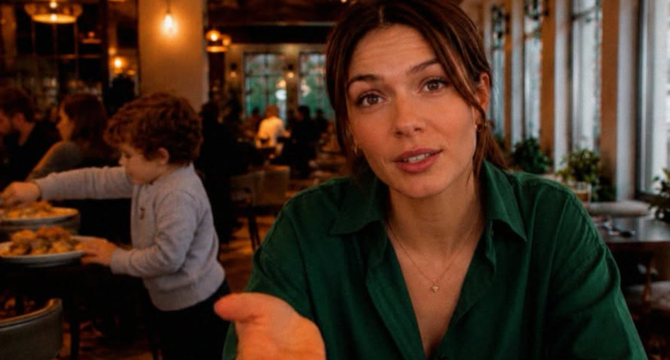
I’ve never wanted to yell at a stranger’s child as badly as I did that night.
At first, I honestly thought he was just spoiled.
The little boy couldn’t have been older than five. He had messy brown hair, a blue dinosaur sweatshirt, and sneakers that lit up every time he ran across the restaurant floor.
He also had no shame about taking food.
A french fry here.
A piece of bread there.
Half a chicken tender from someone’s plate before they even realized what had happened.
I was at dinner with my older sister, Lauren, and our mother, who had chosen the restaurant for her birthday because she liked the chicken parmesan and said the servers “didn’t make a fuss.”
The place was packed.
Families filled the booths, kids colored on paper menus, and servers moved between tables with trays balanced above their shoulders.
Then the boy appeared beside our table.
He didn’t say a word.
He reached over, grabbed a piece of garlic bread from our basket, and shoved it into his mouth.
Lauren gasped. “Excuse me?”
The boy looked at her, cheeks full, then ran away.
My mother blinked at the basket. “Well. That was unexpected.”
I turned in my seat and watched him dart toward a table near the window. He reached for a man’s fries.
“Hey!” the man snapped, pulling his plate back. “What are you doing?”
The boy flinched, but only for a second. Then he moved on.
A woman gasped when he grabbed a piece of pizza from her daughter’s plate.
“Mommy, he took my food!” the little girl cried.
The girl’s father stood halfway out of his seat. “Whose kid is this?”
Everyone looked around.
Then we saw her.
His mother sat in a corner booth near the back wall.
She looked tired, with dark hair pulled into a messy bun and both hands wrapped around a paper napkin.
In front of her sat a plate of pasta she had barely touched, a child’s cup, and a small backpack.
She wasn’t yelling.
She wasn’t chasing him.
She wasn’t even apologizing.
Every few minutes she’d quietly say, “Come back, sweetheart.”
But he never listened.
He’d pull away from her hand, run to another table, and grab another bite of food before anyone could stop him.
“Come back, Eli,” she said softly.
The boy looked at her, then snatched a roll from a basket a waitress was carrying past him.
The waitress jerked back. “Oh my goodness.”
The mother stood halfway, but then stopped.
That made me angrier than anything else.
“Is she serious?” Lauren whispered.
Mom frowned. “Maybe something is wrong.”
“Yes,” I muttered. “Her parenting.”
“Claire,” Mom warned.
“What? Look at this.”
The entire restaurant had turned to watch.
One customer asked to speak to the manager while another said they should both be asked to leave.
The boy ran past our table again, this time holding half a chicken tender like a prize.
I looked back at his mother.
She had one hand pressed against her mouth now. Her eyes were shiny, but she still wasn’t doing enough.
At least, that was what I thought then.
The manager appeared near the front, looking confused and overwhelmed. The father of the little girl pointed toward the boy. The man whose fries had been stolen pushed his plate away and said, “I’m not eating this now.”
I felt my irritation turn into something sharp.
I stood up.
“Claire, don’t,” Mom said quietly.
“I’m just going to say what everyone is thinking.”
Lauren grabbed my sleeve. “Let the manager handle it.”
“The manager is doing nothing.”
I walked across the restaurant before I could lose my nerve.
The boy’s mother looked up as I approached. Up close, she looked younger than I expected, maybe early 30s, but exhausted in a way that made her seem older.
The little boy stood three tables away, staring at another basket of fries.
I stopped in front of her booth.
“If you’re not going to control your son, someone else needs to.”
The restaurant went completely silent.
Every head turned toward us.
For a second, I felt powerful. Righteous, even.
Then his mother slowly looked up at me.
For a few seconds, she just stared at her little boy.
Then she quietly said, “I know what this looks like.”
Her voice cracked.
“I really am trying.”
I folded my arms, but my anger had already started to waver.
She closed her eyes for a moment.
Then whispered something I’ll never forget.
“But if I stop him now…”
She looked at her son again.
“…he’ll think it’s happening again.”
I stared at her, completely confused.
“What do you mean… happening again?”
She looked down at the table. Then she quietly told me why she’d never stopped him.
“His name is Eli,” she said. “And I’m not his mother. I’m his aunt.”
The little boy glanced at us, still holding the chicken tender.
“I got custody of him six months ago,” she continued. “Before that, he was living with my sister and her boyfriend.”
She swallowed hard.
“I didn’t know how bad it was. I knew my sister was struggling. I knew she made bad choices. But I didn’t know what they were doing to him.”
My mother had come up behind me by then. I felt her hand touch my elbow.
The aunt looked at the boy again.
“They used food as punishment.”
No one moved.
She twisted the napkin in her hands until it tore.
“If he cried, they told him he could eat when he stopped being annoying. If he wet the bed, they skipped breakfast. If he took food without permission, they locked him in a closet and made him listen while everyone else ate dinner.”
A woman near the drink station covered her mouth.
The father whose daughter had cried slowly sat down.
I felt all the heat drain from my face.
The aunt wiped her cheek quickly, as if she was embarrassed to cry.
“When child services brought him to me, he was five years old and 23 pounds. He hid crackers inside his pillowcase. He cried the first time I threw away expired milk because he thought throwing food away meant we were going to run out forever.”
The boy took a tiny step closer.
His eyes were fixed on her face.
She lowered her voice.
“We’re working with a therapist. At home, he has a snack drawer he can open anytime. He can touch the food. Count it. Move it around. It helps him understand it’s still there.”
She gave a broken little laugh.
“I know that probably sounds strange.”
“It doesn’t,” my mother said softly.
The aunt looked at her.
Mom’s eyes were wet. “It sounds like you’re trying to make him feel safe.”
The aunt nodded.
“I am. But restaurants are hard. There are plates everywhere. Smells everywhere. People eating. People laughing. He gets scared the food will disappear. His therapist told me not to grab him suddenly when he panics around food, unless he’s in danger. If I chase him or pull food out of his hands, he thinks he’s back there.”
Her voice dropped.
“He thinks he’s being punished again.”
I could barely breathe.
A minute earlier, I’d been convinced she was the worst mother in the restaurant.
By the time she finished, I was the one apologizing.
“I’m so sorry,” I whispered.
She shook her head. “No. I understand why you’re upset. He’s taking food from strangers. That’s not okay.”
“But I didn’t ask. I just judged you.”
“Most people do.”
There was no bitterness in her voice, and that somehow made it worse.
The boy edged closer to the table.
“Auntie?” he whispered.
She turned to him slowly, careful and calm.
“Hi, sweetheart.”
His lower lip trembled. “Am I bad?”
The question broke something in the room. His aunt’s face crumpled.
“No, baby. No,” she said while shaking her head. “You’re not bad.”
“I took food. Are they mad?”
She glanced around the restaurant, then back at him.
“They were confused.”
He looked at me.
I crouched down before I even realized I was moving.
“Hi, Eli,” I said softly. “My name is Claire. I was confused too. And I said something I shouldn’t have said.”
His small fingers tightened around the chicken tender.
“I took your bread.”
“You did.”
His eyes filled with tears.
“Do I go in the closet?”
Someone behind me let out a quiet sob.
His aunt stood, but stopped herself from rushing forward.
“No closets,” she said firmly. “Remember? We don’t do closets. We do safe hands.”
She held out both hands, palms up.
Eli stared at them.
Then, slowly, he walked to her and placed his hands in hers.
She knelt in front of him.
“Are you hungry right now?” she asked.
He shook his head.
“Are you scared the food will go away?”
He nodded.
“Okay. Look at our table.”
He turned.
“Do you see your plate?”
“Yes.”
“Do you see your fries?”
“Yes.”
“Do you see your cupcake?”
His chin wobbled. “Yes.”
“That food is yours. Nobody is taking it.”
“Even if I made mistakes?”
“Even then.”
That was when I noticed the cupcake.
It sat untouched beside a single candle still wrapped in plastic.
“Is it his birthday?” my mother asked.
The aunt nodded, tears running down her face.
“He turned six today.”
My stomach sank.
She looked around the restaurant as if she wanted the floor to open and swallow her.
“He saw this place on the way to therapy last month and asked if kids could eat here even if they messed up. I promised him we could come for his birthday. I thought if we came early, before the dinner rush, it would be okay. But my car wouldn’t start, and by the time we got here…”
She stopped.
My mother finished quietly, “You just wanted to give him a birthday dinner.”
The aunt nodded.
“I should have taken him home.”
“No,” Mom said. “You should have been helped sooner.”
The manager, a tall man with a name tag that read Paul, finally stepped forward. His voice was gentle.
“Ma’am?”
The aunt stiffened. “We’ll leave. I’m sorry. I can pay for anything he touched. I just need a minute to calm him down.”
Paul shook his head.
“You’re not leaving,” he said.
“What?” the aunt said, looking at him with wide eyes.
“We have a small party room in the back. It’s quiet. You and Eli can sit there if that helps.”
Her lips parted, but no words came.
“And his birthday dinner is on us,” Paul added.
A woman near the window raised her hand. “Put ours on there too.”
The man whose fries had been taken cleared his throat. “Same here.”
The father of the little girl stood and looked embarrassed.
“My daughter wants him to have her extra slice of pizza,” he said. “A fresh one. Not the one from her plate.”
A few people laughed softly through tears.
The aunt covered her mouth.
“I can’t accept all that.”
My mother stepped forward. “Maybe tonight you can let people be better than they were five minutes ago.”
For a moment, the aunt looked like she might cry too hard to stand.
Then she nodded.
“Okay.”
Paul led them toward the small party room in the back. Eli held his aunt’s hand, but kept looking over his shoulder at the tables.
When they passed ours, I picked up the bread basket.
“Eli?”
He stopped.
I held it out.
“This is yours if you want it.”
He looked at his aunt.
She nodded. “You can say thank you.”
He reached for one piece, then paused.
“The whole basket?”
“The whole basket,” I said.
His eyes widened.
“Thank you.”
“You’re welcome.”
When they disappeared into the party room, the restaurant stayed quiet for a long time.
No one knew how to return to their conversations.
Lauren sat across from me with her hands folded around her glass.
“I was so sure,” she said.
“Me too.”
Mom looked at both of us. “That’s the danger, isn’t it? We see one piece of someone else’s life and think we’ve seen the whole thing.”
I looked toward the party room door.
“I was horrible.”
“You were wrong,” Mom said. “That doesn’t have to be the same as horrible.”
“It felt the same.”
“Then do something with it.”
I did not know what that meant yet.
After dinner, I found Eli’s aunt near the register. Paul was refusing her card while she tried to insist on paying.
“Please,” she said. “At least let me pay for what he touched.”
Paul smiled kindly. “You can leave a tip for the servers. That’s all I’m accepting.”
She gave a weak laugh. “You’re stubborn.”
“Professionally.”
Eli stood beside her, holding a small cardboard box.
He saw me and stepped behind his aunt’s leg.
“It’s okay,” she told him.
I stopped a few feet away.
“I don’t want to bother you,” I said. “I just wanted to apologize properly.”
She looked exhausted, but less alone.
“You already did.”
“Not enough.”
Her expression softened.
“My name is Mara,” she said.
“Claire.”
“I know.”
That made me smile sadly. “Not my finest introduction.”
Then, I looked at Eli.
“Happy birthday, Eli!”
He peeked out from behind her.
“Thank you.”
“Did you get your cupcake?”
He nodded seriously. “Two.”
“That’s a very good birthday.”
He thought about it. “Auntie says six is big.”
“It is.”
Mara brushed a hand over his hair.
“We should go.”
I reached into my purse and felt a small toy car I had forgotten was there. My nephew had left it with me the week before.
“Would he be allowed to have this?” I asked Mara.
She studied me for a second, then nodded.
I held it out to Eli.
“It’s not food,” I said. “But it has wheels.”
He took it carefully.
“Does it go fast?”
“Very fast. But only if you make the noises yourself.”
He considered that. “I can do noises.”
“I believe you.”
Mara’s eyes filled again.
“Thank you,” she whispered.
I watched them leave the restaurant, Mara carrying the food box and Eli holding the toy car in one hand and her fingers in the other.
Outside, under the parking lot light, he stopped and looked up at her.
I could not hear what he said.
But I saw Mara bend down.
I saw her cup his face with both hands.
And I saw him lean into her like a child slowly learning that not every hand reaches out to hurt.
For days afterward, I could not stop thinking about them.
I thought about Eli every time I opened my refrigerator. I thought about him when I threw away leftovers. I thought about the way he had asked if he was going in the closet.
Three nights later, I called the restaurant.
Paul answered.
“This is Claire,” I said. “I was there Saturday night. Eli’s birthday.”
His voice softened. “I remember.”
“I know you probably can’t give me Mara’s information.”
“I can’t.”
“I figured. But if she ever comes back, could you tell her something for me?”
“Sure.”
“Tell her I meant what I said. And if she ever wants to bring Eli on a quiet afternoon, lunch is on me.”
Paul paused.
“Actually,” he said, “she’s here now.”
My heart jumped. “She is?”
“She’s picking up a job application.”
A moment later, Mara came on the phone.
“Hello?”
“Hi, Mara. It’s Claire. From the restaurant.”
There was a pause.
“Oh. Hi.”
“I hope this isn’t strange.”
“A little,” she admitted.
“Fair.”
That made her laugh softly.
“I just wanted to say again that I’m sorry. And I heard you’re applying there.”
“Paul said they need someone for weekday prep,” she said. “Early hours. Eli’s school has a morning program. I thought maybe it could work.”
“That’s great.”
“I haven’t had steady work in a while. Therapy, court, appointments. It gets complicated.”
“I can imagine.”
She was quiet for a second.
Then she said gently, “No, you probably can’t.”
She was right.
“No,” I said. “I probably can’t.”
I looked down at the family law papers spread across my own kitchen table.
I worked as a paralegal, mostly helping attorneys with custody cases. Suddenly, that felt less like a job and more like a door.
“Mara, I can’t give legal advice, but I know paperwork. If you ever need help reading forms or organizing records, I can help with that.”
The silence on the line stretched.
“Why would you do that?” she asked.
“Because I was unkind when you needed kindness.”
When she spoke again, her voice was thick.
“Maybe we can start with coffee.”
We did.
Not right away. Mara was careful, and I respected that.
Two weeks later, we met at the same restaurant. Eli came too. He sat beside her with a small lunch bag packed with snacks from home, just in case.
Paul gave them the same corner booth, only this time no one stared.
The meal was not perfect.
Eli asked Mara three times if his grilled cheese would still be there if he went to the bathroom. He put two fries in his pocket and cried when she gently reminded him that pocket fries got fuzzy.
But he stayed at the table.
When he wanted something from my plate, Mara touched his hand.
“What do we ask?”
Eli looked at me.
“Can I have one pickle?”
“Yes,” I said. “Thank you for asking.”
He took one pickle and whispered, “I asked.”
Mara smiled. “You did. Good boy.”
That was how healing seemed to happen for Eli.
Over the next few months, I helped Mara organize forms for custody hearings. She never asked for money. She never asked for more than I offered.
Mostly, she asked questions in a voice that always sounded prepared for bad news.
“Will they send him back?”
“What if my sister says she’s changed?”
“What if I make a mistake?”
I never lied to her.
“I don’t know what the judge will do,” I told her once. “But I know Eli is safer with you than he was before.”
She looked toward the living room, where Eli was lining up toy cars along my coffee table.
“I just want him to believe he gets to stay somewhere.”
Months later, Mara called me crying.
For one terrible second, I thought something had gone wrong.
Then she said, “They granted permanent custody.”
I sat down at my kitchen table.
“He’s staying?” I asked.
“He’s staying.”
In the background, I heard Eli ask, “Auntie, why are you leaking?”
Mara laughed through tears.
“Because I’m happy, baby.”
“Happy leaks are weird.”
“Yes,” she said. “They are.”
They celebrated at the restaurant that weekend.
Paul put them in the party room again, but this time the door stayed open. Eli sat at the table with his own plate in front of him.
At one point, a little girl at the next table dropped a french fry.
Eli looked at it.
Then he looked at Mara.
Then he leaned toward the girl and said very seriously, “Your fry fell down. You can ask for another one. They have more.”
The girl’s mother smiled. “Thank you.”
Eli nodded as if he had given expert advice.
Later that night, I went home and opened my refrigerator.
For a moment, I stood there looking at all the ordinary things I had never thought to be grateful for.
Milk.
Bread.
Apples.
Leftovers.
A door that opened whenever I pulled it.
I thought about the little boy I had judged because he reached for food the only way fear had taught him to reach.
I thought about Mara, who had sat still not because she did not care, but because she cared enough not to drag him back into the worst moment of his life.
And I thought about how many times we mistake patience for neglect because we do not know the story behind it.

 admin
admin