When Daniel left for a week-long business trip, I thought the hardest part would be sleeping alone.
I was wrong.
We had been married for 12 years, and his travel schedule was nothing new. Daniel worked in software sales, which sounded boring until he explained how much of it involved airports, hotel coffee, and pretending to enjoy conference rooms.
Before he left, he kissed me in the kitchen and checked his suitcase for the third time.
“You packed your charger?” I asked.
“Yes.”
“Your presentation clicker?”
“Yes.”
“Your emergency almonds?”
He looked offended. “Those are not emergency almonds. Those are strategy almonds.”
I smiled. “Right. For all the chess games you play in hotel lobbies?”
That was Daniel. Calm, kind, and a little nerdy.
He had spent years volunteering at a local chess club, teaching children and retirees. He said chess made people patient.
I told him it made him impossible to beat at arguments.
He laughed, kissed my forehead, and said, “I’ll call when I land.”
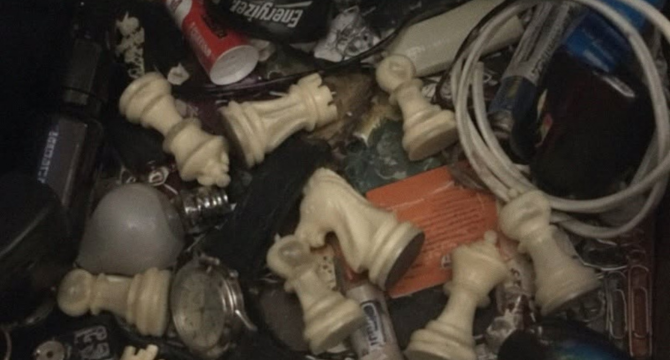
The next morning, I opened the front door to bring in the paper and found a single white pawn sitting neatly on my welcome mat.
There was no note or footprints.
Just one clean wooden chess piece.
I stared at it for a few seconds, then looked up and down the empty street.
“Very funny,” I muttered, though no one was there.
I assumed it was some strange prank. Maybe one of the neighborhood kids. Maybe Daniel had set it there before leaving because he knew I hated chess jokes.
I tossed it into a kitchen drawer and forgot about it.
Until the following morning.
This time, a white knight waited on the mat.
The same size. Same smooth wood. Same polished shine.
I picked it up slowly.
“Okay,” I whispered. “That is less funny.”
Then, I called Daniel from the kitchen.
He answered on the second ring. “Miss me already?”
“Did you leave chess pieces on the porch?” I asked.
There was a pause. Then he laughed.
“What?”
“Yesterday there was a pawn. Today there’s a knight.”
“Maybe someone’s trying to teach you chess.”
“I know what chess pieces are.”
“Barely.”
“Daniel!”
His laughter softened. “No, Liv. I didn’t leave anything. Maybe it’s a kid messing around.”
“Both mornings?”
“Ask next door. Maybe Caleb is bored.”
Caleb was our neighbor’s 11-year-old son. He had once filled our mailbox with plastic spiders, so it was not impossible.
I wanted to believe that.
But the next morning, a bishop appeared.
That was when I checked the doorbell camera.
The footage was normal until 3:14 a.m.
Then the image froze for 12 seconds.
At 3:15, it returned.
The porch was empty in one frame and, in the next, the white bishop sat on the mat.
I watched it five times.
Nothing moved. There was no person.
Just 12 seconds missing.
I asked Caleb first.
He opened the door wearing pajama pants and holding a cereal bowl.
“Did you put chess pieces on my porch?”
He blinked. “Why would I do that?”
“Because you’re 11… and you’re the only one who could do that.”
“Fair,” he said, then shook his head. “But no.”
His mother, Janice, appeared behind him. “What’s going on?”
I explained. She frowned, then lowered her voice.
“Are you alone this week?”
“Daniel’s away.”
Her expression changed.
“Do you want Tom to check around the yard tonight?”
“No, no. I’m sure it’s nothing.”
But I was not sure.
That night, I locked every window twice.
The fourth morning, a white rook sat on the mat.
Again, the camera glitched at 3:14.
Again, 12 seconds.
Again, nothing before or after.
I called Daniel again.
This time, he did not laugh as much.
“That’s weird,” he said.
“Weird? That’s your word?”
“I’m not dismissing it.”
“You are absolutely dismissing it.”
“I’m not. I just don’t want you scared over a prank.”
“Someone is approaching our house every night while you’re gone.”
He exhaled. “Okay. Call the security company.”
“I did. They said the camera is functioning normally.”
“Then maybe it’s Wi-Fi interference.”
“At the same time every night?”
Silence.
“Liv,” he said finally, “don’t open the door at night. If you see anything, call the police.”
Something in his voice bothered me.
“Do you know something?” I asked.
“What? No.”
“Daniel, please. Tell me if you know something.”
“I don’t.”
But he answered too fast.
That afternoon, I went into his office.
I am not proud of that, but fear makes trust feel fragile.
His desk was neat. Daniel was the kind of man who labeled charging cords.
I checked the drawers, expecting nothing.
Then I found an old photograph tucked inside a chess book.
Daniel was in it, maybe 16 years old, standing beside an elderly man with a sharp face and silver hair. Between them was a handmade chessboard.
Behind them, a banner read, “Briar Glen Chess Club Junior Championship.”
On the back, in faded ink, someone had written, “To Daniel, the only student who ever saw the whole board. – Arthur”
I had never heard the name Arthur.
That felt impossible.
Daniel had told me about teachers, bosses, childhood neighbors, and even a dentist he hated in middle school.
But never Arthur.
When I called him that evening, I asked, “Who was Arthur?”
The line went quiet. “Where did you hear that name?”
“In your office.”
“You went through my office?”
“Someone is leaving chess pieces on our porch while your camera magically freezes every night. So yes, I went through your office.”
He sighed. “Arthur was my old chess mentor.”
“And you never mentioned him?”
“I have.”
“No, you haven’t.”
Another pause.
“He died a few months ago,” Daniel said.
The room seemed to shrink.
“What?”
“I didn’t tell you because I hadn’t spoken to him in years. It felt complicated.”
“Complicated how?”
“He was intense. Brilliant, but intense. Chess was everything to him. If he cared about you, he made you feel like the most important person in the room. If he thought you failed him, he could make you feel two inches tall.”
“And did you fail him?”
“No.”
“Did he think you did?”
Daniel did not answer.
That silence frightened me more than the chess pieces.
On the fifth morning, a white bishop appeared.
It was the second bishop.
I now had a pawn, knight, bishop, rook, and another bishop.
They were always white and always placed during those missing 12 seconds.
I took the pieces to the police station because I was tired of feeling foolish.
The officer at the desk, Officer Reyes, listened politely until I emptied the bag onto the counter.
Then her expression changed.
She picked up the rook and turned it over.
On the bottom was a tiny carved mark: AB.
They were Arthur’s initials.
“You know them?” I asked.
She called another officer over, an older man named Harlan.
He looked at the pieces and swore under his breath.
“I haven’t seen one of these in years.”
“What are they?” I asked.
Harlan looked at me.
“Part of a handcrafted set. Arthur had one. A local woodworker made two identical sets sometime in the ’90s.”
“Who had the other one?”
Harlan hesitated.
“That,” he said, “is where this gets unpleasant.”
Before he could explain, my phone rang.
It was an unknown number.
I took a deep breath and answered.
A man’s voice said, “Olivia?”
“My name is Peter. I’m an attorney. I believe you’ve received several items that belonged to Mr. Arthur.”
I looked at the officers.
“Are you the one putting them on my porch?”
There was a pause.
“Not personally.”
Officer Reyes reached for a notepad.
I put the phone on speaker.
Peter cleared his throat. “Arthur left instructions in his estate documents. They were unusual, but legal.”
“Legal?” I snapped. “Someone has been coming to my house at three in the morning and disabling my camera.”
“The camera was not disabled. A technician paused the feed remotely for privacy.”
“For privacy? I thought someone was stalking me.”
“I understand how it looked.”
“No, you don’t.”
Officer Harlan leaned toward the phone.
“This is Officer Harlan. Peter, you need to come to the station.”
The attorney arrived 25 minutes later with a leather briefcase and the nervous face of a man realizing a dead client’s dramatic plan had become a police matter.
He kept apologizing.
“It was never meant to frighten you,” he said.
“Then what was it meant to do?”
“Get Daniel’s attention.”
“Daniel isn’t home.”
Peter closed his eyes. “I know that now.”
“You didn’t know he was on a business trip?”
“The instructions said the sequence was to begin once Daniel was out of town.”
My stomach turned.
“Why?”
Peter looked at the officers, then at me.
“Because Arthur said Daniel would try to stop it.”
“Stop what?”
Peter opened his briefcase and removed a sealed black box.
On top was an envelope.
My name was written across it.
“Why is my name on that?”
“Arthur added that envelope three weeks before he died,” Peter said. “He wrote that if Daniel’s wife became involved, she should open the box first.”
“I’ve never met Arthur.”
“I know.”
Advertisement
“Then why me?”
“Because he said Daniel would blame himself for something that was never his fault.”
At that point, I wanted Daniel home immediately.
I also wanted answers before he could tell me to stop looking.
So I opened the box.
Inside were old tournament score sheets, photographs, newspaper clippings, and a letter addressed to Daniel.
The first clipping showed a teenage boy with dark curly hair holding a silver trophy.
The headline read, “Local Chess Prodigy Favored to Win State Junior Title.”
His name was Marcus.
Another clipping, dated two weeks later, made my stomach drop.
“Trophy Missing After Junior Championship. Teen Player Questioned.”
The next photo showed the same boy leaving the chess club with his head down while adults stared.
Officer Harlan sighed.
“I remember that.”
I looked up. “You knew about this?”
“Everyone in Briar Glen knew. Marcus was accused of stealing the championship trophy after he lost the final match. Nothing was proven, but people believed it.”
“Why?”
“Because he was poor,” Harlan said bluntly. “Because the trophy was valuable. Because people like easy answers.”
Peter handed me a journal.
“Arthur was the tournament director that year.”
I opened it.
His handwriting was thin and sharp.
The first entry I read said, “Marcus did not take it. I knew it the moment I saw his face. But I said nothing because the room had already decided.”
I turned the page.
“I let a child carry my cowardice for 31 years.”
The pieces on my porch suddenly stopped feeling threatening.
“Where does Daniel fit into this?” I asked.
Peter pointed to a photograph.
Daniel was in it, 15 or 16, kneeling beside a dusty storage crate at the old chess club. Arthur stood behind him.
“Years ago, Daniel helped Arthur clean out a storage room at the club. He found that crate and asked why old tournament equipment was mixed with holiday decorations. Arthur realized then that something from the 1994 tournament may have been packed away.”
“The trophy?”
Peter nodded. “He found it last year.”
I stared at him. “Last year?”
“Yes.”
“And he said nothing?”
Peter looked ashamed on behalf of a dead man.
“He tried to find Marcus. He failed at first. Then he became ill. By the time he found him, he was too weak to travel.”
“Why not tell Daniel?”
“Because Daniel was a teenager when he found the crate. Arthur believed Daniel would think he should have recognized the trophy somehow, should have asked more questions, should have solved it sooner.”
“That’s ridiculous.”
“Yes,” Peter said. “But guilt is rarely logical.”
I unfolded Arthur’s letter to Daniel.
“Dear boy,
If this reached you, then I have finally made the last move I was too cowardly to make in life.
I did not teach you chess as well as I should have. I taught you strategy. Patience. Sacrifice. But I failed to teach you the most important lesson.
When everyone at the board is staring at the wrong square, you must still tell the truth.”
I stopped reading because my eyes blurred.
Officer Reyes asked softly, “Are you okay?”
“No.”
Then my phone rang. It was Daniel.
I answered with trembling fingers.
“Liv?” he said. “The security company called me. Why are the police asking about our camera?”
I looked at the black box, the letter, and the carved chess pieces.
“You need to come home.”
His voice changed. “What happened?”
“The king came early.”
“What?”
“Daniel, who is Marcus?”
The silence that followed was so complete I thought the call had dropped.
Then he whispered, “Where did you hear that name?”
That was when I knew this story was not just Arthur’s.
Daniel flew home that night.
When he walked through the front door, his face was pale and furious.
“Are you okay?” I asked.
“I’m fine,” he said.
“Someone came to our house at night for six days.”
“I know.”
“Someone froze our camera.”
“I know.”
“Then why are you sitting there like this is normal?”
Then, I handed him the letter.
“Read it.”
He did.
He was standing at first, then he sat on the couch.
By the end, he had one hand over his mouth.
“I was there,” he said.
“I know.”
“No. Liv, I was there the day Marcus lost. I remember him crying. I remember Arthur telling everyone to calm down, but he didn’t defend him. Nobody did.”
I looked at him.
“I helped clean that storage room. I saw the crate. I joked that the club kept more junk than my grandmother. If I had opened it…”
“You were 16.”
“I was old enough to ask.”
“You did ask.”
He looked at me.
“You asked why tournament equipment was mixed with decorations,” I said. “Arthur ignored what that meant. Not you.”
Daniel looked back down at the letter.
“He knew I’d do this.”
“Yes.”
His eyes filled. “He knew me.”
The next morning, we met Peter at Arthur’s old house.
The white king was there, along with the missing trophy.
It was smaller than I expected, silver with a marble base, wrapped carefully in blue cloth. Its plaque read, “Briar Glen Junior Championship, 1994. First Place.”
Daniel touched it with two fingers.
“All this over a trophy,” he whispered.
“No,” I said. “Over what people did after it went missing.”
He nodded.
Peter had already found Marcus.
He lived two towns over and worked as a high school music teacher. He had not attended a chess event in over 30 years.
“He agreed to come to the club tonight,” Peter said. “I told him Arthur left something for him. Nothing more.”
Daniel looked sick. “He doesn’t know?”
“No.”
The old chess club looked almost exactly like the photographs. Same brick building. Same narrow windows. Same wooden sign, though the paint had faded.
By seven, two dozen people had gathered. Some were former students, while others were old club members.
Officer Harlan stood quietly near the back.
Then, Marcus walked in.
He was in his 50s now, with gray in his beard and kind, cautious eyes.
He paused when he saw the crowd.
“This feels more dramatic than I expected,” he said.
Daniel stepped forward.
“Marcus?”
Marcus looked at him. “You must be Daniel.”
“I am.”
“Arthur mentioned you in his letter.”
Daniel swallowed. “He mentioned you in mine.”
Marcus looked at him with quiet curiosity.
“Arthur talked about you more than he talked about chess near the end,” he said. “He said you were the one person who never stopped asking questions.”
Daniel lowered his eyes.
“I wish I’d asked one more.”
The room went still.
Peter uncovered the trophy.
Marcus stared at it.
For several seconds, his face showed nothing.
Then he laughed once, softly, in disbelief.
“Well,” he said. “There it is.”
Daniel’s voice broke. “It was never stolen.”
Marcus looked at the trophy for a long moment.
“No,” he said. “I suppose it wasn’t.”
Daniel opened Arthur’s letter with shaking hands.
He read it aloud.
Arthur confessed everything.
He wrote that Marcus had been a gifted boy who deserved adults brave enough to protect him. He wrote that the missing trophy had been accidentally packed away by volunteers after the tournament. He wrote that he had suspected Marcus was innocent but let public shame do what evidence never could.
When Daniel finished, no one spoke.
Then Marcus stepped forward and placed a hand on the trophy.
“I was angry for a long time,” he said. “Not because of this.”
He tapped the trophy lightly.
“Because people who had known me since I was seven suddenly looked at me like I was a thief.”
An older woman began to cry.
Marcus turned toward her and smiled sadly.
“But I forgave all of you years ago.”
The woman covered her mouth.
Marcus continued, “Leaving chess hurt. But it also led me to music. Music led me to my wife. My wife led me to the life I have now. I won’t pretend the accusation didn’t wound me. It did.”
He looked at Daniel.
“But wounds are not always the end of the story.”
Daniel shook his head. “I’m sorry.”
“You were a kid.”
“I still should have…”
“No,” Marcus interrupted gently. “Don’t pick up guilt that grown people left on the floor.”
That sentence broke Daniel.
He cried quietly, and I took his hand.
Later, the handcrafted chess set was donated to the club. The recovered trophy was placed in a glass case beside Arthur’s letter and a new plaque.
“Marcus, 1994 Champion.”
Daniel kept only the white king.
For weeks, it sat on our kitchen windowsill.
I hated it at first. Then I understood why he needed it there.
It was a reminder to look at the whole board before deciding what a move means.
One night, I found Daniel staring at it.
“Do you wish Arthur had told you sooner?” I asked.
“Yes.”
“Are you angry?”
“Yes.”
“Do you miss him?”
He gave a small, tired laugh. “Yes.”
I leaned against the counter beside him.
“People are complicated.”
“Chess is easier,” he said.
“No, it isn’t.”
He looked at me.
I picked up the white king and placed it in his palm.
“You just know better than most people that the king isn’t always the one in danger. Sometimes he’s the one everyone is trying to protect.”
Daniel closed his fingers around it.
Outside, the porch was empty.
The game was finally complete.

 admin
admin