I was the first person to accuse the waitress of treating an elderly man with total disrespect.
At the time, I honestly believed I was doing the right thing.
I still think about that day more than I want to admit. Not because I was the only one who judged her, but because I was the first one loud enough to make it worse.
My name is Nicole. I was 36 then, divorced, tired all the time, and proud of the fact that I spoke up when I saw something unfair.
I had spent most of my adult life telling myself that silence helped the wrong people.
If somebody was being mistreated, you stepped in. That was the kind of person I believed I was.
So when I saw an elderly man sitting alone by the window while a young waitress kept passing his table without helping him, I did what came naturally.
I judged what I saw.
The restaurant was busy but not chaotic. The lunch crowd had not fully cleared, and the early dinner crowd had started to trickle in.
I had come in for soup and a few minutes of peace before picking up my daughter from dance class.
The elderly man entered a minute or two after I did.
He had silver hair, dark skin lined deeply with age, and a careful, dignified way of moving. He leaned on a cane but held himself straight.
He smiled at the hostess, thanked her when she led him to a small table by the window, and sat down with a patience that made me notice him right away.
The waitress noticed him too.
Her name, I would later learn, was Kira.
At the time, all I knew was that she looked to be in her early 30s, with her dark hair tied back, tired eyes, and the quick, practiced movement of somebody handling too many tables at once.
She spotted him almost immediately.
Then she turned and walked away.
At first, I assumed she would be right back.
Five minutes passed. Then 10. Then 15.
Kira greeted a family of four who had arrived after him. She brought iced tea to a couple in a corner booth.
She laughed softly with two construction workers who seemed to know her by name.
She carried a tray past the old man’s table, glanced once in his direction, and kept going.
He never raised a hand, complained, or even tried to wave her down.
He just sat there quietly, folding and unfolding the menu in his hands.
He looked gentle. Almost painfully so. And every time Kira passed without stopping, the room around him seemed to notice more.
A woman behind me whispered, “That’s awful.”
A man at the counter muttered, “Some people shouldn’t work with the public.”
The hostess kept glancing over like she wanted to help but did not want to step on the server’s section.
I watched Kira pass his table again and felt my chest tighten with anger.
Maybe I was already carrying too much that day. My ex had texted that morning to say he needed to “adjust” the custody schedule again.
My boss had called my work acceptable in a tone that clearly meant the opposite.
My daughter had cried before school because another girl told her she was weird.
I had spent the whole day swallowing irritation in small bites.
Then I saw that old man sitting there, ignored in plain sight, and it all found a target.
I pushed back my chair and stood.
I walked over to his table and said, “Sir, if she won’t help you, I’ll get the manager.”
He looked up at me with the kindest smile I have ever seen on a stranger.
“That’s very thoughtful of you,” he said. “But please… don’t.”
His voice was soft and warm, the kind of voice that made even simple words sound gentle.
I mistook that gentleness for helplessness.
I smiled back in the brisk, confident way people do when they have already decided what is best. “It’s no trouble.”
His hand moved slightly as he tried to stop me, but I was already turning away.
I found the manager near the register.
His name tag read, Aaron. He was broad-shouldered, maybe 40, with rolled shirtsleeves and the expression of a man who had not had an easy week.
I pointed toward the window table and told him, in a voice just loud enough for nearby customers to hear, that his waitress had been ignoring an elderly man for nearly 20 minutes.
My voice became a spark.
The woman behind me jumped in immediately.
Then the man at the counter and another customer near the pie case.
Suddenly, people were talking over one another, each adding fresh outrage to a situation none of us actually understood.
“He’s been sitting there forever.”
“She walked past him three times.”
“If this is how they treat older customers, I won’t be back.”
“She should be ashamed.”
One woman actually said, “She should lose her job.”
I did not disagree.
Aaron’s face changed in that careful way managers’ faces do when they realize they are no longer handling one complaint but a room full of emotion.
He looked at the old man from a distance, then turned toward Kira.
“Come with me,” he said quietly. “We’ll sort this out in the back.”
The whole restaurant seemed to pause.
Even a toddler stopped dropping crayons.
Kira had been balancing a tray when Aaron spoke.
She set it down carefully on a side station, then looked at him. That was when I saw her face clearly for the first time.
There were tears in her eyes.
She did not argue or defend herself.
She just nodded once, wiped at her cheek with the back of her hand, and started walking toward the kitchen as if she had already accepted whatever was coming.
Around me, people shook their heads in satisfaction.
Then, just as Kira reached the kitchen door, I turned to see the old man approaching as fast as he could, which was slow, considering his age and sickly appearance.
“Please,” he said, barely above a whisper. “Don’t do this.”
Everything stopped.
Aaron turned, and Kira froze.
The old man set his cane carefully against the nearest chair and made his way across the restaurant one slow step at a time.
The room had gone so silent it felt staged, like we were all trapped inside the moment and knew it.
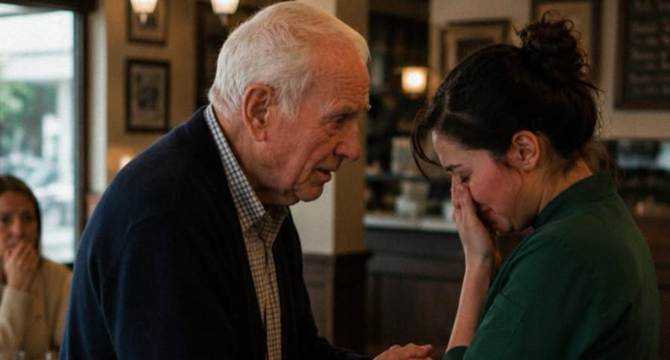
When he reached Kira, he gently took her hand in both of his trembling hands.
She seemed uncomfortable having him hold her hand and still couldn’t look at him.
For several long seconds, neither of them spoke.
Then he quietly asked, “You never told him… did you?”
Kira closed her eyes.
A tear slipped down her cheek before she slowly shook her head.
The old man lowered his head, still holding her hand.
“I was afraid of that,” he whispered.
Then he turned toward all of us in the restaurant.
And in a voice that somehow carried through the whole restaurant without ever becoming harsh, he said, “She wasn’t ignoring me.”
His voice shook as he added, “She is simply protecting herself from the man who failed her when she needed him most.”
No one moved.
I felt the blood leave my face.
Kira covered her mouth with her free hand. Aaron’s expression shifted from managerial concern to stunned confusion.
The woman who had said Kira should be fired suddenly found something fascinating about the sugar packets on her table.
The old man went on.
“My name is Sospeter,” he said. “This young woman is my daughter.”
The room seemed to inhale all at once.
Kira made a broken sound, somewhere between a sob and a laugh, and still did not look up.
Sospeter tightened his hold on her hand gently, like he was afraid she might pull away.
“Many years ago, she got pregnant. She was young, scared, and alone. The man responsible disappeared before my grandson was born.” His voice wavered then, but he kept going.
“Instead of standing beside her, I told myself I had the right to be angry. I told myself I was defending principle.”
He swallowed hard.
“What I was really doing was abandoning my child when she needed me most.”
I wanted the floor to open under me.
Kira finally lifted her head then. Her eyes were swollen and red. “Dad, please…”
He shook his head gently. “No. If there is a room full of people ready to condemn someone today, let them condemn the right person.”
His words landed like stones.
He turned slightly toward Aaron. “You should not punish her. If anyone here deserves humiliation, it is me.”
Aaron looked stunned. “Sir, I didn’t know—”
“Of course you didn’t,” Sospeter said. “None of you did. And still you all decided.
Kira tried to pull her hand free, but he held on just long enough to say one more thing.
“I came here because I am dying. I have tried to reach out privately, but she has rightfully refused to see me.”
That hit the room harder than anything before it.
Even Kira looked up fully then.
“I came here hoping she would not ignore me in public, which is selfish. She has every right to. I have no right to ambush her in her place of work.”
Aaron took a step back.
Sospeter spoke more quietly now.
“I found out three months ago that I’m dying. My heart is failing. The doctors have done what they can.”
He gave a tired little smile that broke my chest. “That tends to make a man count the things he will not have time to fix.”
Someone near the counter gasped. I just stood there with my mouth slightly open, feeling stupid, intrusive, and terribly human in the worst possible way.
Kira stared at him. “How did you find where I work?”
“I asked about you years ago and was told where you live; hence, I sent the letters but got no reply.”
“You just expect to pop back into my life because you are dying,” Kira said.
“I’m sorry. I had to try.” His thumb moved slightly across her knuckles. “A friend of a friend told me where you work, and I came to find you face to face. I didn’t come here for food.”
Kira let out a shaky breath and looked away.
Aaron said quietly, “Should we… give you both some privacy?”
Kira laughed once through her tears. “A little late for that.”
No one knew where to look.
I think we were all waiting for the universe to rewind five minutes and spare us the shame of being ourselves.
It did not.
Sospeter turned back to Kira. “I asked if you told him because I hoped maybe you had spoken of me with less bitterness than I deserve.”
“Who? My manager? Why would I tell my manager about a father who abandoned me in my time of need?” an angry Kira said.
“No, no, I mean your son. My grandson. The one I abandoned you when you got pregnant with. Did you ever tell him about his grandfather?”
She wiped her face angrily. “Danilo doesn’t know you exist.”
Of all the things said that afternoon, that was the one that hurt most to hear.
Maybe because she did not spit it or throw it like a weapon.
She said it like a fact she had learned to live around.
Sospeter nodded slowly. “I understand.”
“No,” she said, sharper now. “I don’t think you do.”
Aaron quietly moved a chair toward them, but neither sat.
Kira drew in a shaky breath. “You don’t know what it was like after you threw me out. You don’t know what it felt like to be 22 and pregnant and suddenly have nowhere to go except a friend’s couch.”
I could feel the room take in her rightful anger.
“You don’t know what it was like when Danilo was born, and I had exactly 63 dollars left after paying the clinic. You don’t know what it was like listening for a baby to breathe because I was too scared to sleep.”
The room was so silent that every word felt indecently intimate.
But none of us deserved the comfort of looking away.
Sospeter lowered his head. “You’re right.”
“I waited,” Kira said. “For weeks, then months. I kept thinking you’d calm down and call. Even after Danilo’s father left me, I kept thinking that at least my father would come around.”
Her voice cracked. “You didn’t.”
Tears slid down Sospeter’s face then. He did not wipe them.
“I know.”
“No, you don’t know. Because while you were being disappointed in me from a safe distance, I was figuring out how to work nights with a newborn.”
She sighed in despair, “I was learning how to smile at customers when I had not eaten enough. I was trying to explain to a little boy why everybody else’s family tree looked different from his.”
At that, something in Sospeter’s face collapsed.
He whispered, “What does he think?”
Kira laughed again, but there was no humor in it. “That I had him young, and his father disappeared. That’s all. He asked about grandparents when he was six. I told him my mother was gone, which was true, and my father…” She stopped. “I never knew him at all.”
Sospeter shut his eyes.
The woman who had applauded earlier was crying now. So was the hostess.
As for me, shame had settled in so deeply I could barely feel my hands.
Aaron cleared his throat softly. “Kira… do you want to take a break?”
She shook her head without looking at him.
Sospeter spoke before Aaron could say anything else. “I did not come here to demand a place in your life. I forfeited that years ago. I came because I could not bear the thought of dying without saying I was wrong.”
Kira’s face twisted. “So this is just about your conscience.”
He continued, voice trembling. “I was wrong to choose pride over my child. Wrong to stay away because shame grew heavier each year until returning felt impossible.”
He took a breath that looked difficult. “And wrong to let my grandson grow up believing he had no granddad. I was just there but didn’t love and care for him as I should have.”
Kira finally looked straight at him.
“What do you want from me?”
It was the question everyone there had been feeling.
Sospeter answered it with heartbreaking simplicity.
“Nothing you don’t want to give.”
She stared.
He gave a tiny shrug. “A conversation, if you can bear it. The chance to apologize to Danilo one day, if you allow it. Maybe the truth, so he knows I exist.”
His voice dropped lower. “And if not, then at least let me leave this world having told you that I was wrong.”
No one in that room deserved to witness that moment, but we all did.
Kira pressed her lips together so hard they turned white.
Then she said, “I don’t forgive you.”
He nodded immediately. “I know.”
“I might never.”
Another nod. “You would be justified.”
“And if you think one apology in front of strangers fixes anything—”
“It doesn’t,” he said gently. “It only admits the truth.”
For the first time since he had stood up, she seemed unsure what to do with him.
I think that was when Aaron finally remembered he was still the manager of a full restaurant.
He took a breath and said, with remarkable softness, “Everyone, your drinks are on the house today.”
No one objected.
Then he turned to Kira. “Take whatever time you need.”
She looked at him, startled.
Aaron just nodded once, like he was trying in one small way to undo the harm the room had done.
Sospeter reached for his cane, but his hand shook. Instinctively, Kira steadied it before catching herself.
The gesture was small, but it wrecked me.
They moved to a corner booth near the back, away from most of us, though privacy was impossible now.
Still, the room worked hard to pretend. Conversations restarted in low murmurs.
I sat down because my knees suddenly needed help.
My soup arrived at some point. I never touched it.
I kept looking toward the back booth where Kira and Sospeter sat across from each other.
They were two people connected by blood and years of damage, trying to build a bridge out of what little time was left.
About 20 minutes later, the restaurant door opened, and a boy walked in.
He looked about 11, slim and serious, with Kira’s eyes and a backpack hanging from one shoulder. He paused just inside the entrance, looking around for his mom.
The hostess leaned down and said something to him.
He nodded and started toward the back.
Kira stood and hugged him.
“Danilo,” she said.
The boy looked between her and Sospeter. “Mom? Who is this?”
There was confusion in his voice.
Sospeter had gone completely still.
Kira knelt so she was eye level with him. Her hands were shaking. “Baby, this is…” She stopped and started again. “This is my father.”
Danilo blinked.
He looked at Sospeter, then back at his mother. “Your father?”
Kira nodded.
“My grandpa?”
Her eyes filled again. “Yes.”
Danilo frowned the way children do when new information has to force itself into an old map. “I thought you didn’t have one.”
Kira let out a sound that was almost a laugh. “I told you that because it was easier than an explanation.”
Sospeter spoke then, very softly. “Hello, Danilo.”
The boy studied him with open, unguarded seriousness.
“How come I’ve never met you?”
There are questions only children can ask with enough honesty to strip everyone bare.
Sospeter answered him the right way.
“Because I made a very bad mistake a long time ago,” he said. “And your mother had every reason not to let me near her.”
Danilo looked at Kira again. “Did he hurt you?”
I don’t think there was a dry eye left in that restaurant.
Kira swallowed hard. “Not with his hands.”
Danilo seemed to understand more than a child should.
He set his backpack down and moved closer to her, leaning against her shoulder.
Then Danilo asked, “Is that why you’re crying?”
Kira nodded.
He thought for a second, then looked at Sospeter again. “Have you told her you are sorry?”
Sospeter let out one broken laugh and covered his mouth briefly. When he looked up again, his eyes were shining.
“Sorry,” he said. “Very, very sorry.”
Danilo considered this with the unbearable seriousness of a child deciding whether the world deserves another chance.
Finally, he said, “Okay.”
Kira put both arms around Danilo and bowed her head into his hair.
Sospeter looked at them like the sight hurt and healed him at the same time.
By the time I left, the restaurant had changed. Not in some magical way.
The toddler had moved on to kicking the booth. Life had resumed.
But none of us were the same as when we walked in.
I picked up my daughter late from dance class that day. I cried in the parking lot before I went in, then wiped my face and told her traffic had been awful.
A week later, I went back to Maple House.
Not out of guilt exactly. Though that was there.
Out of unfinishedness.
Kira was working again. So was Aaron.
When Kira came to my table, there was a brief awkwardness, then she smiled.
“Just coffee today?” she asked.
“And pie, if that’s allowed for people with public-shaming histories.”
She laughed, and the sound was such a relief I almost cried again.
Over the next few months, I learned things slowly.
Not because I pried, but because small-town restaurants are where life leaks out around the edges.
Sospeter did not have long, but he had some.
Kira let him meet Danilo more. An hour here, a park bench there, and a school recital in the back row.
Enough for Danilo to begin saying “Grandpa” without confusion. Enough for Sospeter to hear it more than once.
Still, Kira did not rewrite the past to make the present prettier.
She gave her father limits and honesty. Eventually, she gave him time.
I saw them once at a farmer’s market, Danilo between them, carrying peaches like they were treasure.
Sospeter died in early spring.
Aaron told me in a low voice when refilling my coffee one afternoon. Kira had taken the week off.
When Kira came back to work, she no longer looked over her shoulder every time the front door opened.
There was grief in her face, yes.
But also something like peace and rest.
Today, I still think people should step in when something is wrong.
But I think something else now, too:
Sometimes what looks like coldness is pain trying not to spill in public.
Sometimes what looks like neglect is a person fighting to stay upright.
That day in the restaurant, I thought I was defending a helpless old man.
Instead, I helped shame a woman who had already survived being abandoned once by the person now standing in front of her.
The moment I will never forget is not my own embarrassment, though I earned it.
It is Sospeter’s voice, soft and steady, saying to a room full of strangers that his daughter was not ignoring him.
She was simply protecting herself from the man who failed her when she needed him most.
I have never heard a truer sentence.
And I have never forgotten how quiet an entire room can become when the truth finally comes to light.

 admin
admin