I first told myself it was none of my business.
That is what older women say when they are trying very hard not to become the kind of mother-in-law everyone complains about.
We say it while watching too closely. We say it while standing in someone else’s kitchen pretending not to notice the tension in the air.
We say it because we know how easy it is to be accused of meddling, and how hard it is to come back from it once you are.
So when I started noticing that Faith never let anyone prepare my grandson’s food, I kept my mouth shut.
At first, it was easy to explain.
Nick was eight months old then. Sweet, soft, and serious-eyed little thing. He had the kind of face that always looked on the edge of a question.
Faith said she wanted to make all his food herself so she could be sure what went into it. No sugar, no salt, no additives, no packaged jars unless absolutely necessary.
I could understand that. Young mothers have their own ways now. Half of them live in terror of ingredients I cannot pronounce, and the other half think homemade puree is a spiritual calling.
Faith was not unkind about it.
She would smile and say, “I’ve got it, Rosa,” in that careful, gentle tone people use when they are trying to keep you from helping without making it sound like rejection.
If I offered to mash the sweet potatoes, she’d take the bowl from my hands.
If I reached for the spoon, she’d say, “No, no, I already measured everything.”
If Silas wandered into the kitchen and said, “Need me to feed him?” she’d answer too quickly.
“I’ll do it.”
Always: I’ll do it.
Silas, being Silas, usually kissed the side of her head and went back to whatever he had been doing.
My son was a good man, but like many good men, he could be blind in the exact places where blindness made life easier.
I was living with them temporarily that winter after a plumbing disaster in my apartment building.
“Temporarily” had stretched into almost three months because contractors lie with the confidence of prophets.
Faith had insisted I stay with them rather than waste money on a hotel. She had even said it warmly.
So I tried to be grateful. Quiet and useful only when asked.
But living in someone’s house teaches you their rhythms, whether they want you to learn them or not.
And Faith had rhythms. She checked the baby monitor every few minutes, even when Nick was sleeping peacefully two rooms away.
She woke at the slightest sound.
She wiped down his toys so often I started to wonder if the poor child would grow up believing the natural smell of childhood was disinfectant.
She was exhausted all the time and yet never seemed able to rest.
If Nick fussed for more than ten seconds, her whole body changed. Her shoulders went high and stiff. Her eyes sharpened.
Once, when he let out one startled cry in his high chair because he had dropped a biscuit, Faith rushed over so fast she knocked a cup off the counter.
I bent to help and said gently, “He’s all right.”
“I know,” she snapped.
Then, immediately, she looked horrified with herself.
“I’m sorry,” she said. “I’m sorry. I just… I know.”
I told her it was fine, and it was. But something in her face stayed with me. It was not anger. It was fear wearing anger’s coat because fear hates to be seen clearly.
The powder started a few days later. Or maybe it had been there before, and I had not noticed. That bothered me, too.
The first time I really saw it, Faith was making Nick oatmeal in the kitchen while I sat at the table sorting coupons I did not need.
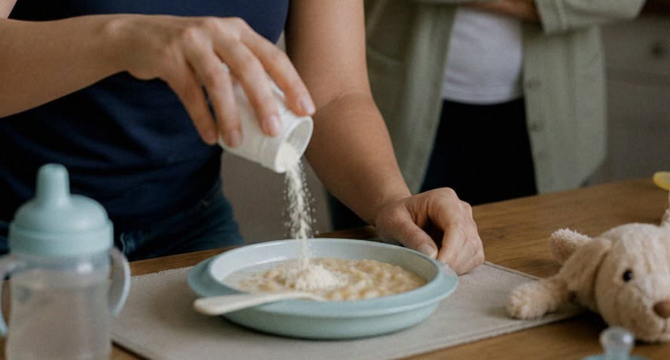
She opened the upper cabinet, reached into the back behind a stack of tea tins, and took out a plain white container with no pharmacy label on the side I could see.
She unscrewed the lid, tapped a little white powder onto a spoon, and stirred it into the oatmeal.
Just a pinch.
I looked up. “What’s that?”
She did not flinch, but she did screw the lid back on faster than seemed natural.
“Just vitamins.”
“For babies?”
“Mm-hmm.”
She smiled without looking at me and carried the bowl to Nick.
That should have been the end of it.
Plenty of babies take supplements. Iron drops, powdered probiotics, whatever else the experts say they need now.
But the next morning, she added the same powder to mashed banana. That night, it went into pureed peas. The day after that, applesauce.
Every meal. Always from the same hidden container.
Always with that same small, quick motion, like she was doing something ordinary but privately urgent.
I watched for two weeks before I let myself admit I was frightened.
The worst part was that Nick did start to seem unusually calm.
Not sick or limp. Just… quiet. Sleepy, sometimes. Easy to settle. Slow to cry compared to most babies I had known.
Once, while Faith was upstairs showering and Silas had run to the store, I sat on the living room floor with Nick and bounced a stuffed rabbit in front of him.
He watched it with heavy eyes and then leaned sideways against my leg as if he were tired halfway through playing.
I touched his cheek.
Too drowsy, I thought.
Or maybe I was imagining it.
That is the terrible thing about suspicion in a family. It makes you feel disloyal even before you know whether you are right.
A week later, I asked again.
Faith was making carrot puree, and I was determined to sound casual.
“What vitamins are those, exactly?”
She did not turn around. “Just a supplement my friend recommended.”
“What kind of supplement?”
Now she did turn. Her expression changed so quickly it startled me.
More like panic disguised as irritation.
“Rosa, why are you so focused on it?”
“Because it goes into everything he eats.”
Her jaw tightened. “Because I want him healthy.”
I held up both hands. “I’m only asking.”
“And I’m answering.” Then, softer but somehow worse, she added, “Please don’t make me feel like I can’t even feed my own baby without being watched.”
That shut me up.
That night, I lay awake in the guest room listening to the soft sounds of the house and wondering whether I was becoming exactly the meddling old woman I had promised myself I would never be.
Then I remembered the way Faith’s hand had trembled when she put the spoon down.
The next afternoon, opportunity came my way.
Faith had just mixed Nick’s lunch when the baby monitor crackled from upstairs. She glanced at it, frowned, and set the spoon down.
“He woke up early from his nap,” she said. “Can you watch his bowl for one second?”
She hurried upstairs.
I heard her footsteps on the hall floor above me, then the soft rise of her voice through the ceiling.
I looked at the counter.
The white container was sitting there with the lid half screwed on.
My heart started pounding so hard I could hear it in my ears.
I picked it up and turned it.
The pharmacy label was on the other side.
The patient’s name had been partly peeled away, but not enough. I could still see the last few letters: …ITH.
The drug name meant nothing to me.
The warning label did.
“May cause drowsiness” and “Do not operate heavy machinery.”
My mouth went dry.
I took out my phone and snapped two quick pictures.
Then I put the container exactly where it had been and sat back down just as Faith came downstairs holding Nick against her shoulder.
She looked at me, then at the counter, then back at me.
For one split second, I thought she knew.
Instead, she just smiled too brightly and said, “Sorry. He startled himself awake.”
I nodded and said nothing.
The second she carried Nick into the dining room, I texted the photo to Shawn.
Shawn had been my pharmacist for nearly 15 years and, more importantly, my friend for almost that long.
He was the kind of man who remembered every medication his regulars took and every grandchild by name.
If anyone could tell me I was overreacting, it would be him.
I wrote only: “Can you tell me what if this is a supplement? It’s being mixed into a baby’s food.”
He replied in under three minutes.
“Rosa, this isn’t a supplement.”
I stared at the screen.
Another message came right after.
“It’s a prescription sedative compound.”
Then:
“Not safe for an infant unless a pediatric specialist specifically prescribed the right quantity, which would be very unusual.”
Then:
“Do not give him more until a pediatric specialist approves.”
From the dining room, I could hear Faith making little cheerful sounds while she fed Nick, as if the world had not just tilted beneath my feet.
I stood up so fast my chair scraped the floor.
Faith looked up immediately. “Everything okay?”
I walked into the room holding my phone so tightly my knuckles hurt.
“What is that powder?”
The spoon stopped halfway to Nick’s mouth.
Faith blinked. “What?”
“You told me it was vitamins.”
“It is…”
I cut her off. “Do not lie to me again.”
Her face drained of color.
Silence dropped over the room so suddenly it felt like another person had stepped in.
I held out my phone. “I sent the label to Shawn, a pharmacist I know. He says it’s a prescription sedative.”
Faith’s lips parted, but no words came out.
“Why,” I asked, and my voice shook on the word, “are you putting that in my grandson’s food?”
She stood up so quickly the chair legs screeched. Nick startled and whimpered.
“It’s not what you think.”
“Then tell me what to think.”
Her eyes darted toward the kitchen, the stairs, the front door. Anywhere but me.
“Rosa, lower your voice.”
“No.”
She put Nick down in his play seat with shaking hands. “Please.”
“Answer me,” I said.
Footsteps sounded in the hallway just then. The front door opened. Silas came in carrying grocery bags and stopped dead the second he saw our faces.
“What happened?”
Faith turned toward him as if salvation had walked through the door.
“Your mother went through my things.”
I almost laughed from pure disbelief. “I looked at the container because you keep drugging your baby.”
Silas froze. “What?”
Faith’s voice rose. “I am not drugging him.”
I shoved my phone into his hand. “Read the messages.”
He looked from me to the screen and back again. At first, his face hardened in exactly the way I had feared.
“Mom, what are you doing? You can’t just…”
Then he read Shawn’s second message.
I watched the blood leave his face.
The room went so quiet I could hear Nick sucking on his lower lip in the play seat.
Silas looked at Faith, handed her the phone, and said. “Tell me that’s wrong.”
She started crying before she finished reading.
“I had to,” she said.
My whole body went still.
Silas whispered, “Had to what?”
Faith pressed both hands over her mouth, then dragged them down her face.
“I had to make him calm. I had to keep him calm.”
I felt the floor go strange beneath me. “Faith…”
“You don’t understand,” she said, looking at both of us now with wild, exhausted eyes. “You don’t know what it’s like. Every noise, every cry, every time he doesn’t sleep, every time he coughs or startles or breathes too fast, it feels like something terrible is about to happen. It feels like if I look away for one second, he’ll stop breathing or choke or fall or…”
She broke off on a sob so raw it silenced all of us.
Silas took one step toward her. “Faith, what are you saying?”
She shook her head violently. “I couldn’t make it stop.”
“Make what stop?”
“The thoughts.”
That landed in the room like a dropped dish.
I understood before Silas did.
Not all of it. But enough.
I said more gently, “Those pills. They were prescribed to you.”
Faith nodded once, eyes squeezed shut.
Silas stared at her. “You have a prescription?”
She gave a miserable laugh. “Had. I got it after the six-week checkup when I finally told my doctor I wasn’t sleeping and I kept panicking. She said it was postpartum anxiety and gave me something to help while I waited to start therapy, but I never told you.”
“Why not?”
That question came out of him broken.
Faith looked at him with such naked terror that my anger cracked right down the middle.
“Because I thought if I said it out loud, then it would become real,” she whispered. “And if it became real, then everybody would think I was unfit. Like, I couldn’t be trusted with him. Like one day I’d wake up, and you’d all decide he was safer without me.”
Silas sat down hard in the nearest chair.
I had seen women frightened before. I had seen women proud, angry, defensive, and ashamed. But this was something else.
This was a woman who had been drowning in plain sight and using both hands to hold her baby while she went under.
Faith kept talking as if now that the truth had started, it could not stop.
“The medicine made me feel calmer, and then one day Nick had been crying for hours, and I hadn’t slept, and I thought… I thought if he could just calm down, too, then everything would be okay. Just a little. Just enough to help him sleep. Enough to keep him from getting so worked up.”
Tears ran down her face unchecked.
“I know how insane that sounds.”
Nobody answered.
“At first I told myself it was only once,” she said. “Then it wasn’t. And every time I wanted to stop, I’d get scared again. Scared, he was too loud, too fussy, too overstimulated, too anything. I kept thinking calm meant safe.”
Silas covered his face with one hand.
I looked at Nick, who was watching us with sleepy, confused eyes, and felt my heart twist so hard it hurt.
He was all right, I told myself.
He had to be all right.
I took a breath and said the hardest thing first.
“We need to call his pediatrician right now.”
Faith recoiled. “No.”
“Yes.”
“They’ll take him.”
I wheeled closer until she had no choice but to look at me.
“Listen to me, Faith. Hiding this is how children get hurt, and mothers disappear into their own fear. Calling for help is how both of you stay here.”
She shook her head, sobbing harder.
Silas looked up at last. His eyes were red already. “She’s right.”
Faith whispered, “You don’t know that.”
I put my hand over hers. She flinched, then let me keep it there.
“I know this,” I said. “I know I would rather stand beside a mother who tells the truth than watch a frightened woman lie herself into a disaster she can’t come back from.”
Something in her face changed then.
I saw in her maybe the first flicker of being seen.
Silas called the pediatrician. I called Shawn back.
Between the two of them, we got instructions fast. “No more powder. Bring Nick in immediately for evaluation. Tell them exactly what had been happening and how often.”
Faith almost backed out twice before we got to the car.
At the last second, as Silas buckled Nick into the seat, she grabbed my wrist.
“Please don’t let them think I’m a monster.”
I looked at her and saw not a monster, not even close, but a woman terrified that her mind had betrayed her so thoroughly she no longer deserved to be called a mother.
“I won’t,” I said. “But you have to stop lying now. Completely.”
She nodded.
The next 24 hours felt like a month.
Nick was examined, monitored, and, by some mercy, I will thank God for until I die, found to have no lasting harm. He was sleepy, yes. His doctor was deeply alarmed, yes.
There were difficult questions, consultations, and mandatory reports because that is how the world works when children are involved, and it should be.
But there was also something I had not fully expected.
Compassion.
The pediatrician listened. The on-call psychiatric doctor listened.
Faith’s own obstetrician listened the next morning when Silas finally took her in, and she told the whole truth without trying to tidy it.
Postpartum anxiety, they said. Severe. Complicated by sleep deprivation, secrecy, and a spiral of obsessive fear.
Words help, sometimes. Not because they fix anything, but because naming a fire is the first step toward stopping it from eating the house.
Faith began treatment that week. Proper treatment.
Therapy and medication that were actually meant for her, taken by her, with supervision.
Sleep support, follow-up care, plans, appointments, and check-ins.
And because she had told the truth before something irreversible happened, the help she got was built around keeping Nick safe and keeping her in his life, not tearing them apart.
That mattered. She mattered.
The first week after everything came out, she barely looked at me.
Not from anger but from shame.
I recognized it because I am old enough to know shame’s posture on sight. It lowers the chin. It hollows the eyes. It makes every kindness feel like pity, and every silence feel like judgment.
So I kept showing up.
I folded laundry and warmed bottles. I sat with Nick while Faith showered or slept or cried behind a closed bedroom door. I did not hover or preach.
I did not say, “I knew something was wrong,” because what good would that have done anyone?
Two weeks later, she came into the kitchen while I was peeling peaches and said quietly, “I thought you were going to hate me.”
I set down the knife. “I was frightened.”
She nodded. “I know.”
“I was angry too.”
“I know that too.”
I waited.
Then she said, barely above a whisper, “But you still stayed.”
I looked at her for a long moment.
“Faith, when new mothers are breaking apart, the world is very eager to sort them into saints or monsters. Most of the time, they’re neither. Most of the time they’re sick, scared, and trying not to lose everything at once.”
Her mouth trembled.
“I really love him,” she said.
I almost laughed and cried in the same breath.
“Of course you do,” I said. “That was never the question.”
The real healing took time.
Silas struggled with guilt in a way that made him short-tempered at first. He kept saying, “How did I not see it?” as if repetition could reverse blindness.
Faith had to learn that asking for help did not make her less of a mother.
I had to learn that sometimes protecting your family means stepping over a line someone else drew and risking being hated for it.
A month later, I watched Faith sit at the kitchen table with Nick in his high chair and a bowl of mashed banana in front of them.
There was no hidden container, no quick, guilty motions, and no fear crackling in the room like static.
Just Faith, tired but steadier, spooning up banana with hands that no longer shook.
Nick kicked his legs and smeared some across his own cheek.
Faith laughed.
A real laugh. Not the brittle little sounds she had been making for months.
I stood in the doorway longer than I meant to.
She looked up and caught me watching.
For a second, I thought she might feel embarrassed. Instead, she smiled and said, “He still thinks half the food in the bowl belongs on his face.”
“He’s an artist, with his face as his canvas,” I said.
She smiled wider.
Later that night, when the house was quiet and Nick was asleep upstairs, I sat alone in the living room and thought about how close we had all come to disaster while calling it normal.
That is the part people miss.
Families rarely fall apart in one dramatic moment. Usually, they drift there in small silences. A woman says she is tired when she means terrified.
A husband says she seems fine because he needs to believe it. A mother-in-law says it is none of her business because she is afraid of being unwelcome.
And a baby gets quieter while the house gets louder with things no one will name.
Love is not always gentle.
Sometimes love is a hard question asked at the exact moment someone most wants you to stay quiet.
Sometimes it is a phone call that feels like betrayal until later.
Sometimes it is seeing the truth before someone is ready to say it and helping them carry it anyway.
I still wish I had noticed sooner. I probably always will.
But when I hear Faith humming to Nick now in the kitchen, voice low and steady, cabinet empty of secrets, I think this:
Judgment would have been easier.
Help was harder, but it was what was needed.
This help was love.

 admin
admin