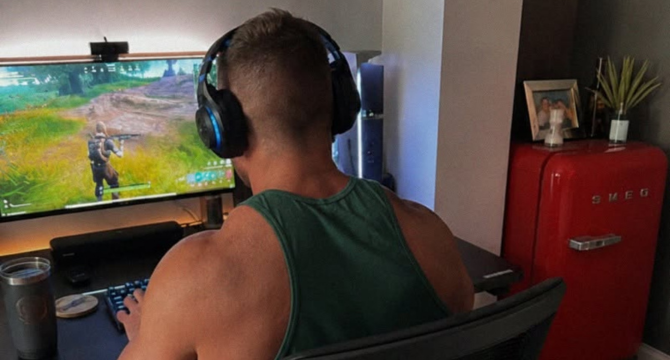
Let me tell you about the gaming room first, because it matters to understanding everything else.
Jake had been talking about converting our spare bedroom for almost two years before he actually did it.
He wanted a dedicated space, somewhere he could set up his PC properly, get good lighting for the monitor, and not feel like he was taking over the living room.
I had resisted longer than I probably needed to, because the spare room was also where I kept my sewing things and a treadmill I used approximately four times a year.
The idea of losing that space felt like a bigger deal than it actually was.
Eventually, I said fine, mostly because he had been so patient about asking, and because the sewing machine could go in the bedroom closet and the treadmill could go in the garage, where it would be equally ignored.
He converted the room over one weekend with an enthusiasm I found genuinely endearing. He kept himself busy with the new desk, monitor arms, cable management that he spent three hours perfecting, and LED lighting that I teased him about mercilessly.
“You’re 34 years old,” I told him, standing in the doorway while he adjusted the color of the lights with his phone. “You have mood lighting for your video games.”
“Atmosphere is important,” he said, without looking up.
“You sound like a 14-year-old.”
“A very comfortable 14-year-old,” he said, and grinned at me over his shoulder.
Jake had that easy, deflecting humor that made it impossible to stay annoyed at him for long. We had been married for eight years, and I still found it disarming, which I suspected was entirely intentional on his part.
The mini fridge conversation started about two months after the room was finished.
He mentioned it casually one evening, the way he mentioned most things he had already decided to do.
“I’m thinking about getting a mini fridge for the gaming room,” he said.
I looked up from my book. “For what?”
“Energy drinks and protein shakes. I do my meal prep on Sundays anyway. I could just keep a few containers in there so I’m not going back and forth to the kitchen during long sessions.”
“Jake,” I said. “We have a kitchen, and it’s just 20 feet away.”
“But I’d have to pause the game,” he said.
I stared at him for a moment. “That is the laziest thing you have ever said, and you once asked me to hand you the remote from two feet away.”
He laughed. “So that’s a yes?”
“That’s a you’re-buying-it-yourself,” I said, and went back to my book.
He bought it the following week.
It was a small, silver thing that fit neatly under the right side of his desk, humming quietly alongside the rest of his setup.
I saw it when I brought him tea one evening, and I shook my head at it with the fond exasperation that had become my default mode for the gaming room generally.
“Happy now?” I said, setting the mug on his desk.
“Extremely,” he said, not taking his eyes off the screen.
“You’re a child,” I said.
“You married me,” he said.
I left him to it.
Looking back now, I can identify the moment things started shifting. It didn’t happen dramatically. There was no single day when Jake became a different person.
It was more like a gradual dimming, so slow that I kept explaining it away before I had accumulated enough evidence to see the pattern.
He started going to bed earlier.
Jake had always been a night person, happy to stay up until one or two in the morning on weekends, and he began turning in at ten, sometimes 9:30 p.m., which I attributed to a busier period at work.
He lost his appetite in small ways.
He still used to eat and still cooked on weekends like he always did, but I noticed him leaving food on his plate more often, pushing things around rather than finishing them.
I asked once if the chicken was okay, and he said, “Yes, I’m just not very hungry.”
I believed him.
Besides that, he was in the gaming room more than usual. Long sessions, sometimes entire evenings, and I assumed he had found a new game he was absorbed in because that happened periodically, and I had learned not to take it personally.
And then there were the business trips.
Jake worked in software sales, which had always involved some travel — client visits, conferences, and quarterly meetings in the regional office four hours away. Travel was normal.
But in the five months before everything came apart, the trips had become more frequent and less predictable. A Tuesday to Thursday here, a four-day stretch there, once a full week that he said was a major client situation that needed his personal attention.
“You’re traveling more than usual,” I said one evening.
He had just mentioned another upcoming trip.
“It’s a busy quarter,” he said. He was doing something on his phone and didn’t look up immediately. “The Henderson account is taking a lot of hand-holding right now.”
“You look tired,” I said.
He did look up then, and he smiled at me in the way that I would think about later, after I knew everything.
A smile that was real and also working slightly too hard.
“I’m fine,” he said. “Just a lot on my plate. It’ll settle down.”
I accepted this. I don’t say that with guilt exactly, because I had no concrete reason not to, but I accepted it because it was easier than pressing and because Jake had always been honest with me, and I had no framework yet for questioning that.
He left for another trip on a Monday morning, kissing me at the door with his travel bag over his shoulder, telling me he’d be back Thursday and to call if I needed anything.
I watched him walk to the car and thought he looked thinner than he had a few months ago. Then I went back inside and got on with my day.
I decided to deep-clean the house on Wednesday.
Jake would be home the following day, and I liked the idea of him returning to everything fresh and ordered — it was a small thing, but I found I expressed care in practical ways, and this was one of them.
I worked through the house systematically. Kitchen, bathrooms, living room, bedroom. By mid-afternoon, I got to the gaming room, where I vacuumed carefully around the desk setup and straightened the few things on the shelves without disturbing anything that looked important.
Jake had a specific order to his things in there, and I respected it.
Then I noticed the mini fridge.
He had been gone for several days, and it occurred to me that if he had left any meal prep containers inside, the food might have spoiled by now.
I didn’t want him coming home to something unpleasant. And I thought I might restock it with drinks before he got back, a small welcome-home gesture.
So, I crouched down and opened the door.
There was no food inside. No energy drinks. No protein shakes, no meal prep containers, nothing I had expected to find.
There was nothing that Jake had said he’d put in there.
What was there, arranged with a neatness that seemed deliberate, was a collection of things I needed several seconds to process.
There were medication boxes, two of them, with Jake’s name on the prescription labels and dosage instructions I didn’t recognize. Then there was a small zip case containing syringes.
I also found cooling packs of the kind used to keep temperature-sensitive medications stable. And tucked into the door shelf, folded but visible, was a document on the letterhead of a medical facility — a treatment center located, I registered with a cold, specific shock, in the same city Jake traveled to most frequently for work.
I sat back on my heels and looked at the inside of that fridge for a long time.
Then I went to the kitchen table and sat there for considerably longer.
I am not proud of the two days that followed, though I understand why I did what I did.
I went through our financial records, which I had access to through our shared account.
I found charges at the medical facility going back almost five months. I found prescription refill charges, parking fees at a hospital I recognized, and a hotel that I cross-referenced against his trip dates and confirmed was in the right city.
I called a woman from his company, Diane, whom I had met at a work event the previous year, and had her number from a group text about a gift for a colleague’s birthday.
I kept it casual, asking if she knew whether Jake was going to make it to some fictional upcoming event that I’d come up with.
Diane paused for a moment and then said that Jake hadn’t actually been traveling for work in quite some time.
That his territory had been reassigned a few months back to reduce his load.
I thanked her and hung up.
Then, I sat at the kitchen table, trying to process it all.
No work trips. Five months of medical facility charges. Medication in a fridge he had specifically purchased and specifically told me was for protein shakes.
I did not sleep well on Wednesday night.
I lay in our bed and went through every possible explanation, looking for the one that fit all the evidence, and by Thursday morning, I had landed somewhere I did not want to be but couldn’t argue myself out of.
Jake was seriously ill, and he had not told me.
He came home at four in the afternoon.
When I heard his key in the lock, I was already sitting at the kitchen table, and I had placed the medication boxes and the folded document from the fridge in front of me.
I had decided I was not going to have this conversation around them as though they didn’t exist.
He came into the kitchen with his bag and stopped when he saw me.
His eyes went to the table.
At that point, his expression completely changed.
He set his bag down slowly.
“Hey,” he said, and his voice came out quiet.
“Hey,” I said. “Sit down, Jake.”
He sat across from me.
He looked at the medication boxes, the document, and then at my face. He didn’t say anything immediately.
“These were in the fridge,” I said.
“I know,” he whispered, unable to meet my gaze.
“I called Diane,” I told him. “She told me you haven’t been traveling for work in months.”
He closed his eyes briefly.
“Jake.” My voice broke on his name, just slightly, and I pressed on. “What is going on? And please, please just tell me the truth.”
He looked at his hands on the table.
For a long moment, he didn’t speak. I watched him and felt the silence as something physical.
“I’m sick,” he said. “I’ve been sick since March.”
March was five months ago.
“What kind of sick?” I asked.
He told me.
It took a while, and he told it haltingly, in the way of someone who has been holding something tightly for so long that releasing it doesn’t come easily even when they’ve decided to release it.
It had started with a diagnosis in early spring. The condition required ongoing treatment at a specialist center four hours away.
The prognosis was manageable, but only if he continued treatment. He chose that word carefully and watched my face as he said it.
He wasn’t dying. But the treatment was serious.
Looking back, I realized the past five months had been much harder on him than I understood at the time.
“Why didn’t you tell me?” I said.
“Because you were already dealing with so much,” he said. “Your mom’s health stuff in April, the project at work, and I just—” He stopped. “Every time I came home from a session, and I saw your face, I thought, I’ll tell her next time. I’ll tell her when I know more. I’ll tell her when I have better news to give alongside the bad.”
“Jake,” I said.
“I know,” he said. “I know it was wrong. I know that now more clearly than I can explain to you.” He looked at me with an exhaustion that was not just physical. “I kept telling myself I was protecting you. But I think somewhere in there I was also just terrified, and it was easier to be terrified alone in the gaming room than to say it out loud and make it fully real.”
I looked at the mini fridge document.
“The gaming room…” I said.
“I needed somewhere to keep the medication cold that you wouldn’t open,” he said. “You never came in there much. I thought—” He stopped. “It was stupid. All of it was stupid. I convinced myself I was managing it.”
“You were managing it alone,” I said. “For five months.”
“Yes.”
I stood up from the table, and he looked up at me with uncertainty. He didn’t know how I’d react.
I walked around the table and put my arms around him. I held on, and after a moment, he put his face against my shoulder, and I felt him exhale in a way that sounded like something releasing after a very long time of being held.
We stayed like that for a while.
“You don’t have to do this alone anymore,” I said into his hair. “Do you understand me? Not one more appointment, not one more treatment, not one more scared night in the gaming room. I’m coming with you.”
He didn’t answer immediately. Then he said, “Okay.”
“I mean it, Jake.”
“I know you do,” he said. “That’s why I should have told you in March.”
I went with him to his next appointment the following Tuesday.
I sat in the waiting room while he was in with the treatment team.
Then, I met his doctor and asked the questions I had been accumulating for five months in the absence of knowing there were questions to ask.
The prognosis was what he had said — manageable. The treatment was working. There was a clear path forward that required continued effort and monitoring, but did not lead somewhere we couldn’t come back from.
On the way home, he fell asleep in the passenger seat about 20 minutes into the drive. It felt like his body had been running on anxiety for months and had finally been permitted to rest.
He looked like a baby sleeping in the car.
I drove the remaining three hours in the quiet and thought about a mini fridge humming under a gaming desk, and a man sitting in mood lighting, trying to carry something that was always too heavy to carry alone.
I thought about how love sometimes looks like protein shakes, energy drinks, and a door you can close, because the person inside it is trying to protect you from something that frightens them more than it frightens you.
And I thought about how it looks, after all of that, when you finally open the door.

 admin
admin