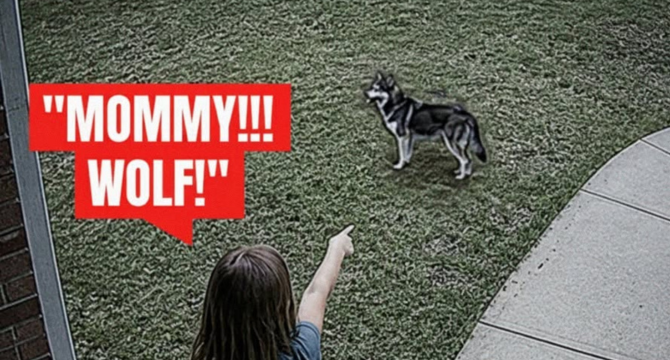
I was slicing apples for my daughter’s lunch when something moved at the edge of the yard.
At first, I thought it was a dog, then it stepped out of the trees.
And I realized I was looking at a wolf.
For a second, my brain refused to process what I was seeing.
We lived near the woods, but wolves usually stayed far away from houses.
My daughter was only 20 feet away.
I dropped the knife and ran outside. “Sweetie, come stand by me,” I said, trying not to sound afraid.
The wolf looked at neither of us.
Instead, it walked directly toward me.
I froze.
The animal was old. Much older than any wolf I’d ever seen in pictures. Its gray fur was patchy, and it moved with a noticeable limp.
Then it did something I’ll never forget.
It pressed its head gently against my leg.
Not hard.
Just enough to get my attention.
A low whine escaped its throat.
The sound wasn’t threatening. It sounded desperate.
It simply stood there, looking up at me, waiting. I remember glancing toward my daughter, then back at the wolf. That’s when it turned around and walked several yards toward the forest before stopping.
Then it looked back at me.
Waiting again.
My stomach tightened. This did not seem like a lost or wandering animal; it wanted me to follow. Every rational part of my brain told me not to move.
Instead, I called out to my husband, who’d been working in the shed.
“Can you come to the back now?” I asked.
“What happened?”
“There’s a wolf in our yard.”
Silence.
Then:
“A wolf?”
“And I know this sounds crazy, but I think it’s trying to lead me somewhere.”
Even saying the words felt ridiculous.
But three minutes later, after my husband came around the back and promised to stay with our daughter, I found myself standing at the edge of the woods.
The wolf was still there.
Waiting.
The moment I stepped beneath the trees, it started walking. It led me deeper into the forest than I ever would have gone on my own.
At first, I kept expecting it to stop.
It didn’t.
The trees grew thicker around us.
Sunlight filtered through the branches in scattered patches, and the sounds from the road disappeared completely.
Several times, I nearly turned back.
Each time, the wolf stopped ahead of me and looked over its shoulder as if checking whether I was still there.
Twenty minutes later, it finally halted.
We had reached a massive oak tree. Its trunk was so wide that three people probably couldn’t have wrapped their arms around it. The wolf walked to the base of the tree and sat down.
Then it whined.
I looked around, confused.
There was nothing there. At least, that’s what I thought.
Then I noticed disturbed soil near one of the roots. A small section of earth looked darker than the rest, like it had been recently dug.
My pulse quickened.
I crouched down and brushed away a layer of leaves, exposing something metallic beneath the dirt.
For a moment, I just stared, then I started digging.
Within minutes, I uncovered a rusted metal box.
The wolf never moved, simply watching.
The box was surprisingly heavy.
Its latch had nearly rusted shut, but after several attempts, I managed to force it open. Inside were several items wrapped carefully in plastic. A photograph, a small notebook, and an envelope.
My hands shook as I opened the envelope first.
There was only a single sheet of paper inside.
One sentence, six words.
If you’re reading this, he never told you.
I read it twice.
Then a third time.
It made absolutely no sense.
Who never told me?
Told me what?
I looked around the empty forest as though someone might suddenly appear and explain.
Nobody did.
The wolf stood up, another soft whine escaping its throat.
Then it started walking again.
I almost stayed behind to examine the rest of the box. Instead, something made me slip the photograph, notebook, and letter into my jacket.
The wolf hadn’t brought me all this way just to find a buried box. Of that much, I was suddenly certain.
Whatever it wanted me to see was still ahead.
Ten minutes later, I caught my first glimpse of the cabin, and the moment I saw it, I realized somebody had been living out here.
Recently.
Smoke was rising from the chimney, but something felt wrong. The front door was standing open, one hinge broken.
I stopped several yards from the cabin.
Every horror movie I’d ever seen suddenly felt relevant.
The wolf walked straight toward it, and my heart couldn’t stop pounding in my chest.
“Hello?” I called.
No answer.
The only sound was the wind moving through the trees.
The wolf disappeared inside.
I hesitated, then stepped onto the porch.
The wood creaked beneath my feet.
“Hello?” I called again.
Still nothing. I pushed the door wider.
The cabin was small, one room. A wood stove stood on a charred table in one corner, and bookshelves lined up one half of a wall.
A narrow bed stood in the corner.
And lying on the bed was an elderly man.
For one terrible moment, I thought he was dead. Then his chest moved.
Barely.
I rushed forward.
“Sir?”
His eyes opened slowly. They were a cloudy blue, and the moment they landed on me, his expression changed.
Shock.
He did not seem confused or afraid. What I read on his face was recognition.
Actual recognition.
His lips parted. “You…”
The word came out as little more than a whisper.
I quickly knelt beside him.
“Can you hear me?”
His gaze never left my face.
Then he said something that made every hair on my arms stand up.
“You have her eyes.”
I blinked.
“What?”
The old man swallowed painfully.
The wolf had moved beside the bed now, resting its head against his arm.
“You have her eyes,” he repeated.
I had never seen this man before in my life, yet he was looking at me as though he knew exactly who I was.
“Who are you?” I asked.
His gaze shifted toward the photograph sticking out of my jacket pocket.
Immediately, something changed in his expression. Resignation, as if he had always known this day would come.
“You found it.”
“What is that box?” I asked.
No answer.
Instead, he struggled to sit up.
I helped him, noticing the violet tremble in his hands.
“How long?” he asked.
I frowned.
“How long what?”
“How long has it been?”
The question made no sense.
Then he looked directly into my eyes.
“Since Thomas died.”
The name hit me like a punch.
Thomas.
My grandfather.
The grandfather I had spent my entire life hearing about, the grandfather who supposedly abandoned his wife and children and vanished, the grandfather nobody ever spoke about unless it was with anger.
I slowly stood.
“How do you know that name?”
The old man’s face went pale, then he whispered:
“Oh, God.”
It was not the reaction of a man remembering an old friend; it seemed more like a man realizing something was terribly wrong.
“What?” I demanded.
“What is it?”
His eyes filled with something that looked disturbingly close to guilt.
Then he said:
“He never knew.”
I stared.
“Never knew what?”
The old man looked toward the wolf, then back at me, and what he said next shattered everything I thought I knew about my family.
“Thomas spent forty years trying to find you.”
I laughed. The claim was impossible.
“No.”
The old man closed his eyes.
“Then they never told you either.”
Before I could ask another question, his entire body suddenly went limp.
He collapsed sideways onto the bed.
And that’s when I noticed something sticking out from beneath his pillow. A second photograph, one that should not have existed.
Because standing beside my grandfather was my mother.
The photograph slipped from my fingers onto the floor.
I picked it up again immediately.
My hands were shaking. I tried to make sense of it, but there was no mistake; the woman standing beside my grandfather was my mother.
She appeared to be in her twenties and was smiling.
Standing shoulder-to-shoulder with the man I’d been told disappeared before I was even born.
I flipped the photograph over.
A date was written on the back.
The picture had been taken 12 years after my grandfather supposedly abandoned the family.
I looked toward the old man, but he wasn’t moving. Panic surged through me, and I quickly grabbed my phone and called emergency services.
As I spoke, my eyes kept drifting back to the photograph.
Nothing about it made sense.
My entire life, I’d heard the same story.
Thomas left.
Thomas disappeared.
Thomas abandoned everyone.
That story had never changed.
Not once.
Yet somehow my mother had been standing beside him years later, smiling as if nothing had happened.
By the time paramedics finally arrived, I had developed a pounding headache.
The old man was still alive, but barely.
They rushed him to the hospital.
I rode behind the ambulance with more questions than answers. And sitting in my lap was the notebook from the metal box.
I didn’t open it until we reached the hospital. If I’m being honest, part of me was afraid to, but part of me already knew that whatever was inside would change everything.
Hours later, while doctors worked to stabilize the old man, I sat alone in a waiting room and opened the first page.
The handwriting was neat.
Careful.
The first entry was dated 31 years earlier.
My eyes immediately landed on a name.
Thomas.
My grandfather.
I started reading.
The notebook wasn’t a diary. It was a record. Page after page documented phone calls, letters, visits, and attempts.
Every entry described another effort by my grandfather to contact his family.
Near the front of the notebook, one sentence had been underlined twice.
“If anyone from my family ever comes looking, tell them everything.”
Beneath it, Arthur had written:
“I promised I wouldn’t interfere unless they came on their own.”
Then I found a copied letter my grandfather had written shortly after my mother turned eighteen. I unfolded the paper, which was yellow with age.
The words blurred as tears filled my eyes.
Not because the letter was emotional.
Because it was hopeful.
Painfully hopeful.
He wrote about birthdays he had missed, graduations he wished he could attend, children he hoped to meet someday, and at the end was a single sentence.
“Please tell her I never stopped trying.”
I lowered the letter.
My mother had told me he vanished.
This letter proved he hadn’t.
My phone buzzed.
The caller ID showed my mother’s name.
I answered.
“Mom.”
Silence.
Heavy breathing.
Then:
“Did Arthur give you the box?”
Every muscle in my body went rigid.
Slowly, I sat forward.
“How do you know about Arthur?”
Silence again.
Longer this time.
Then my mother whispered something that changed the entire story.
“Because I burned the others.”
I barely remember the drive to my mother’s house.
The entire way there, one question kept repeating in my head.
Why?
Not whether she lied.
The notebook proved she had.
Not whether she’d met my grandfather.
The photograph proved that too.
The question was why.
Why would someone spend decades hiding the truth?
By the time I pulled into her driveway, it was dark.
The lights were on inside, and she was waiting.
I found her sitting alone at the kitchen table.
No television.
No music.
No distractions.
Just a woman staring at a cup of coffee that had long since gone cold.
For the first time in my life, I saw how nervous she looked. I placed the photograph on the table.
A flicker of recognition, then she closed her eyes.
She knew exactly which photograph it was.
“Tell me,” I said.
My voice sounded calmer than I felt.
She stared at the picture for a long moment.
Then she surprised me when she started crying. It was not some dramatic sobbing.
Just silent tears. The kind people cry when they’re exhausted from carrying something too heavy for too long.
“I hated him,” she whispered.
I frowned.
“Then why were you smiling in that picture?”
She looked away.
No answer.
I pulled the notebook from my bag. Then the letter, then several photographs. Each piece of evidence landed on the table between us.
A life, buried for decades.
Her eyes filled with fresh tears.
“He never stopped trying,” I said.
The words came out harsher than I intended.
“He wrote letters.”
Silence.
“He called.”
More silence.
“He wanted to see us.”
My mother finally looked up.
And what she said next was not what I expected.
“He wanted to see you.”
Not us.
You.
The distinction hit me immediately.
“What does that mean?”
My mother swallowed.
She couldn’t seem to form the words. Then she stood and walked toward a cabinet. From the very back of a shelf, she removed a small wooden box.
It was old, worn, protected.
She carried it to the table.
My pulse quickened. “What’s in that?”
She sat down and slowly opened the lid. Inside were dozens of letters, all addressed to me.
I stared.
My name appeared again and again on the envelopes. Some were written before I started school, some during high school, and some only a few years old.
I couldn’t breathe.
“These…”
My voice cracked.
“These are from Grandpa?”
She nodded.
Every letter was unopened. Every single one.
“You kept them?”
Tears rolled down her cheeks.
“I couldn’t let him back in.”
I stared at her. “Why?”
The answer came immediately.
Too quickly.
As if she’d rehearsed it a thousand times.
“Because he abandoned us.”
“But he didn’t.”
I pointed at the notebook.
“The evidence says he didn’t.”
For the first time all evening, my mother became angry. Not defensive, terrified. A different emotion entirely.
“No,” she said.
“You don’t understand.”
I leaned forward.
“Then help me understand.”
My mother looked down at the letters, then at the photograph, then finally at me.
And when she spoke, the final piece of the puzzle shifted again.
Because, according to her, my grandfather hadn’t abandoned the family. But neither had he been the victim.
“He did something,” she whispered.
I waited.
For the first time all evening, she looked older.
“When my mother got sick, he left.”
I frowned.
“He abandoned you?”
She shook her head.
“Not exactly.”
Her eyes filled with tears.
“That’s what makes it so hard.”
She stared at the photograph.
“He said he needed time. He said he’d come back after things cooled down.”
Her voice cracked.
“Then weeks became months, months became years, and eventually I stopped believing him.”
The room fell silent.
“Did he ever come back?”
My mother looked at the box.
“That’s the problem.”
Slowly, she lifted the oldest letter.
“He tried.”
For years, I had believed this man walked away from his family without looking back. Now I was holding a letter he had written decades ago, anticipating that one day someone might finally learn the truth.
My mother didn’t try to stop me.
She just sat there.
Exhausted.
Defeated.
As though she had known this moment would eventually come.
I carefully broke the seal.
The paper inside crackled as I unfolded it.
The first line immediately caught my attention.
“If you are reading this, then Arthur kept his promise.”
I frowned.
Arthur.
The old man from the cabin.
The wolf’s owner.
The man now lying in a hospital bed.
I continued reading.
“Arthur promised me he would protect these records until the day someone in our family was finally willing to hear the truth.”
A chill ran through me.
The entire thing had been planned.
Not recently.
Decades ago.
“Years ago, I left after a brutal argument with my wife. I thought distance would protect everyone from more damage. By the time I realized leaving had become its own wound, Emily had turned my absence into proof that I never loved her.”
I read the final page three times, then I set the letter down.
The room was completely silent.
My mother sat across from me, staring at the table.
For the first time all night, I wasn’t angry.
I was confused.
Deeply confused.
Slowly, I reached toward the wooden box, toward the dozens of letters she had hidden for years.
“You burned the photographs,” I said quietly.
My mother nodded.
“You lied to everyone.”
Another nod.
I looked at the stack of envelopes.
“Then why keep these?”
For a long moment, she didn’t answer. And when she finally spoke, her voice was barely above a whisper.
“Because I couldn’t throw them away.”
That answer hit me harder than I expected.
It wasn’t an explanation, but rather a confession.
I picked up one of the envelopes; the postmark was nearly thirty years old.
“You never opened these?”
She shook her head.
“No.”
“Not one?”
“No.”
I stared at her.
“Why?”
Tears filled her eyes again. Because beneath all the anger, all the secrets, all the years of silence, she suddenly looked like a little girl.
A little girl who had been hurt.
“I was afraid.”
The words hung between us.
My mother wiped at her eyes. “When he disappeared, nobody explained anything.”
Her voice trembled.
“I waited every day.”
I said nothing.
“I thought he would come back.”
She swallowed.
“Then weeks became months.”
Another tear rolled down her cheek.
“Then years.”
“He missed birthdays.”
She laughed bitterly.
“Graduations.”
More silence.
“And eventually I stopped being sad.”
She looked down at the letters.
“I became angry.”
“What happened when he finally contacted you?” I asked.
My mother stared at one particular envelope.
“He didn’t.”
I frowned.
She pointed.
“The first letter arrived when I was 23.”
I looked at the date.
She was right.
“I remember holding it.”
Her voice cracked.
“I remember staring at his name.”
Then she whispered:
“And I was terrified that if I opened it, I’d find out he had a good reason.”
My mother closed her eyes.
“Because then I’d have to let go of 30 years of anger.”
Then my mother reached into the box and carefully removed the oldest letter.
She handed it to me.
“Open it.”
I looked at her.
She managed a small, broken smile.
“I think somebody should.”
For a moment, I couldn’t move.
The letter felt strangely heavy in my hands.
Not because of the paper.
Because of everything it represented. Thirty years of silence, of assumptions, of pain, all folded into a single envelope.
My mother watched quietly as I slid my finger beneath the seal. The paper crackled softly.
Then I unfolded the letter.
The first line made my chest tighten.
“Dear Emily,”
It was my mother’s name.
Not mine.
Not Grandma’s.
My mother’s.
I kept reading.
“I don’t know if you’ll ever read this. I don’t know if you’ll throw it away before opening it. Truthfully, I wouldn’t blame you if you did.”
I glanced up.
My mother was staring at the floor.
I returned to the page.
“There are a thousand things I want to explain, but I suspect explanations are the one thing you’re tired of hearing. So instead, I’ll tell you the truth.”
I stopped breathing.
The next sentence was only six words long.
“I should have come back sooner.”
Not “I was forced away.” Not “It wasn’t my fault.” Not “I was innocent.”
“I should have come back sooner.”
By the time I reached the final page, tears were running down my face.
The final paragraph was short.
“If you never want to see me again, I will understand. But if there is even the smallest part of you that still remembers the father who taught you how to ride a bicycle, I’ll be here.”
“Waiting.”
“Always waiting.”
I lowered the letter.
My mother was crying now. The way people cry when they finally stop carrying something.
For several minutes, neither of us spoke.
My grandfather was gone, and there would never be another chance.
Then my mother surprised me. She reached for the box and pulled another letter free.
Then another.
And another.
She placed them in front of me.
“Read them.”
I looked up.
“What?”
Her eyes were red.
Exhausted.
But somehow lighter than they had been all evening.
“Read all of them.”
A small smile appeared.
The first genuine smile I’d seen from her that night.
“I think we’ve wasted enough time.”
Three days later, the old man from the cabin finally woke up.
Arthur.
The wolf was lying beside his hospital bed when I walked into the room.
The moment he saw me, he knew. His eyes filled with tears.
Slowly, he nodded.
The wolf lifted its head, its cloudy eyes moving between us.
Then, unexpectedly, Arthur reached down and rested a trembling hand on its neck.
“He almost didn’t make it.”
I looked at the wolf.
“What do you mean?”
A faint smile appeared on Arthur’s face.
“For three days, he wouldn’t leave the house.”
I frowned.
Arthur gently scratched behind the wolf’s ear.
“The morning after Thomas died, I buried the box where nobody would find it by accident.”
His eyes drifted toward the window.
“I thought that was the end of it.”
The wolf let out a soft sigh.
“But every day after that, he’d go sit beside the oak tree.”
I felt a chill.
Arthur smiled sadly.
“Hours at a time.”
Neither of us spoke.
“After a while, I started thinking he was guarding it.”
The wolf’s ears twitched.
Arthur looked at me.
“Then a few weeks ago, he stopped going to the tree.”
I frowned.
“Why?”
Arthur’s smile grew.
“He started going toward your road instead. I think he got tired of waiting.”
For a moment, neither of us spoke.
Then I smiled.
“You were right.”
Arthur’s eyes filled with tears.
Slowly, he nodded.
A week later, my mother and I returned to the forest.
The old oak tree stood exactly where it always had.
Silent.
Ancient.
Watching.
We buried the metal box beneath its roots once more.
Not because we wanted to hide the truth, but because some things no longer needed protecting.
On the drive home, my daughter sat in the back seat asking questions about the family she’d never known. Questions I finally had answers for. And as I listened to her, I realized something.
The wolf hadn’t led me into the forest to change the past.
The past couldn’t be changed.
It led me there so the past would finally stop controlling the future. And if that old wolf hadn’t walked into my yard that afternoon, an entire family’s story might have disappeared forever.
Instead, it found its way home.

 admin
admin