I was absolutely furious.
Not the kind of furious where you huff under your breath and complain on the ride home. I mean the kind of furious that makes your hands shake before your brain can catch up.
My nine-year-old son, Leo, had been counting down the days to this game for six months.
Six months.
He had circled the date on the calendar in red marker. He had asked Ethan every Sunday, “How many more days now?” He had watched old highlights at the kitchen table while eating cereal. He had practiced catching with his oversized glove in the backyard until the sun went down and the mosquitoes came out.
That game was all he talked about.
So when the day finally came, I wanted it to be perfect.
Leo woke up before 7 a.m. and came bursting into our bedroom wearing his favorite jersey over his pajamas.
“Mom,” he whispered loudly, which was his version of being quiet. “It’s game day.”
Ethan, my husband, groaned into his pillow. He was 36 years old and could sleep through a thunderstorm, but not through our son’s excitement.
I rolled over and smiled at Leo. “I know, baby.”
He held up his glove like it was sacred. “Do you think I’ll catch a ball?”
Ethan lifted his head, hair sticking up in every direction. “With that glove? The ball would be foolish not to land in it.”
Leo grinned so wide that one of his missing teeth showed.
I remember thinking, right then, that I wished I could bottle that happiness. Leo had always been sensitive. Sweet, hopeful, and eager to believe the best in everything.
He noticed when people were sad. He thanked waiters before I reminded him. He still kissed me on the cheek in public, even though he was beginning to act embarrassed about it afterward.
That morning, he was pure joy.
By noon, we were headed to the stadium.
Leo wore his favorite jersey, brought his oversized glove, and spent the entire afternoon staring at the field, praying a ball would come our way.
He barely touched his hot dog. He barely blinked.
Every time a ball flew into the stands, he shot to his feet.
“Almost!” Ethan said after one sailed three sections over.
Leo slumped back into his seat, then lifted his chin again. “Next one.”
I leaned closer to Ethan. “He’s going to be heartbroken if nothing comes near us.”
Ethan squeezed my hand. “Then we’ll buy him a foam finger and tell him it’s basically the same thing.”
I gave him a look.
He smiled. “Fine. Bad plan.”
The stadium was packed and loud, the kind of loud that rattled in your chest. Fans shouted, clapped, groaned, laughed, spilled popcorn, and waved signs.
The air smelled like nachos, sunscreen, and grass. Everywhere around us, people were wrapped up in the game, but I was mostly watching Leo.
His little face changed with every play.
Hope.
Shock.
Disappointment.
Hope again.
By the fourth quarter, the score was close enough that the whole stadium felt tense. Ethan leaned forward with his elbows on his knees. Leo stood whenever anyone else stood, even if he didn’t fully understand why.
Then it happened.
During the fourth quarter, a massive field goal kick went wide, spiraling directly toward our section.
For one strange second, everything seemed to slow down.
The ball rose high against the bright afternoon sky, turning and turning as thousands of eyes followed it. People started screaming before it even came close. Arms lifted all around us. A man two rows down jumped. Someone behind me yelled, “Heads up!”
The crowd erupted.
Leo leaped up, his arms outstretched, and miraculously, the ball fell straight into his hands.
Not near him.
Not beside him.
Straight into his hands.
For a second, he froze like he couldn’t believe his body had actually done it. Then he pulled the ball against his chest.
He was beaming, hugging it to his chest like it was made of solid gold.
“Mom!” he screamed.
I gasped so hard I nearly choked.
Ethan shouted, “You caught it! Leo, you caught it!”
People around us cheered. A teenager in front of us clapped him on the shoulder. A woman behind me said, “That is so sweet.”
Leo looked at the ball, then at us, then back at the ball. I saw his whole world light up in his face.
He had waited six months for this moment.
And somehow, impossibly, it had happened.
But his joy lasted exactly three seconds.
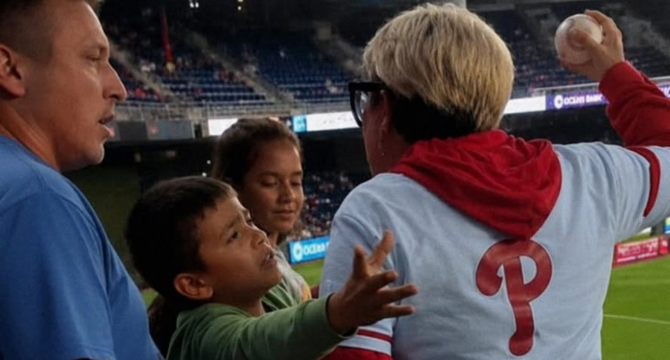
Out of nowhere, a GROWN WOMAN in a faded team hoodie lunged across the aisle.
At first, I thought she had tripped. Her movement was so sudden and strange that my mind could not make sense of it. Then her hands closed around the other side of the ball.
She grabbed the other side of the ball, pulling it with immense force.
Leo stumbled, refusing to let go, his eyes wide with fear and confusion.
My heart dropped.
For one second, I didn’t move. I just stared, unable to process what I was seeing.
This woman was around 40 years old.
Old enough to know better.
Old enough to have watched a child catch something special and clap like everyone else. Her hair was tucked messily under a cap, and her face was tight with a kind of panic that made her look almost wild.
But none of that mattered to me in that moment.
She was pulling on a football my son had caught with his own hands.
Leo’s knuckles went white around the leather.
“Mom?” he cried.
That sound snapped me awake.
I COULDN’T BELIEVE what I was seeing. A grown adult was actively engaged in a physical tug-of-war with a child over a souvenir.
Ethan shot up beside me.
His face was red with anger. “What do you think you’re doing?” he barked, his voice carrying over the roaring stadium.
The woman did not answer. She only pulled harder.
Leo’s shoulder jerked forward.
That was when the anger truly hit me.
Not irritation. Not embarrassment. Anger.
The kind that starts in your stomach and burns all the way up your throat.
The surrounding fans noticed and immediately started booing her.
“Let the kid have it!” a man shouted.
“What’s wrong with you?” someone else yelled.
A young woman across the aisle lifted her phone. “Are you serious right now?”
The woman’s eyes flicked around for half a second, but she still did not let go.
I stepped in, my hands trembling with rage.
“Are you seriously fighting a child over a football?” I snapped, staring her down. “Let go of my son’s ball right now!”
Leo looked terrified.
Ethan moved closer, one arm half extended like he was ready to pull Leo back but afraid of hurting him if the woman yanked again.
“Lady,” Ethan warned, his voice lower now, “you need to let go.”
The woman’s jaw trembled.
For the first time, I noticed her eyes were wet.
But I was too angry to care.
All I saw was my son’s fear.
All I saw was his perfect moment being ripped out of his hands by someone who should have known better.
Then the woman stopped pulling.
The sudden stillness was almost worse than the struggle.
Her fingers loosened slightly on the ball, but she did not release it.
The boos around us faded into a tense murmur.
She looked at Leo, then at Ethan, then finally at me.
There was something in her expression I couldn’t name. It wasn’t entitlement. It wasn’t greed. It wasn’t even shame.
It was desperation.
Then she looked me straight in the eyes and uttered five words that made the entire section fall silent.
“It’s for my son, please.”
The words were so soft I almost missed them.
For a moment, nobody moved. The woman’s hands were still on the ball, but her grip had gone loose. Leo stared at her with tears gathering in his eyes. Ethan kept one hand on our son’s shoulder, his face still tense, still protective.
I swallowed hard. “What?”
The woman blinked quickly, like she was fighting to keep herself from falling apart in front of all of us.
“It’s for my son,” she repeated. “Please. His name is Tyler. He’s 11 years old.”
The anger inside me did not disappear all at once.
It stayed there, hot and sharp, because my child had been frightened. But something in her voice changed the air around us.
I looked at Leo’s small hands wrapped around the football. Then I looked at hers.
“Then why are you grabbing it from my son?” I asked, quieter now.
Her face crumpled.
“I know,” she said. “I know how it looks. I’m sorry. I’m so sorry. I just saw it coming, and I panicked.”
Around us, people leaned closer, listening.
She finally let go of the ball completely.
Leo pulled it tight against his chest and stepped back into Ethan’s side.
The woman pressed both hands over her mouth.
“Tyler is in the hospital. He’s critically ill. He loves this team more than anything. For years, he collected balls from professional games. Whenever I could, I brought him to games. The staff here knew him. They would help us with seats, with access, with everything, because sometimes he couldn’t walk far.”
Her voice shook badly.
“But now he can’t come anymore. His condition has gotten too severe. The doctors don’t know how much time he has left.”
The whole section went silent.
Not polite quiet. Not awkward quiet.
A heavy silence.
The kind that made you hear the wind moving through the stadium.
She looked at Leo then, and shame filled her face.
“I didn’t mean to scare you, honey. I swear I didn’t.”
Leo didn’t answer. He only looked at me.
That look broke something in me.
Because I knew what he was asking without saying it.
“Mom, what do we do now?”
The woman wiped her cheek with the sleeve of her faded team hoodie. “Bringing home pieces of the game is one of the few things that still makes him smile. I came today hoping I could catch a ball for him. Just one. I wanted to put it in his hands tonight and tell him he was here with me.”
Ethan exhaled slowly beside me.
I felt my rage turn into something else.
Not forgiveness, not yet, but understanding. A painful, human kind of understanding that left no room for the easy version of the story I had believed three minutes earlier.
She was not some heartless woman stealing from a child.
She was a desperate mother.
And I was a mother too.
Before I could speak, the crowd reacted again, but this time it wasn’t with anger.
It started with murmurs.
Then clapping.
Then a man behind us shouted, “Someone get her a ball!”
That was when I noticed the giant video board.
My stomach dropped.
Our entire confrontation had been shown on the stadium’s giant screen.
At first, it had probably looked like exactly what I thought it was: a grown woman fighting a child over a ball. But someone must have caught enough of the sound or passed the story along, because within minutes, the announcer’s voice came over the speakers.
“Folks, we’re hearing there’s a special young fan named Tyler who couldn’t be with us today.”
The woman covered her face and started crying.
The stadium, which had been roaring moments earlier, grew still again.
The announcer continued, his voice softer. “Tyler, if you’re watching this later, your team is thinking of you tonight.”
I looked down at Leo.
His face had changed. He was still shaken, but his eyes had softened.
“Mom,” he whispered, “does her son really love the team?”
“I think he does,” I murmured.
Leo looked at the football in his hands.
For a second, I thought he might offer it to her.
Part of me would have been proud.
Part of me would have hurt for him, because I knew how much that ball meant to him too.
But before he could say anything, a stadium employee in a navy jacket came up the aisle.
“Ma’am?” he said gently to the woman. “Could you and your family come with me?”
She looked confused. “My family?”
He nodded toward us. “All of you.”
A few innings later, both families were invited onto the field.
I held Leo’s hand as we walked down the steps, my heart thudding with every cheer that rose around us. Ethan walked on Leo’s other side. The woman walked a little behind us, still wiping her eyes.
On the field, everything looked brighter and bigger. The grass was impossibly green. The players stood nearby, some with their gloves tucked under their arms, watching us with kind expressions.
A man from the team staff crouched in front of Leo.
“What’s your name, buddy?”
“Leo,” my son answered, still clutching the ball.
“Well, Leo,” the man said warmly, “that ball is yours. You caught it fair and square.”
Leo looked at me in surprise.
I smiled through the lump in my throat. “You did.”
The crowd cheered, and Leo’s shoulders relaxed for the first time since the woman had grabbed the ball.
Then the staff member turned to her.
“And you must be Tyler’s mom.”
She nodded, unable to speak.
He placed another official game ball into her hands.
“This one is for Tyler.”
She held it like it was something holy.
“Thank you,” she whispered. “Thank you so much.”
But the night was not done with us.
One of the players stepped forward with a microphone. I recognized him immediately because Leo had his poster in his room.
“We heard Tyler has been one of our biggest fans for years,” he said. “So we talked it over, and we’re not just sending a ball.”
The woman froze.
The player smiled. “We’re coming to see him.”
The stadium erupted.
She pressed the ball to her chest and sobbed.
He continued, “We’ll bring signed baseballs, jerseys, and memorabilia. We’ll take photos with him, hang out with him, and spend time with him. Tell Tyler his team is coming.”
I looked at Leo.
His eyes were wide, not with fear anymore, but wonder.
“Mom,” he whispered, “that’s better than a ball.”
I squeezed his hand. “Yes, baby. It is.”
The woman turned to us then. Her face was wet with tears.
“I’m sorry,” she said to Leo. “I should never have grabbed it. I scared you, and that was wrong.”
Leo looked down at his ball, then back at her.
“It’s okay,” he said quietly. “I hope Tyler likes his.”
She nodded, crying harder. “He will.”
By the end of the night, Leo left with the football he had caught, tucked safely in his arms. He talked about it all the way to the car, but he also talked about Tyler.
He asked if hospitals let kids watch games.
He asked if Tyler had a favorite player. He asked if maybe we could make him a card.
Ethan glanced at me over the roof of the car, his eyes soft.
Later, as Leo slept in the back seat with the ball against his chest, I looked out at the lights passing by and thought about how quickly people become villains when we only see one piece of their story.
That woman had been wrong.
But she had also been hurting.
And somehow, in the middle of a stadium full of strangers, two boys got what they needed.
Leo got his moment.
Tyler got his team.
And I learned that sometimes grace begins right after anger, in the small pause where we choose to listen.

 admin
admin