I spent fifteen years learning how to answer the question. Harper asked it in different ways at different ages.
At five, it was simple and direct, the way five-year-olds are: “Where’s my daddy?”
At nine, it came with more weight behind it.
At thirteen, she stopped asking altogether, which was somehow worse than any of the other versions.
“Where’s my daddy?”
Every time I gave her the same answer.
“He loved you. He just wasn’t strong enough to stay.”
It was the kindest lie I knew how to tell.
Prom night started the way I’d pictured it for years.
Harper in her blue dress, standing on the front porch in the last of the evening light.
It was the kindest lie I knew how to tell.
My sister fussed with her corsage. Harper’s date was waiting by the driveway with his hands in his pockets, doing that nervous thing teenagers do when they’re not sure where to look.
I was trying not to cry, which I had promised myself I would not do.
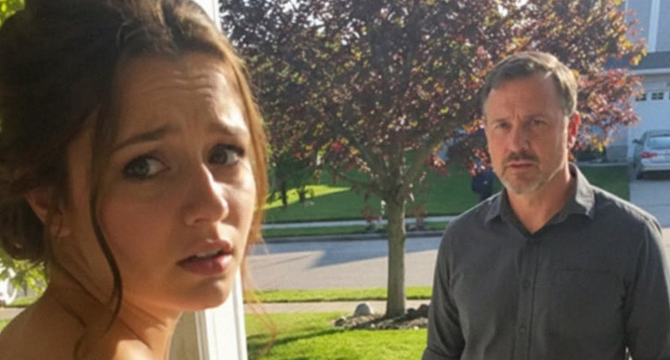
Then a black truck slowed in front of the house.
We weren’t expecting anyone.
It stopped at the curb. The driver’s door opened, and a man stepped out.
We weren’t expecting anyone.
Gray at the temples. Older. A little thinner than I remembered. Fifteen years had done what time does.
I knew him. My heart knew him before my mind caught up.
Harper had gone very still beside me.
“Mom,” she whispered. “Is that… Dad?”
I couldn’t answer.
Harper had gone very still beside me.
Caleb came up the driveway like a man who had finally made up his mind. And before he even reached the porch, I knew this night wasn’t going to end the way it had started.
He stopped a few feet from me. Then he looked at me, and I saw something I hadn’t seen in fifteen years.
Fear.
He held my gaze. “I came to tell Harper the truth.”
I stepped in front of Harper.
“I came to tell Harper the truth.”
“No,” I said. “You don’t get to do this tonight.”
“I know. But I don’t have another night.”
Behind me, I felt Harper’s hand tighten around her flowers.
“Mom? What’s going on?”
Caleb looked past me at our daughter, and his eyes did something complicated that I didn’t have time to interpret.
“You’re grown up now,” he said. “It’s time you knew the truth.”
“You don’t get to do this tonight.”
He reached into his jacket.
I grabbed his arm.
“Inside,” I said. “Right now. You and me.”
My sister took Harper and her date to the driveway, and I pulled Caleb through the front door and closed it behind us. We stood in the hallway of the house he had never once set foot in, and I looked at him and waited.
“Did you tell her?” he finally asked.
He reached into his jacket.
I had rehearsed so many versions of this conversation in the back of my mind over the years, always imagining that if it ever came, I would be composed and ready and calm.
I was none of those things.
“Tell me why you’re here first,” I demanded.
He rubbed the back of his hand across his mouth.
I had rehearsed so many versions of this conversation.
“A week ago I was at a medical consultation. Routine, nothing serious, it doesn’t matter.” He paused. “There was a woman in the waiting room. She was very ill. She looked at me for a long time, and then she said my name.” He paused again. “She said she’d been following Harper from a distance. Online, whatever she could find. She showed me a photograph. Alexis, she knew her. She knew what she looked like and what school she went to. She knew everything.”
My hands were cold.
“She’s dying,” Caleb went on. “She asked me if Harper knew. If there was any chance she could see her before…”
“Stop.”
“She’s dying.”
“She deserves to know, Alexis.”
“Don’t.” I pressed both hands flat against my chest. “Don’t stand in my hallway after fifteen years and tell me what my daughter deserves.”
“She isn’t your…”
“I know who she is,” I hissed. “I know better than anyone who she is. That’s why I never told her.”
Caleb went still.
“She deserves to know, Alexis.”
“Harper has a heart condition,” I added, hoping he understood what hearing the truth this way could do to her. “She was diagnosed when she was seven. Her cardiologist told me that severe emotional trauma during her developmental years could cause serious complications. I was going to tell her. I planned to tell her a dozen times. But every time I sat down to do it, I looked at her and I thought about what it would do to her, and I waited for a better moment, and then another year passed and then another.”
I paused.
Caleb was looking at me in a way I couldn’t read.
“I looked at her and I thought about what it would do to her.”
“She’s eighteen now,” he said softly.
“She is eighteen years old with a heart condition, and it is prom night, and her date is standing in my driveway,” I snapped. “So whatever you came here to do, whatever you think is the right thing, I am asking you. Please. Not tonight.”
He looked at the floor for a moment.
Then the front door opened.
“Please. Not tonight.”
Harper stood in the doorway in her blue dress, her corsage slightly crooked again, her eyes going from my face to Caleb’s and back.
“What truth?” she asked.
There are moments in your life where you understand, with complete clarity, that the conversation you always meant to have has arrived without your permission, in the wrong place, at the worst possible moment.
This was that moment.
“What truth?”
I looked at my daughter’s face.
Caleb reached slowly into his jacket and pulled out a small object.
A bracelet. Thin and delicate, made for a newborn, with a tiny tarnished clasp.
He set it in his palm and held it out.
Harper looked at it without touching it.
“What is that?”
Harper looked at it without touching it.
“It was on your wrist,” I replied, “the night we found you.”
The silence that followed was absolute.
Harper stared at me, searching my face for the explanation that would make this make sense.
“Found me?”
“Harper, honey,” I reached for her hand.
She pulled it back.
“It was on your wrist the night we found you.”
Caleb unfolded a piece of paper, worn soft at the creases from years of folding and unfolding, and held it out to her.
“When I left fifteen years ago,” he said, “the bracelet and the note somehow ended up with my things. I held onto them.”
I watched my daughter read it.
I watched her read the words a stranger had written eighteen years ago, the words I had memorized the night we found them, standing on our doorstep in the rain with a baby in a car seat and a note tucked beneath the handle.
“Please love her. I cannot keep her safe the way she deserves. I am so sorry. Please love her.”
“I held onto them.”
Harper’s hands began to shake.
The flowers fell to the floor.
“Harper.” I was already moving toward her. “Harper, baby, look at me.”
She looked up, and her face was the color of the walls behind her.
Her hand went to her chest and her knees buckled, and I caught her before she hit the floor.
The flowers fell to the floor.
The hospital waiting room smelled the way hospital waiting rooms always smell: like cleaning solution and old coffee and the particular anxiety of people sitting with things they can’t control.
I sat in a plastic chair with Harper’s corsage in my lap. I had picked it up off the driveway and carried it all the way there.
Caleb sat two seats away. He hadn’t spoken since the ambulance.
When the doctor came out, he told us Harper was stable. That it had been a stress response. That her heart had been managed, and she was resting.
He hadn’t spoken since the ambulance.
I nodded, said thank you, and then turned to Caleb. And all at once, the old memories came rushing back.
Eighteen years earlier, we had been desperate for a baby, praying for a miracle that never seemed to come. Then, on a rainy night, we found Harper abandoned on our doorstep with a note tucked beside her.
We searched for her parents and found nothing.
In the end, we adopted her.
At first, Caleb loved her like she were his own.
We had been desperate for a baby.
But three years later, when I finally got pregnant, something in him changed. He became obsessed with protecting me and the pregnancy, while Harper started feeling more and more like an afterthought.
Then one afternoon, Harper nearly fell off the couch. I rushed to catch her, tripped on the rug, and the fall caused a miscarriage.
When the doctors told Caleb, who was a doctor himself, that I would never be able to carry another child, something in him broke. A few weeks later, he walked out and left a note saying he couldn’t do it anymore.
The grief of losing our unborn baby had hollowed him out until there was nothing left in him strong enough to stay.
The fall caused a miscarriage.
Very quietly, I said, “You need to leave.”
He didn’t argue.
He stood up and looked at me with that tired, hollowed-out expression.
“Alexis, I thought I was doing the right thing.”
He left.
I sat with the corsage in my lap and waited for my daughter.
“You need to leave.”
Harper came home two days later.
We sat at the kitchen table for a long time before either of us said anything. Then I told her everything: the night we found her, the car seat on the doorstep, the rain, the note, the bracelet.
I told her about the months of searching that led nowhere, the adoption process that eventually gave her a name, a home, and us.
And I told her about the years I had loved her unconditionally, without hesitation, and without any asterisk attached.
I told her everything.
I told her about the woman who was dying. That she had never stopped thinking about her. That she had watched from a distance for as long as she could, that she had never wanted Harper back, only ever wanted to know she was loved.
Harper sat with all of it for a very long time.
She cried.
I sat with her through all of it and didn’t try to fix it or speed it along.
I told her about the woman who was dying.
The biological mother passed away six weeks later.
Before she died, she left a letter. Her attorney contacted me, and I brought it home, and I sat with it in my hands for a full day before I gave it to Harper.
It was three pages long.
She said she was sorry. That she had been seventeen, alone, and frightened, and had done the only thing she could think of to give her daughter a better life than she could offer.
Before she died, she left a letter.
She wrote that she had driven past our house more times than she could count over the years, not to interfere, just to see. And the last thing she wanted Harper to carry was anger on her behalf.
At the end, she wrote: “You were loved from before I let you go. That never changed. Not for a single day.”
Harper read it alone in her room.
When she came out, her eyes were red and her face was quiet. She sat down beside me on the couch and put her head on my shoulder.
We sat like that for a long time without talking.
Harper read it alone in her room.
Two months later, we found the grave.
It had taken some time, some searching, a few phone calls that were harder than I expected.
But we found it on a Saturday morning in early May, a simple headstone in a small cemetery outside the town where Harper’s mother had spent her last years.
Harper brought white flowers. She stood at the grave for a long time without speaking.
I stood a little behind her and gave her the space to have whatever she needed to have.
It had taken some time, some searching.
After a while, she reached back and took my hand.
We were standing like that when I heard footsteps on the path behind us.
I turned.
Caleb stood at the edge of the path, hat in hand, looking like a man who wasn’t sure he had the right to be there but had come, anyway.
He looked at Harper first, then at me.
I heard footsteps on the path behind us.
“I’m sorry,” he said. To Harper, not to me. “Not for leaving your mother. That’s its own thing. But for leaving you. For every year of your life I wasn’t there because I couldn’t figure out how to carry what I was feeling. You didn’t deserve that. You never did.”
Harper looked at him for a long moment.
There was no anger on her face. That surprised me.
“I appreciate that,” she said finally. “I do.”
“I wasn’t there because I couldn’t figure out how to carry what I was feeling.”
Caleb nodded. He looked like he was hoping for more, waiting to see if there was a door she was about to open.
Harper turned back to the grave.
“My whole world has always been one person,” she said softly, her eyes locked on mine. “That’s my mother, Alexis. The one who raised me and loved me with everything she had.”
She set the flowers down at the headstone. She stood there for another moment with her head bowed. Then she slipped her hand back into mine, and we walked back down the path together.
“My whole world has always been one person.”
Behind us, I heard Caleb’s footsteps stay where they were.
I didn’t turn around.
Some things you don’t turn around for.
You just walk forward and hold on to the person who stayed.

 admin
admin