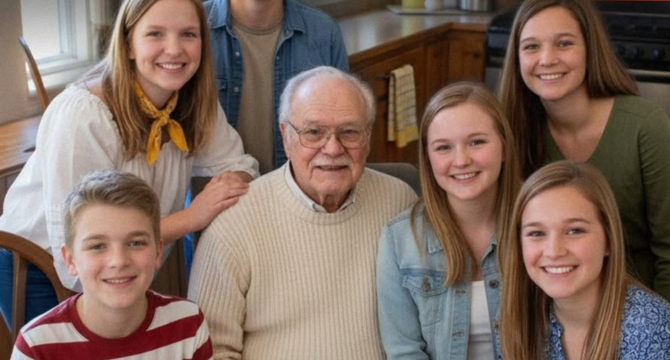
The chapel smelled of lilies and old wood, the kind of stillness that pressed against my ribs until breathing felt like a chore. I stood beside Grandpa Harold’s casket with my five younger siblings clustered behind me, and for the first time in seventeen years, I felt like a child again.
Lily slipped her hand into mine.
“He looks peaceful, Elena.”
My mind kept slipping backward, the way grief makes time fold in on itself.
“He earned peaceful,” I whispered.
I had been the eldest the day our parents died in the summer house fire. I had been the eldest when Harold opened his door to six broken children and never once made us feel like a burden.
“Do you remember the lunches?” Lily asked, her voice cracking.
“He cut the crusts off yours for nine years straight.”
“He couldn’t braid hair at all in the beginning.”
I laughed, and it surprised me. “He watched videos at the kitchen table. Three in the morning. He thought I was asleep.”
He had shown up to every recital.
A cousin drifted past, squeezing my shoulder. I barely felt it.
My mind kept slipping backward, the way grief makes time fold in on itself. I saw Harold hunched over my prom dress, threading a needle with shaking hands because the seamstress wanted money we didn’t have.
“You look like your mother in this,” he had told me that night, his eyes wet.
“Grandpa, you’re going to ruin your eyes.”
“Then I’ll ruin them proudly.”
He had shown up to every recital, every parent-teacher meeting, every awkward middle school play, sitting in the front row in the same gray sweater no matter the weather.
I turned. My brother Marcus, only nineteen, looked lost in his borrowed suit.
“Elena.”
I turned. My brother Marcus, only nineteen, looked lost in his borrowed suit.
“People are starting to leave. Do you want us to wait outside?”
“Give me a minute with him. Please.”
They drifted away, leaving me alone with the casket and the long shadows the chapel windows threw across the floor.
I touched the polished wood and remembered the question I had asked Harold a hundred times growing up.
“Grandpa, why did Mom and Dad go to the summer house that day?”
I had stopped asking when I was sixteen.
He had always looked away. Always.
“Please, sweetheart. Not today.”
“But why won’t you tell me?”
“Because some memories burn a man twice, Elena. Let me carry it.”
I had stopped asking when I was sixteen, because I loved him too much to make him cry again. Now I would never know, and somehow that felt right, like a promise kept.
“I hope you’re with them now,” I whispered to the casket. “I hope Dad finally got to thank you.”
woman in a dark coat and headscarf stood very still beside the last pew, watching me.
The chapel had emptied without my noticing. The candles flickered against the stained glass, and the silence settled heavy as a coat across my shoulders.
Then I felt it. A presence. The unmistakable weight of eyes on the back of my neck.
I lifted my head slowly and looked toward the rear of the chapel. A woman in a dark coat and headscarf stood very still beside the last pew, watching me.
And then, without hurry, she began walking toward the casket.
The watching presence didn’t stay hidden for long. She came forward slowly, an old woman in a heavy coat and a faded headscarf, threading through the empty pews as if she had been waiting for the chapel to clear.
“If you want to know what really happened to your parents, read this.”
I straightened beside Harold’s casket, wiping my cheeks with the back of my hand.
“I’m sorry,” I said. “Did you know my grandfather?”
She didn’t answer. She only reached for my hand and pressed something into my palm, folding my fingers around it.
“If you want to know what really happened to your parents, read this,” she whispered. “Read it alone. Don’t tell the others. Not yet.”
My throat closed.
“Wait. Who are you?”
She squeezed my wrist once, looked at the casket, and turned away. By the time I found my voice again, she was already moving down the side aisle.
I stood there shaking, the folded paper damp in my fist.
“Please, just tell me your name,” I called after her.
The chapel door swung shut behind her. I ran out into the parking lot, but the gravel paths were empty. A gray sedan was already pulling onto the road, too far away to read the plate.
I stood there shaking, the folded paper damp in my fist.
I didn’t open it at the church. I drove to Grandpa’s house instead, knowing my siblings were still at the reception hall with the neighbors and the casseroles. The front door creaked the way it always had, the way it had every morning of my childhood when Harold called us down to breakfast.
The man who learned to braid Lily’s hair had not been there.
I sat at the kitchen table where he had sewn my prom dress. I unfolded the note with hands that would not stop trembling.
“Your grandfather was at the summer house that morning. There are papers in his house. Look where he never let you look. I am sorry I waited so long. — Margaret”
I read it three times.
“No,” I said out loud, to no one. “No, this is wrong. Somebody is sick.”
The man who learned to braid Lily’s hair had not been there. The man who walked two miles in the rain to my middle school choir concert had not been there. I crumpled the note and threw it across the table.
I went to his study first.
Then I picked it up again.
He had told us he was in the city that weekend. He had told us a hundred times. And if that one thing was not true, then I did not know what else might be hiding inside this house.
The basement door was at the end of the hallway, behind the coat rack. Grandpa had always kept it locked. He told us the stairs were rotten, that he would fix them one day, that there was nothing down there but old paint cans and mice.
I went to his study first. I pulled out the drawers of the old roll-top desk one by one, emptying them onto the rug, finding nothing. I was halfway to the door when I saw it: a small brass key hanging on a nail behind the desk, half hidden by the edge of the feed-store calendar he had pinned there every January for as long as I could remember.
I reached for the upper-right drawer. It stuck for a moment, then slid open.
“I’m sorry, Grandpa,” I whispered, turning it in the lock.
The stairs were not rotten. They had been swept clean. A single bulb hung from the ceiling, and I pulled the cord.
A cabinet stood against the far wall, dark wood, the kind that used to be in our old house before the fire. I had not seen it in seventeen years. My knees nearly buckled.
“Why would you keep this?” I murmured. “Why would you hide this down here?”
I reached for the upper-right drawer. It stuck for a moment, then slid open.
The drawer held more than I could process. A stack of yellowed letters tied with twine. A faded insurance document with red stamps across the top. And photographs.
I lifted the first letter with shaking fingers.
Photographs of my parents standing in the driveway of the summer house, faces twisted in anger, my grandfather between them with his hands raised.
I lifted the first letter with shaking fingers.
“Daniel, you cannot keep ignoring the payments. The bank will take everything if you do not respond by the end of the month. Please call me. Dad.”
The next was worse. A reply in my father’s handwriting.
“Stay out of it. The house is mine. I will handle it my way.”
Margaret’s note had a phone number written beneath her name.
I dug deeper and found a folded sheet at the bottom, the paper soft from being touched many times. Harold’s handwriting wobbled across the top.
“To my grandchildren, if you ever find this.”
My vision blurred as I read.
“I went to the summer house that morning. There was an argument. The kitchen. Then the blast came. I survived. They did not.”
The words swam. I couldn’t read further. I shoved the page back into the drawer with the rest of it still unread and ran upstairs.
I knew where to find her. Margaret’s note had a phone number written beneath her name.
“Why did you wait so long?”
She answered on the second ring.
“I wondered if you would call,” she said.
“Who are you?”
“I lived next door to the summer house for forty years. I have wondered about that morning every day since.”
“Tell me. Now.”
She paused.
“I came outside after the blast. Your grandfather was already on the lawn, on his knees, watching the kitchen burn. I assumed he had run out before it went up. I never saw him at the porch door. I only know he did not go back in after I got there.”
I drove back to Grandpa’s house in a fog, the confession still folded in my coat pocket.
“Why did you wait so long?”
“Because he was raising you,” she said quietly. “And I told myself that was punishment enough, if there was anything to punish. But when he died, I could not carry the not-knowing anymore.”
I hung up without answering.
I drove back to Grandpa’s house in a fog, the confession still folded in my coat pocket. Lily’s car was in the driveway when I pulled in.
She met me at the door, her eyes red.
“Where have you been? I’ve been calling you.”
I almost told her. The words sat at the back of my throat, hot and bitter.
“I needed to be alone.”
“Elena, you’re scaring me. What’s going on?”
I almost told her. The words sat at the back of my throat, hot and bitter. I thought of the prom dress hanging in my closet, the careful hand-stitched hem.
“Nothing,” I lied. “I just needed air.”
She watched me for a long moment.
“You’re a terrible liar.”
I could end it here. Burn the lie, burn the proof.
“I know.”
She went upstairs, and I walked into the kitchen. I pulled the confession from my pocket and laid it flat on the counter beside the sink.
I struck a match.
The flame flickered between my fingers. I could end it here. Burn the lie, burn the proof, let my siblings keep the grandfather they remembered. Let Lily believe in the man who braided her hair.
But my hand wouldn’t move.
I thought of every question I had asked as a child. Every time he had wept and begged me to stop. Every time I had let him off the hook because I loved him too much to push.
Then I picked up the confession with both hands and turned to the page I hadn’t finished reading.
I had spent seventeen years not knowing. I could not choose not knowing again.
The match burned down toward my fingertips.
I blew it out.
Then I picked up the confession with both hands and turned to the page I hadn’t finished reading.
Harold’s shaky handwriting filled the paper.
“Daniel called me that morning. He said he smelled gas and could not find the leak. I drove faster than I ever had in my life.”
My eyes blurred.
Harold had mortgaged his own home to keep us together.
“I was on the porch when the kitchen blew. I tried. God knows I tried. I could not reach them.”
I pressed the paper to my chest and sobbed. Then I turned to the last page.
“I told the investigators the payments were current. I mortgaged this house to make it true. Daniel had fallen three months behind. If the policy had lapsed on paper, you children would have lost everything. So I lied. That is the lie I have carried.”
The lie had never been about them. It had been about the insurance. Harold had mortgaged his own home to keep us together.
I called my siblings that night and gathered them around his kitchen table.
Lily clutched my sleeve.
The next morning, I drove to Margaret’s small house at the edge of town.
“Elena, whatever it is, just tell us.”
“I need you to listen to every word. Grandpa wrote this for us.”
I read it aloud, page by page, until my voice broke on the last line.
Lily wept into her hands.
“He carried that. For us. For all those years.”
“He did.”
The next morning, I drove to Margaret’s small house at the edge of town. She opened the door and her face crumpled when she saw mine.
“Can you forgive an old woman?”
“I had it wrong, didn’t I?”
“You did. But you meant well. And I needed to know.”
“Can you forgive an old woman?”
“I already have.”
I drove to the cemetery alone that afternoon.
I laid a single white rose on the fresh earth above him.
“I know who you really were now, Grandpa. I am so sorry I ever doubted you.”
The wind moved through the grass like an answer.

 admin
admin