The Tuesday morning light came in soft through the kitchen window, turning the counters gold and making everything look warmer than it was. I poured Alex’s coffee into his favorite blue mug, the one Henry had given him three Christmases ago, and set it beside his keys.
Our wedding photo still hung in the hallway between Henry’s college portrait and Ivy’s senior picture. I passed it every day without really seeing it. That is what 20 years does. You stop noticing the evidence of your own life.
I texted Alex a red heart.
A second later, the bubble appeared.
“Already miss you,” he wrote. “Don’t forget Saturday.”
Saturday was a family dinner. Henry was coming in from downtown. Ivy was taking the train from campus. Roast chicken, good wine, and board games if everyone stayed awake long enough. The kind of night I had built my life around.
“I bought the wine yesterday,” I called toward the bedroom.
“You’re a saint, Cindy,” he called back.
Saint. That had been his name for me since college. I had never gotten tired of it.
I opened the front door to grab the paper.
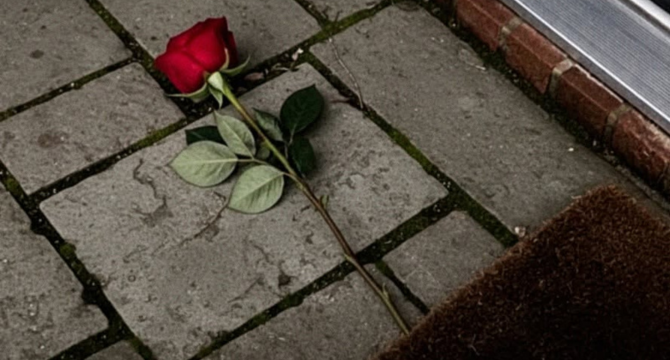
A single red rose lay on the welcome mat.
No card or florist tag. Just one perfect bloom, fresh and open, placed so carefully it looked deliberate.
I smiled to myself.
“You sneaky man.”
I carried it inside, found a small glass, and set it on the kitchen island where he would see it.
I was already imagining his face when I thanked him. Alex had never been good at pretending he hadn’t planned a surprise.
He came downstairs, adjusting his cuffs, stepped into the kitchen, and stopped.
The color drained from his face so slowly that it was worse than shock.
“Where did that come from?” he asked.
I frowned. “The doorstep. I assumed it was from you.”
“No.”
The answer came too fast.
He crossed the room, yanked the rose out of the glass, and threw it into the trash under the sink.
I stared at him.
“Alex. What was that?”
“Nothing.” He grabbed a dish towel and wiped his hands even though it wasn’t wet. “Wrong house. Probably meant for the neighbors.”
“It was on our mat.”
“Cindy, please.”
He poured his coffee. His hand shook badly enough that it spilled across the counter.
For the rest of the day, he barely spoke. That night, he lay beside me in bed breathing too evenly, too carefully, like a child pretending to be asleep.
Around two in the morning, I got up.
The kitchen was cold. I lifted the trash lid and reached down past coffee grounds and paper towels until I felt the stem.
I removed it from the trash can and saw that something was wrapped in the middle of the petals.
A small strip of paper.
My heart started pounding before I even opened it.
Five words were written across it: “20 years is long enough.”
I sat down on the kitchen floor in my nightgown and read the note until the window turned gray with morning.
When Alex came down, showered, and dressed for work, I was waiting at the table.
I slid the note toward him.
“Who sent this?”
He froze. His coffee mug tilted in his hand.
“Cindy, I don’t know what that is.”
I laughed once. It sounded ugly. “Do not lie to me.”
“I’m not lying.”
“It was at our doorstep, so it was obviously meant for this household.”
He set the mug down too hard. “I have to go.”
“Sit down.”
“I’m late.”
“Then be late.”
He didn’t sit. He grabbed his briefcase and walked out without touching his coffee, without kissing my forehead, and without looking back.
That was the moment I knew whatever was wrong had been wrong for a long time.
The next three days were unbearable.
He answered questions in single words. He kept his phone angled away from me. He drifted through the house like a man trying not to leave fingerprints.
Friday morning, I opened the front door and found another rose.
This note was shorter.
“Ask him about me,” it read.
I stood there on the porch, barefoot in my robe, staring at the words until something inside me went still.
I needed clarity.
That night, around seven, Alex grabbed his keys.
“Where are you going?” I asked.
He didn’t turn around. “Hardware store. The faucet in the guest bath is leaking.”
I didn’t believe him.
“Okay,” I said softly. “Drive safe.”
He left.
I counted to 30, grabbed my purse, and followed him.
He didn’t go anywhere near a hardware store.
He took the highway east, exited into a part of the city we never used.
My husband turned into the lot of a small apartment building with faded blue paint and one weak porch light over the entrance.
I parked down the block with my lights off. Rushed after him and hid in the bushes just beside the house.
Alex got out of his car and climbed the steps like he’d done it before. A woman opened the door.
She looked around my age, maybe a little older, dark hair pulled back, shoulders squared as if she had spent years bracing herself against disappointment. I held my breath, waiting for the moment that would confirm what I thought I already knew.
But he didn’t kiss her or even touch her.
She looked at him with open contempt.
“Twenty years, Alex.”
Her voice carried cleanly through to me.
“Twenty years of lies.”
I was close enough to hear, hidden by shadow.
“I told you not to do this,” Alex said.
“Do what?” she shot back. “Tell the truth? You should have tried it years ago.”
There was the sound of paper rustling.
“Look at him,” she said. “Look at his face.”
I risked a glance.
She was holding an old photograph. Even from a distance, I could make out a much younger Alex standing beside her while she held a newborn baby.
My knees weakened.
“I was eight months pregnant when you left,” she said. “You walked out and never came back.”
Alex dragged a hand over his face. “I was 22. I panicked.”
“You were old enough to make a child.”
Silence.
Then she said the sentence that changed everything.
“I never wanted your money. I wanted you to be his father.”
It was then that it dawned on me that this was not an affair or a current betrayal.
It was an old one. Buried so deep it had roots.
“You took the checks,” Alex muttered.
“For him. Only for him. Do you know what he asked me every birthday? Why did his father send money for school but never call? Why would his father pay for braces but not speak his name?”
I pressed my hand over my mouth.
There was a child. No, not a child anymore. A whole person. A son. A life that had existed beside mine for 20 years without my knowledge.
“His name is Victor,” she said. “Say it, Alex.”
He said nothing.
“That’s what I thought.”
The silence stretched so long it became its own answer.
Then she said, quieter, “The roses weren’t mine. Those were from him. I told him not to send them, but he said he’s done waiting. He wanted you to know he sees you for what you are.”
“Please don’t tell Cindy.”
The woman gave a bitter laugh.
“I’m not telling your wife anything. That was always your job.”
I walked back to my car before I could hear more.
On the drive home, the road blurred at the edges. I kept both hands tight on the wheel and thought about every year of my marriage. How he had lied to me every day of those years.
This was somehow worse than an affair.
An affair could be reckless, selfish, and stupid. This was sustained, maintained, and a choice remade every day for 20 years.
He had hidden a son from me. Hidden a brother from Henry and Ivy. Sent money and called it conscience while refusing the one thing that mattered.
Acknowledging his son and being there for him as his father.
I sat at the kitchen table when I got home. I placed the second rose in front of Alex’s chair and waited.
When he walked in half an hour later, he knew something was wrong.
He saw it in my face.
“How many children do you have, Alex?”
He closed his eyes. His shoulders folded inward.
“Cindy.”
“How many?”
“Three,” he whispered.
The number struck me harder than I was ready for. Three. Not just Henry and Ivy. But a secret third child. Three siblings who should have known each other.
He sat down slowly. “It was before you. We were kids. Melanie got pregnant, and I panicked, so I left. A few months later, I tried to fix it by sending money, but by then…”
“By then what?” I snapped. “By then, it was easier to stay away?”
He flinched.
“I never cheated on you,” he said. “I swear. It wasn’t like that.”
“That is your defense?”
He pressed his hands together, desperate now. “I was ashamed.”
“You should be.”
“Cindy, please try to understand.”
I laughed, and this time it sounded like glass breaking. “Understand what? That my husband could tuck our children into bed and still leave another one out in the cold for 20 years? That you paid for things so you could tell yourself you weren’t a monster?”
His face crumpled.
“I wanted to tell you.”
“No, you didn’t.” I leaned forward. “If your son hadn’t left roses on my porch, I would still be making roast chicken on Saturday while you pretended to be a good man.”
He cried then. Twenty years ago, I might have gone to him. That night, I felt nothing but exhaustion.
The next morning, there was a knock at the door.
Melanie stood on my porch holding one last red rose.
She looked tired, but steady.
“This is from him,” she said, handing me a folded letter. “I thought you deserved the truth from someone who hasn’t spent 20 years running from it.”
I didn’t invite her in. We both knew this wasn’t a coffee conversation.
After she left, I stood in the kitchen and opened the letter.
The handwriting was neat, careful.
Victor wrote that he had not wanted to destroy my marriage. He had only wanted an answer. He had spent his whole life watching a man pay from a distance and stay absent on purpose. When he turned 20, he decided he would stop begging for scraps of acknowledgment.
He ended with one line I read several times.
A father who hides you is still hiding from himself.
I filed for divorce the following week.
Alex didn’t fight me on it at first because I think he still believed remorse should earn him mercy. It didn’t. When he realized I was serious, he tried everything. Tears, apologies, promises, counseling, and religion.
He offered me the whole museum of our marriage, like I might forget which piece had rotted.
Then came the harder part. Telling Henry and Ivy.
We sat in the living room one Saturday, the roast chicken untouched in the kitchen, the good wine unopened on the counter.
Henry kept looking between Alex and me. “Can someone please just say what’s going on?”
So I did.
I told them their father had another child before he met me. That he’d known all along. That he’d sent money but had never been a father in any real sense. That the boy was a man now. That his name was Victor. That I was ending the marriage because I could survive many things, but not a lie built into the foundation of my family.
Ivy cried first. Henry went quiet in that dangerous way men do when the pain is too big to name. Alex tried to speak once. Henry stood up and said, “Not now, Dad.” The word sounded wrong.
The divorce took eight months.
Victor met Henry and Ivy before it was final. Not because Alex arranged it. Because the three of them wanted what he had denied them for years.
Victor was tall, serious at first, with Alex’s eyes.
He had a caution that made me ache for him instantly. He came to my backyard the first warm Sunday of spring, carrying a six-pack for Henry and flowers for me. Not roses. Yellow tulips.
“I thought red might be too much given our history with it,” he said.
I laughed for the first time in weeks.
By the end of that afternoon, Henry and Victor were arguing about baseball, Ivy was showing him old family photos, and I was standing at the grill trying not to cry where anyone could see.
Alex stood beyond the back fence at one point, hands in his pockets, not invited in.
He looked smaller than I had ever seen him.
Not because I hated him. Hate is hot. This felt cooler than that. I was just done with him.
I went over to Victor with a plate of food.
He looked up at me with that careful expression, like he still wasn’t sure what he was allowed to want.
“More chicken?” I asked.
He smiled then. “Yes, please.”
And something settled inside me. Peace that he was now a part of our family.
People say one thing ended my marriage. One rose, alongside the note and discovery it came with.
But that isn’t true.
The rose only opened the door.
What ended my marriage was the truth standing in the light and refusing to be thrown in the trash again.

 admin
admin