The café smelled of cinnamon and burnt espresso, the same way it had every weekday for the last six years. I slid into my usual booth by the window at exactly 12:15 and opened the laminated menu I never actually read.
My older sister Lily disappeared three days before Christmas when I was 12. She walked out of our front door in a red wool coat and never came back.
After that, my father never hung Christmas lights again.
The only person who held us together was Uncle Raymond.
My mother packed away every ornament in a cardboard box and labeled it “Attic” in black marker. We stopped saying Lily’s name at the dinner table. Eventually, we stopped saying it at all.
The only person who held us together was Uncle Raymond, my father’s younger brother.
He moved closer to help. He organized search parties, kept my mother eating, drove me to school when my father couldn’t get out of bed.
“More coffee, hon?”
I looked up at the waitress and nodded.
She poured, smiled, drifted away. I wrapped my fingers around the warm cup and stared out at the parking lot like I always did.
She slid in across from me and set her bag carefully on the seat.
That was when a shadow crossed my table.
“Excuse me. I’m so sorry to bother you.”
A young woman stood beside the booth, maybe late twenties, dark hair pulled back, a worn canvas bag slung over her shoulder. She looked nervous in a way that didn’t match her polite smile.
“The other tables are full,” she said. “Would you mind if I sat? Just while I wait for my food.”
I glanced around.
“Of course,” I said. “Go ahead.”
There was something in her face I couldn’t place.
She slid in across from me and set her bag carefully on the seat. Her eyes flicked to mine, then away, then back, like she was trying to decide something.
“Thank you. Really.”
“It’s fine.”
“You eat here a lot?” she asked.
“Every day.”
“Routines are comforting.”
The key chain, inscribed with my childhood dog’s name, Biscuit, caught the woman’s eyes.
There was something in her face I couldn’t place, something that tugged at a memory I couldn’t catch.
“I’m sorry,” I said. “Have we met?”
She hesitated. Her tea arrived. She wrapped her fingers around it and watched me as if measuring whether to say what she had come to say.
As I reached for my plate, my keys fell out of my pocket. The key chain, inscribed with my childhood dog’s name, Biscuit, caught the woman’s eyes.
“You know, my mother used to talk about a golden retriever named Biscuit. He had one floppy ear, didn’t he?”
My mother stopped baking those cookies the year Lily disappeared.
The menu slipped a little in my hand. Biscuit had died when I was eleven. No one outside my family knew that name.
“I’m sorry, do I know you?”
“Not yet,” she said softly. “She also talked about cinnamon-star cookies. Her mother baked them every Christmas. She said the dough always smelled like home.”
My mother stopped baking those cookies the year Lily disappeared. I hadn’t tasted one in thirty years.
“Who are you?”
The woman reached into her purse, pulled out a small photograph, and slid it across the table.
I stared at her face and finally saw it.
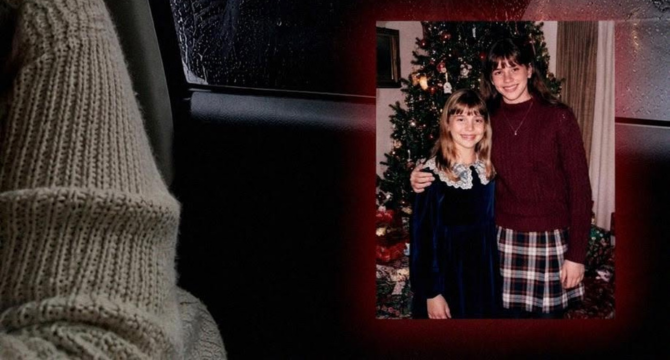
I picked it up with hands that wouldn’t stay still. Lily at sixteen, me at twelve, standing beside our Christmas tree in matching red sweaters. The photo had lived inside my mother’s album for as long as I could remember.
“How did you get this?”
“My name is Emma,” she said. “I’m Lily’s daughter. I sent you a letter in March. I called twice in April from a number you didn’t recognize. I’m guessing you never saw the letter, and I don’t blame you for the calls. This was the last thing I wanted to do, Clara, but I know you come here every weekday at lunch, and I was running out of ways to reach you that he wouldn’t notice first.”
I stared at her face and finally saw it. The curve of her jaw. The shape of her mouth. My sister’s mouth.
I opened my mouth, but Emma’s eyes drifted past my shoulder to the window.
“That’s not possible. Lily is. Lily has been gone since I was twelve.”
“She’s not gone, Clara.”
I opened my mouth, but Emma’s eyes drifted past my shoulder to the window. Whatever she saw drained the color from her face.
“We need to leave. Right now.”
“What are you talking about?”
“Please.” She was already standing, dropping bills on the table. “My car is around the corner. I’ll explain everything, but we can’t stay here.”
Inside her small blue sedan, Emma locked the doors.
Every cell in me wanted to stay in the booth. But as Emma reached for her coat, she pinched the collar between two fingers and gave it that small, impatient shake before sliding it on — the exact gesture Lily used to make with her school cardigan, the one I had described to a grief counselor at thirteen and never spoken of since.
I went anyway.
Inside her small blue sedan, Emma locked the doors.
“Where is Lily? Is she alive? Just tell me that.”
Tears spilled down her cheeks. She nodded, opened her mouth to speak, and a sharp knock rattled the driver’s side window.
The man outside smiled at me, the man who held my mother through her worst nights.
“Listen to me,” she whispered. “Whatever he tells you about my mother, do not believe him. He is the reason she disappeared thirty years ago.”
“Emma, who is—”
“Promise me, Clara. Promise me you won’t believe a word.”
Slowly, I turned toward the window.
The man outside smiled at me, the man who held my mother through her worst nights. The man who taught me to drive after my father couldn’t bear to.
Raymond tapped the glass and made a little waving motion.
Uncle Raymond.
And he was lifting his hand to knock again.
Raymond smiled at me through the glass.
Emma’s fingers dug into my wrist.
“He’s been parked outside your mother’s house every morning this week,” she whispered. “I knew he’d follow me the second I made contact. Don’t get out. Please, Clara. Just drive.”
Raymond tapped the glass and made a little waving motion.
Raymond pulled me into a careful hug and lowered his voice.
“Clara, sweetheart, roll the window down. Let’s talk.”
My chest felt split in two. This was the man who had sat with my mother through every anniversary of Lily’s disappearance.
“I have to hear what he says,” I told Emma.
“He’ll lie to you.”
“Then I’ll know he’s lying.”
I stepped out. Raymond pulled me into a careful hug and lowered his voice.
“Honey, that girl has been stalking your mother for months. I didn’t want to worry you.”
“Stalking her how?”
I watched her taillights vanish and felt something inside me lurch toward grief again.
“There was a break-in at your mother’s house in spring. Photos went missing from the album. I didn’t tell you because she begged me not to. You know how fragile she’s been.”
He sounded so reasonable. He always had.
“She showed me a picture of Lily,” I said.
“I know. That picture was stolen from the album. Clara, please. Come home with me. We’ll call the police together.”
Behind me, Emma’s car pulled away from the curb, slow at first, then gone. I watched her taillights vanish and felt something inside me lurch toward grief again.
The slot where the photo of Lily and me should have been was empty.
I went home with Raymond that night. I needed to believe him for as long as I could.
For two days, I tried to live inside his story. I rehearsed his sentences in my head until they almost fit. But the story only covered the photograph. It did not explain how a stranger would know Biscuit had one floppy ear, or that my mother hid almond cookies in the bread tin every December for a daughter who never came home.
On Thursday afternoon, I sat at my mother’s kitchen table, the family album open in front of me, and flipped to the Christmas pages.
The slot where the photo of Lily and me should have been was empty.
I stared until my hands went cold. The album had lived on this shelf for thirty years. No stranger had walked through this kitchen in spring. The only person who came and went freely was Raymond.
I waited until she went to lie down. Then I called Emma.
“Mom,” I said, when she shuffled in for tea, “did somebody break into the house this spring?”
She looked up, puzzled.
“Break in? Here? No, honey. Why?”
“Raymond mentioned it.”
“He must be confusing it with something else. Nothing like that happened.”
I waited until she went to lie down. Then I called Emma.
“I need to see what you have.”
She met me at a diner the next morning and slid a shoebox across the table.
“Open it.”
Inside were letters. Dozens of them. Yellowed envelopes, all in the same looping handwriting I would have known anywhere.
“To Clara,” one read. Another: “To Mom and Dad.” Another: “Clara, please write back.”
None had been opened. None had ever reached us.
“She wrote every year,” Emma said. “The return address was always the same. She never moved.”
“Where did you get these?”
I pressed a letter to my mouth and tried to breathe.
“Lily found Raymond’s address last spring after her letters finally came back with his handwriting on it. I cleaned his house for three weeks under a different name. Found a key in his desk drawer and a rental receipt. The manager let me in because I had the key. He kept every letter. Years ago, he convinced Lily to send everything through a private mailbox. Then he emptied it himself for thirty years.”
I pressed a letter to my mouth and tried to breathe.
“I trusted him,” I whispered.
“I know.”
“He sat with my mother every Christmas. He held her while she cried.”
Emma reached across the table and took my hand.
A woman knelt in the garden, gray streaking her hair. She looked up.
“Do you want to meet her?”
I nodded before I could speak. Then I found my voice.
“Take me to my sister.”
Emma drove in silence while I stared at the letters in my lap.
The town was four hours away. The house sat at the end of a quiet street, white paint peeling, daffodils nodding along the walk.
A woman knelt in the garden, gray streaking her hair. She looked up.
It was Lily.
“I never stopped looking. I just didn’t know I was looking.”
Thirty years collapsed into a single breath. Neither of us spoke. She stood slowly, and then I was in her arms.
“You came,” she whispered.
“I never stopped looking. I just didn’t know I was looking.”
Inside, she told me everything.
“I was sixteen. I caught Raymond stealing from Mom’s drawer. He grabbed my arm and told me Dad would think I was lying. He said I’d destroy the family.”
“So you ran.”
Three days later, the five of us stood in our parents’ living room.
“He found me a week later. He promised he’d deliver my letters. I believed him, Clara. I believed him. He told me Mom had had a breakdown after I left, that another shock could kill her. That Dad had a heart condition. Every time I wrote, he answered with worse news. Mom in the hospital. Dad barely sleeping. He said if I showed up, I’d be the thing that finished them. I couldn’t risk it. By the time I was old enough to doubt him, I’d already missed twenty years. What was I supposed to do, knock on the door and say sorry?”
Three days later, the five of us stood in our parents’ living room. My father hadn’t spoken since I’d told him Lily was alive. He had just sat in his chair, hands folded, waiting, as if any word might break what was left of him. I placed the stack of letters on the coffee table in front of Raymond.
“No. You’ve explained enough for thirty years.”
He smiled the way he always had, ready with a story.
“Clara, sweetheart, let me explain.”
“No. You’ve explained enough for thirty years.”
My mother picked up a letter. Her hand shook as she read Lily’s handwriting. My father turned his face away, then back, and looked at Raymond like he was seeing him for the first time.
On Christmas Eve, my father carried the ladder out to the porch.
Raymond started to say, “You don’t understand what she was like—” but my father stood up, and Raymond’s voice died in his throat. He walked to the door, paused, and left without another word. By morning, my father had called the police, and Raymond was no longer welcome in the house he had haunted for three decades.
On Christmas Eve, my father carried the ladder out to the porch. Lily handed him the string of lights, and Emma plugged them in.
The house glowed again.

 admin
admin