I watched my son Larry peering through the window above the sink, his small face pressed to the glass, studying the house across the street like it was a puzzle only he could solve.
That house belonged to Mrs. Hollis, 79, widowed, and as far as I knew, completely alone.
Larry tugged my sleeve. “Mom, her porch light’s been off for three nights.”
“Maybe the bulb burned out, sweetie.”
“No,” he said, very seriously. “And her hands shake when she carries the bags. I counted. Four times this week.”
“Mom, her porch light’s been off for three nights.”
I dried my hands on the towel.
Larry noticed things that other children walked right past. It was the thing about him that scared me and made me proud in equal measure.
“She told the mailman her heart pills cost too much,” he said. “I heard her, Mom.”
He disappeared down the hall.
When he came back, he was carrying his allowance jar, the one with the masking-tape label that read LEGO CASTLE in his careful second-grade letters.
“She told the mailman her heart pills cost too much.”
“How much is in there, Larry?”
“$53. Do you think it’s enough to get Mrs. Hollis her medicine?”
My heart broke. “That’s your castle money. You’ve been saving since Christmas.”
He looked up at me with those steady brown eyes. “She needs it more than I need plastic bricks.”
At the time, I thought I was watching my son give up a toy.
I had no idea that less than twenty-four hours later, police cruisers would be parked outside our house because of that decision.
“$53. Do you think it’s enough to get Mrs. Hollis her medicine?”
I knelt down so we were eye to eye. I wanted to say something wise, something motherly. Instead I just nodded, because some choices belong to the child making them.
“Okay,” I whispered. “Get your shoes.”
We walked to the pharmacy together, his small hand wrapped around mine.
At the counter, I spoke to the pharmacist and told him we were there to buy the pills on Mrs. Hollis’s prescription.
He checked his computer. “That’ll be $46,50.”
We walked to the pharmacy together.
Larry counted every crumpled bill and stack of quarters out loud.
The pharmacist glanced at me, waiting for me to interrupt. I didn’t.
“Forty-six fifty,” Larry announced, sliding the pile forward.
The pharmacist slid the white paper bag across in return.
On the walk home, Larry dictated his note, and I helped him spell the harder words. He wrote it himself on a torn piece of notebook paper.
The letters slanted across the page: “For your heart. From your friend, Larry.”
Larry counted every crumpled bill and stack of quarters out loud.
We set the bag on her porch and turned to leave.
The door opened before we reached the sidewalk.
Mrs. Hollis stood in her faded blue housecoat and lifted the bag, pressing it against her chest.
She did not say one word.
She only lifted both shaking hands to her mouth and cried, silent tears spilling down her cheeks like something held back for a very long time.
The door opened before we reached the sidewalk.
Larry waved.
She nodded once, and closed the door.
I remember thinking I’d never seen gratitude look so much like heartbreak.
If I’d known that would be the last time anyone on our street saw Mrs. Hollis alive, I would’ve paid closer attention.
At 6 a.m. the next morning, I heard engines. Then voices. Then the doorbell, over and over.
I’d never seen gratitude look so much like heartbreak.
I pulled my robe tight and shuffled down the hallway.
Larry padded behind me in his dinosaur pajamas, rubbing his eyes. “Mom, what’s that noise?”
“Stay behind me, baby.”
I turned the lock and pulled the door open. My breath left my body all at once.
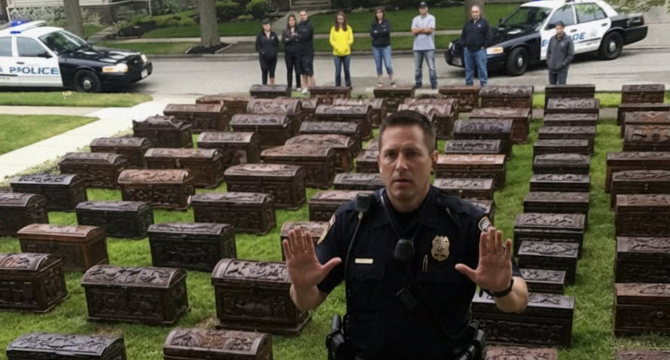
Our entire front yard had been transformed into something out of a dream. Dozens of dark, hand-carved wooden trunks sat in perfect rows across the dewy grass.
Two police cruisers blocked the street with their lights spinning silently.
I turned the lock and pulled the door open.
Neighbors had gathered on the sidewalk, phones raised, whispering behind their hands.
A tall officer was already making his way up our driveway.
His badge read Davis. His face was pale.
“Ma’am,” he called, climbing the porch steps. “Sarah?”
“Yes,” I whispered. “What is all this?”
He reached out and caught my wrist. “Whatever you do, don’t open them. Not yet. He’s almost here.”
A tall officer was already making his way up our driveway.
“Who?” I whispered. “Who’s coming?”
He looked down at Larry, standing barefoot beside me in his dinosaur pajamas.
And what he said next made me sit down right there on the porch steps.
“The person who thinks you stole all of this.”
I frowned. “What are you talking about?”
Officer Davis glanced toward the rows of trunks. “All I know is that your neighbor, Mrs. Hollis, passed away during the night. The estate attorney requested a police standby while some property was transferred this morning.”
What he said next made me sit down right there on the porch steps.
The words hit me like a physical blow. I stared across the street at the dark house.
Mrs. Hollis was gone. We’d given her those heart pills just yesterday, but if she’d had to go without medication for a while, maybe it was too little, too late.
“But what do the trunks have to do with anything?” I asked.
Officer Davis hesitated. “I can’t answer that, ma’am.”
Before I could ask another question, tires screeched against pavement.
“But what do the trunks have to do with anything?”
A sleek black car swung in behind the police cruisers.
The driver’s door flew open, and a man in a tailored gray suit stepped out, jaw clenched, eyes locked on our porch.
He marched straight across the lawn, weaving between the trunks like they personally offended him.
“Which one of you is Sarah?”
I stood. “I am.”
He marched straight across the lawn.
“That was my mother.” He jabbed a finger toward the empty house across the street. “She wasn’t in her right mind.”
“What are you talking about?”
He swept his arm toward the rows of trunks. “Those are family heirlooms. Solid silver. Antique jewelry. Pieces my grandfather brought over from the old country. They rightfully belong to me, you thief.”
I felt my heart hammering against my ribs. “Sir, I had nothing to do with—”
“Save it.”
“They rightfully belong to me, you thief.”
He stepped closer, and Officer Davis immediately moved between us.
“My mother was alone. Then suddenly some neighbor’s kid shows up with a gift, and overnight everything changes?”
I looked down at Larry. He was crying quietly, confused, still in his dinosaur pajamas.
Something inside me steadied.
“My son spent every dollar he had on her heart pills,” I said. “He gave up a Lego set he’d been saving for since Christmas. That is what happened. Nothing else.”
He was crying quietly, confused, still in his dinosaur pajamas.
He laughed. It was a sharp, ugly sound.
“His allowance. Right.” He pointed at the trunks. “And now he gets a yard full of antiques. Quite the return on investment.”
A car door closed at the end of the driveway. A thin older man in a gray coat walked up the path carrying a leather folder against his chest.
“Mr. Hollis,” he called. “I’m Mr. Vance. I handled your mother’s affairs.”
“And now he gets a yard full of antiques. Quite the return on investment.”
Mr. Hollis spun toward him. “Good. Then you can tell these people to hand over my property.”
“I’m afraid I can’t do that.” Mr. Vance stopped beside the porch, opened the folder, and removed several papers. “Your mother signed these documents yesterday afternoon in my presence and in the presence of two witnesses. They were properly notarized.”
The neighbors on the sidewalk fell silent.
Mr. Hollis snatched the papers from his hands.
His face moved through several colors as he read.
“Good. Then you can tell these people to hand over my property.”
“This is a forgery,” Mr. Hollis snapped.
“It is not.”
“She was confused.”
“She was lucid.”
“I am her son.” Mr. Hollis’s voice cracked. “Her only son.”
Mr. Vance nodded once. “Yes. And yet she chose to leave every trunk on this lawn to a boy named Larry. Would you like to know why?”
“This is a forgery.”
The crowd murmured.
Mr. Hollis stared at him. “Why?”
Mr. Vance folded his hands over the folder. “She told me the boy gave her something no one else had given her in years.”
Mr. Hollis swallowed. “And what was that?”
“Attention.”
The word landed harder than a shout.
Mr. Hollis turned slowly toward Larry. His eyes burned with rage.
“She told me the boy gave her something no one else had given her in years.”
“You think you’re clever,” Mr. Hollis said. “You think a few pills bought you a fortune.”
“Don’t.” I stepped fully in front of my son. “Don’t you dare talk to my son like that.”
“I want them opened,” Mr. Hollis snapped. “Right now. In front of everyone.”
Officer Davis crossed his arms. “That’s not a good idea.”
“I don’t care.” Mr. Hollis pointed at the trunks. “I want everyone here to see what my mother supposedly gave away.”
He strode across the lawn toward the largest trunk.
“You think a few pills bought you a fortune.”
I should have felt afraid.
A week ago, I would have. Instead, I felt Larry’s hand slip into mine.
“Mom,” he whispered. “It’s okay.”
I looked down. “What?”
He shrugged. “Mrs. Hollis told me what was inside.”
My heart skipped. “She did?”
“Mrs. Hollis told me what was inside.”
Larry nodded. “She said they were her favorite things.”
Mr. Hollis dropped to his knees beside the largest trunk.
He grabbed the iron clasp.
The whole street leaned forward.
With a violent jerk, he ripped the latch free and threw open the lid.
Then he froze.
I held my breath, bracing for silver, jewels, and whatever other treasure Hollis had spent the last ten minutes shouting about.
With a violent jerk, he ripped the latch free and threw open the lid.
Instead, the morning fell completely silent.
Inside the trunk sat an enormous, hand-carved model of a cathedral.
The sunlight caught hundreds of polished wooden surfaces and intricately carved details, and sent warm amber light spilling across the velvet lining.
Gasps rippled through the crowd.
Mr. Hollis screamed.
The sunlight caught hundreds of polished wooden surfaces.
“For God’s sake.” Hollis waved dismissively at the model. “Not this junk. Where’s the silver?”
He dropped to the next trunk and threw it open.
Inside was a carving of a covered bridge. The next trunk he ripped open contained a carved courthouse, and the next held a town square complete with miniature trees, benches, and shop windows.
Each piece was more intricate than the last. Each one was beautiful.
Mr. Hollis looked genuinely angry now.
“These were Mother’s worthless little hobby projects.” He turned to Vance. “Where is my silver?”
“Not this junk. Where’s the silver?”
Mr. Vance stepped forward. “The silver is long gone. Your mother had to sell it to buy her medication and groceries. She asked you to help her financially, but you refused. She did what she had to do.”
Mr. Hollis’s jaw dropped.
Mr. Vance continued. “And for the record, these are not junk, or ‘little hobby projects.’ Your father built the trunks. He built furniture. Cabinets. Tables. Chests. But your mother made art. She spent thirty years creating these models. Entering exhibitions. Teaching classes. Winning awards.”
Larry tugged my sleeve.
“And for the record, these are not junk, or ‘little hobby projects.'”
I looked down.
“Mom, they’re like giant Lego castles,” he whispered.
I smiled despite the tears burning behind my eyes. “Yeah, baby. They are.”
Mr. Hollis stared across the lawn at the things he had dismissed as hobbies.
The things his mother had spent decades creating.
For the first time since arriving, Mr. Hollis looked less angry than lost.
“Mom, they’re like giant Lego castles.”
Officer Davis placed a steady hand on Mr. Hollis’s shoulder. “Mr. Hollis, it’s time for you to leave. Quietly.”
Mr. Hollis looked at Larry one last time.
Something passed across his face, regret, maybe, or the beginning of it.
He climbed into his black car without another word, and the engine faded down the street.
The neighbors lowered their phones. A few of them wiped their eyes. Officer Davis tipped his hat to Larry before walking back to his cruiser.
“Mr. Hollis, it’s time for you to leave. Quietly.”
That afternoon, Larry and I sat together on the porch in the warm sun. We’d carried the trunks inside earlier.
“Mom, do you think she knew?” Larry asked.
“Knew what, sweetheart?”
“That I would have helped her even without the castles.”
I pulled him close and kissed the top of his head. “I think she knew that better than anyone, Larry.”
The porch light across the street stayed dark now, but somehow our whole street felt brighter than it had in years.
And I finally understood what real wealth looked like.

 admin
admin