I’ve always believed I was a careful mother.
Not perfect, but intentional. I knocked before entering Emma’s room, even when she was seven and still left her toys scattered across the floor. I never read her messages, never searched her drawers, never touched anything that wasn’t freely offered.
“Emma?” I used to say, tapping softly. “Can I come in?”
Sometimes she’d laugh. “You don’t have to knock, Mom.”
But I always did.
Because trust, to me, wasn’t something you demanded. It was something you protected. That’s why what happened on Tuesday doesn’t feel like something I did. It feels like something I broke.
Her room was messy in that familiar, lived-in way — clothes draped over a chair, books leaning unevenly on her desk, her backpack dropped carelessly on the floor. I sighed, stepping inside.
“Just a quick tidy,” I murmured. “She won’t even notice.”
I bent to pick up her backpack, but the zipper snagged. Before I could fix it, it gave way, spilling everything onto the carpet.
“Seriously?” I muttered, crouching down.
Pens rolled, and Papers slid out in uneven stacks. And then a worn notebook slipped free and fell open.
I froze.
I knew what it was immediately.
“Don’t,” I whispered to myself, my hand hovering. “Just close it.”
But my eyes had already landed on the page.
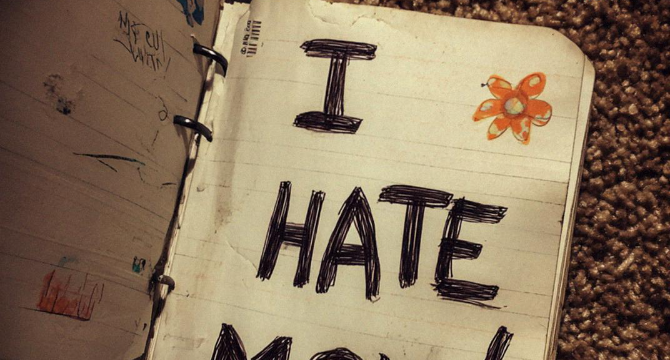
“I HATE HER.”
The words hit like a physical blow. My breath caught as I saw my name written beneath it in Emma’s careful handwriting.
“No…” I said softly. “Emma…”
I should have closed it. I knew that; every part of me knew it. But something deeper, something desperate, kept me there.
“Just one line,” I whispered.
“She ruined everything. She took the most important thing from me.”
My chest tightened painfully.
“What are you talking about?” I murmured, my voice barely steady.
I kept reading.
“One day I’ll tell her the truth about what really happened. Then she’ll understand why I can’t forgive her.”
The truth? A cold unease settled into my stomach.
“What truth?” I asked the empty room.
My hands trembled as I turned the page. The next entry was recent.
“She thinks I don’t remember anything. But I remember EVERYTHING.”
Then a sharp slam echoed through the house. I jumped, snapping the diary shut.
“Mom, I’m home!”
Emma’s voice.
Too close.
My heart pounded as her footsteps climbed the stairs, steady and unhurried. I sat frozen on her bed, the notebook still in my hands.
Move, I told myself. Put it back.
But I couldn’t.
Her shadow appeared first, stretching across the hallway. Then she stepped into the doorway, and her eyes went straight to the diary, then to me.
Silence filled the room, thick and suffocating.
“You read it, didn’t you?” she asked.
Her voice was calm.
That terrified me more than anger.
“I… Emma, I didn’t mean to—”
She didn’t react. She just watched me, her expression unreadable. And then something shifted in her gaze.
Something knowing.
“You weren’t supposed to find out like this,” she said quietly.
A chill ran through me.
“Find out what?” I asked.
She held my eyes, steady and unflinching. And in that moment, I realized whatever she believed was about to change everything.
Emma didn’t look away, and the steadiness in her eyes unsettled me more than anger ever could.
“I remember that night,” she said quietly, as if she had repeated those words to herself for years.
My throat tightened. “Emma… what night?”
She stepped inside and closed the door behind her, the soft click sealing us into something unavoidable. “You and Dad were arguing,” she said. “You thought I was asleep, but I wasn’t. I came downstairs and stood by the stairs. You didn’t see me.”
A faint, long-buried memory stirred, and dread followed close behind.
“I heard you,” she continued, her voice trembling despite her effort to stay composed. ‘You have to go. It’s better for all of us.’ And then he left.”
The words echoed in my head exactly as I had said them years ago.
“You told me he abandoned us,” she added, her eyes glistening now. “You made me believe he didn’t want me.”
“Emma, it wasn’t like that,” I said quickly, taking a step toward her. “I did’t tell you the truth because I was trying to protect you.”
“Protect me?” she repeated, her voice cracking. “By letting me think my father didn’t love me?”
The pain in her words hit harder than anything written in that diary.
“I thought it would hurt you less,” I admitted, my voice unsteady. “Your father was involved in things back then… Dangerous things. There were people, problems… I was afraid they would follow him home. I was afraid for you.”
She stared at me, searching my face as if trying to separate truth from excuse. “So you forced him to leave?”
“Yes,” I said, the word heavy with years of silence. “I told him to go because I believed it was the only way to keep you safe.”
Her arms wrapped around herself, as if holding together something fragile inside her. “Then why didn’t you tell me that?” she asked softly. “Why did you let me grow up thinking I wasn’t enough for him to stay?”
I felt something break inside me. “Because you were a child,” I said. “Because I thought losing him was already too much, and I didn’t want you to live in fear on top of that. I thought I was choosing the lesser pain.”
“Well, you didn’t,” she whispered, tears finally falling. “You just gave me a different kind.”
Silence settled between us, heavy but honest.
“I’m sorry,” I said, the words raw and unpolished. “For lying. For letting you carry that alone. And for reading your diary.” I lowered it slowly. “I should have trusted you more.”
Emma looked at me for a long moment, her expression torn between anger and something softer, something uncertain.
“I don’t know if I can forgive you yet,” she said.
“I understand,” I replied quietly.
She glanced at the diary, then back at me. “I wrote everything there because I didn’t have answers,” she admitted.
“You deserved them,” I said.
Another pause passed, but this one felt different — less like a wall, more like a fragile bridge.
“Do you think we could find him?” she asked suddenly, her voice hesitant but hopeful. “If what you’re saying is true… I want to hear it from him.”
The question caught me off guard, but as I looked at her, I saw not a child to shield, but someone ready to face the truth.
“Yes,” I said gently. “If that’s what you want, we’ll find him.”
Finding him wasn’t easy.
It took weeks of searching, old contacts that led nowhere, and conversations I hadn’t expected to revisit. There were moments I almost gave up, moments I told Emma it might be better to leave the past where it was.
But she didn’t let it go.
And neither did I.
When we finally stood in front of that small, weathered house, I felt the same fear I had buried years ago rising back to the surface. My hand hovered near the door before I knocked, my pulse unsteady.
“Are you sure?” I asked softly, glancing at Emma.
She nodded, her expression firm but nervous. “I need to know.”
The door opened slowly.
And there he was.
Older, worn in ways time alone couldn’t explain, but unmistakably the same man. His eyes moved from me to Emma, and something in them shifted — shock, then disbelief, and finally something that looked dangerously close to hope.
“Emma?” he said, his voice barely above a whisper.
She didn’t run to him. She didn’t speak right away. She simply stood there, taking him in, as if measuring the years between them.
“We came for the truth,” she said at last.
And this time, there were no lies.
The conversation wasn’t easy. It wasn’t clean or quick or comforting in the way I had once imagined truths should be. But it was honest. Piece by piece, everything was laid bare — his past, my choices, the fear that had driven us apart.
And when it was over, Emma didn’t look at me with anger.
Not completely. But not the same way as before, either.
That night, as we drove home, she leaned her head against the window, quiet but no longer distant.
After a while, she spoke.
“You should’ve told me,” she said softly.
“I know,” I replied.
Her fingers brushed mine briefly, hesitant but real. And though nothing was magically fixed, something had shifted.
We were finally facing it together. And somehow, that felt like the beginning of something stronger than what we had before.

 admin
admin