Brian had never imagined that at 67, his life would shrink to a duffel bag, a thin blanket, and a list of places where security guards might let him rest for an hour before telling him to move along.
There had been a time when he woke before sunrise for honest work. He had spent years doing everything a man was supposed to do.
He worked long shifts, paid bills, fixed broken sinks, carried groceries, and kept going even when his back ached, and his hands went stiff from age. He believed that if he gave enough of himself, his family would always remain his safe place.
He had been wrong.
His own children had turned their backs on him one slow, painful step at a time. At first, they stopped visiting. Then they stopped asking if he was all right. After that, they stopped answering his calls altogether.
Brian kept telling himself they were busy, that people had their own lives, that pride was a dangerous thing for an old man to hold too tightly.
But excuses did not make the silence easier. When he finally lost the last place he could stay, there was no one waiting with a key, a couch, or even a kind lie.
Living on the streets was never something he accepted as his identity.
He refused to let that be the full story of who he was. So he searched for whatever work he could find, anything that would keep a little money in his pocket and a little dignity in his chest.
That was how he became a children’s entertainer.
Every weekend, Brian showed up at birthday parties, school fairs, and small neighborhood events. He wore bright costumes that smelled faintly of face paint, sweat, and old storage boxes.
He learned how to tie balloon animals with stiff fingers. He practiced silly dances in public parks when no one was looking. He let children tug at his sleeves and shout over one another while he smiled as if joy came easily to him.
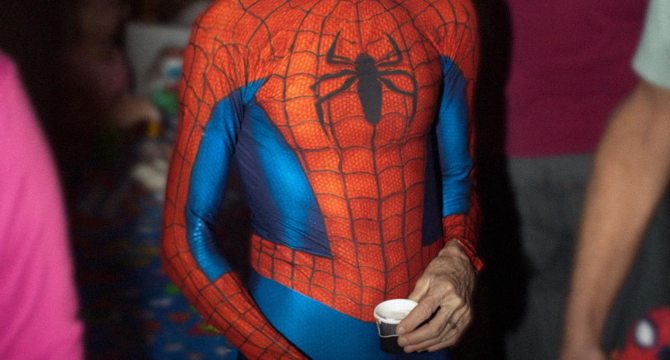
On that particular afternoon, he was dressed as Spider-Man.
The red-and-blue suit clung uncomfortably to his tired frame, and the mask made the heat feel worse. The party was being held in a backyard filled with colorful streamers and plastic tables covered in cake crumbs and paper plates.
Parents chatted in small clusters, half watching their children, half checking their phones. Music played from a speaker near the patio. Under the hot sun, Brian did his best to become someone lighthearted, someone the children could cheer for without thinking too hard about the man under the mask.
He made the kids laugh.
He waved his arms dramatically, pretended to shoot webs, and joined in games that left him breathless but oddly grateful. For a while, everything felt normal.
That was the dangerous part. Normal could fool a man into hope.
When the children crowded around him, chanting for Spider-Man to dance again, Brian gave them one more exaggerated spin, one more clumsy pose. Their laughter rose around him, bright and easy. It almost drowned out the ache in his knees and the heaviness that never quite left his chest.
Then the heat caught up with him.
During a short break, Brian stepped toward the side of the yard, away from the music and the noise. He bent slightly, bracing his hands on his thighs, and drew in a careful breath.
His face was damp, his skin burning beneath the mask. Thinking no one was paying attention, he lifted it for just a second to catch his breath.
It was only a second.
But it was enough.
The moment the kids saw his face, everything changed.
The laughter stopped so abruptly that Brian felt it before he fully understood it. He looked up and found several children staring at him. Their eyes held the blunt confusion only kids could show so openly. A few of them leaned toward one another and started whispering. Then came the giggles.
This time, they were not laughing with him.
“Why is Spider-Man so old?” one kid said loudly.
Brian froze.
The mask hung in his hands.
He did not know whether to put it back on quickly or pretend he had not heard the question at all. Heat rushed to his face, and for a moment, he felt older than he had ever felt in his life.
The suit suddenly seemed ridiculous. The bright colors, the silly act, and the effort he had made to seem cheerful all turned fragile at once.
A couple more children laughed. One pointed. Another covered his mouth and whispered something to a friend.
Brian swallowed hard and looked down at the mask, ashamed of how much that one sentence had shaken him.
He had been pitied before.
Ignored, too. But being mocked by children while dressed as a hero was a humiliation so sharp that it left him speechless.
And then, suddenly, a little girl’s voice cut through the noise.
“Shut up!”
The words rang across the yard.
Everyone turned.
The little girl stepped forward, her small hands clenched at her sides. Tears filled her eyes, but her gaze never left Brian’s face. The shock in her expression shifted into something deeper, something that made Brian’s pulse stumble.
“This… this can’t be,” she said quietly.
Brian stood frozen, the Spider-Man mask hanging from his hand as the backyard fell silent around him.
Her small chest rose and fell quickly. Tears shimmered in her eyes, but now there was uncertainty in them, too, as though she was trying to make sense of something she had only half understood.
A woman hurried over from near the cake table. She looked to be in her late 30s, elegant but tired around the eyes, with the kind of face that suggested she had learned to hold herself together in front of other people. She rested a hand on the girl’s shoulder.
“Emily,” she said gently, “what is it?”
Emily pointed at Brian with a trembling finger. “Mom,” she whispered, “he looks like the man in your photo. The one in your room.”
Brian’s breath caught.
The woman turned toward him properly then, no longer glancing at him as a party entertainer, but looking. At first, she only seemed confused. Brian could hardly blame her. Time had thinned him out, carved lines into his face, and bent his shoulders. The bright costume only made him look more absurd.
Then he saw her expression change.
A flicker of recognition touched her eyes, then vanished, then returned stronger, as if memory were fighting its way through shock.
Brian stared at her, feeling his heart pound with something close to fear.
“Rachel?” he said softly.
She went completely still.
Her lips parted, but no sound came out. For a moment, she looked like a woman staring at someone she had once buried in her heart just to survive. Her hand slipped from Emily’s shoulder.
“Dad?” she whispered at last.
The word broke something open inside him.
Brian had imagined many reunions during the long nights when sleep would not come. In some, his children refused to speak to him. In others, they cried and embraced him.
But none of those dreams had placed him in a faded Spider-Man suit, standing in a stranger’s yard under the eyes of children and parents, with his daughter looking at him as though she had stumbled into the past.
“I didn’t know this was your house,” Brian said, his voice rough. “I only came for the job.”
Rachel blinked hard, tears rising too fast for her to hide.
“We thought you were gone. Liam told me you stopped calling. He said you didn’t want us anymore.”
Brian shook his head at once. “Your brother lied. I called until I couldn’t. I tried for so long, Rachel. Then I lost everything. I thought all of you had decided I wasn’t worth answering.”
Rachel covered her mouth, and the pain in her face was so raw that Brian had to look away for a second. He felt suddenly exposed, not because of the costume, but because every lonely year had now stepped into the light with him.
Emily looked from one face to the other, her tears spilling freely now. “Mom,” she said, voice trembling, “is he really Grandpa?”
Rachel gave a broken nod.
That was all Emily needed. She ran forward and wrapped her arms around Brian’s waist. The force of it nearly took what little strength he had left. Brian stiffened in surprise, then slowly folded one arm around her, holding her as carefully as if she might disappear.
“Grandpa,” she cried into the costume, “I knew he looked like you in the picture.”
Brian closed his eyes. He had gone years without hearing that word. Years without feeling a child cling to him with love instead of fear or mockery. The warmth of her small body against him undid him more completely than any cruelty ever had.
His throat tightened.
“Hello, sweetheart,” he managed.
Rachel stepped closer, wiping at her cheeks, though more tears kept coming. “I kept that old photo of you holding me on your shoulders at the county fair. Emily saw it a few weeks ago and kept asking about you. I don’t even know why I let myself believe the story I was told. Maybe because it hurt less than thinking you needed us and we weren’t there.”
Brian looked at her then, really looked. Beneath the guilt and grief, he saw the daughter he remembered. Not the girl she had been, but the woman life had shaped from her. There was regret in her eyes, but also love, bruised and delayed, yet still alive.
“I never stopped needing you,” he said.
Rachel let out a trembling breath. “Then let us fix this. Please.”
The party around them no longer mattered. The parents who had been watching looked away politely or began gathering plates and gifts, sensing something sacred had taken over the afternoon. The laughter from earlier had vanished. Even the children were quiet now.
Emily pulled back just enough to look up at him. “Are you coming with us?”
Brian hesitated. Years of disappointment had taught him to be careful with hope. Hope could make a fool of a man faster than poverty ever could. But Emily’s hand slid into his, small and trusting, and Rachel stood before him with tears on her face and no distance left in her voice.
“Yes,” he whispered.
Rachel gave a shaky laugh through her tears. “Good. Because you are not going back to the streets.”
When the party finally broke apart, Brian changed out of the Spider-Man mask but kept the suit on beneath an old jacket someone found for him. Emily refused to leave his side. She held his hand all the way to the car as if she thought he might vanish if she loosened her grip.
Brian climbed in slowly, his worn duffel bag resting at his feet. As Rachel started the engine, he looked out at the fading sunlight spilling across the quiet street.
That morning, he had arrived as an old man pretending to be a hero for strangers’ children.
That evening, he left as Brian again.
A father. A grandfather. And a man who, after years of being forgotten, had finally been seen.

 admin
admin