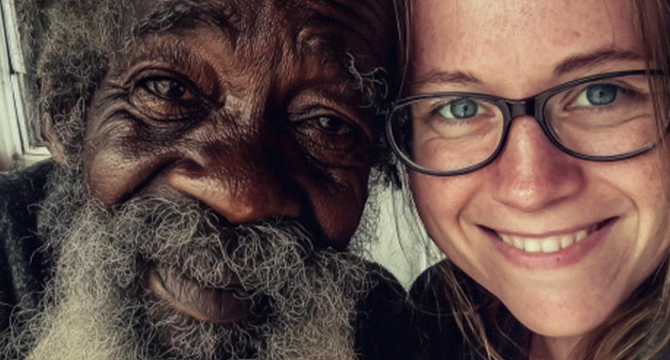
At first, it really was simple.
Every morning, I stopped by the same coffee shop on my way to work. It sat on the corner between my office building and a narrow street lined with dry cleaners, flower stands, and a newsstand that never seemed to open on time.
The barista knew my order before I reached the counter.
Medium latte, one pump of vanilla, no foam.
And almost every day, I saw him sitting by the entrance.
He always had the same old backpack beside him and the same quiet expression on his face. He didn’t hold out a cup. He didn’t ask for money.
He didn’t even look up at people the way some did when they were hoping to catch your eye. He just sat there, like he was trying to take up as little space in the world as possible.
For the first week or two, I only noticed him in passing. I would glance at him, then look away and tell myself the same thing most people do.
Someone else will help.
I’m in a hurry. I already donate. I can’t save everybody.
The truth was uglier.
I had become very good at walking past pain, especially if it threatened to stir up my own.
Then one morning, I came out of the shop carrying my coffee, saw him sitting there in the cold with his hands tucked into the sleeves of his worn coat, and stopped.
I went back inside and bought an extra coffee and a sandwich.
When I handed them to him, I felt awkward for no reason at all, like kindness needed an explanation.
“Hi. This is for you.”
He looked up, surprised, then gave a small nod.
“Thank you.”
That was it.
No dramatic speech. No heartbreaking story. Just two words spoken in a low, rough voice.
After that, I started bringing him something every day.
Some mornings it was coffee and a sandwich. Other days, it was tea and a muffin, depending on what looked freshest behind the glass case.
I told myself it was a small thing, barely an inconvenience to me, but over time it became something steadier than that. A ritual. A quiet thread in the middle of my rushed, structured life.
We barely talked.
Usually, it was just quick “good mornings” and “thank yous.” Sometimes he would nod before I even said anything, as if he had already expected me. I didn’t know why that small sign of trust affected me so much, but it did.
I didn’t even know his name.
And somehow, that made it easier.
Names make people real in ways that can be dangerous. Real people stay with you. Real people can hurt you.
A few weeks passed, and I learned a few things without asking. He was always there before I arrived. He kept himself neat, even in the same weathered clothes.
He never pushed, never begged, and never tried to keep me talking. There was a calmness about him that unsettled me even then, though I could not have explained why.
By then, I had started looking for him before I reached the coffee shop.
That realization should have embarrassed me, but instead it made me feel strangely less alone.
Then one morning, I approached him like usual, balancing the paper bag in one hand and my coffee in the other.
“Good morning.”
He looked up at me.
And suddenly smiled.
“Good morning… Emmy.”
Something inside me dropped.
The world did not stop. Cars still moved through the intersection. Someone behind me laughed. The coffee shop door opened and closed. But inside me, everything went still.
Only one person had ever called me that.
My father.
And he had been gone for ten years.
The bag nearly slipped from my hands.
“How… do you know that?”
He looked at me calmly. Too calmly.
“I know a lot more about you than you think.”
My hands went cold.
I didn’t ask anything else.
I couldn’t.
My throat had closed up, and every nerve in my body screamed at me to get away from him.
So I just turned around and walked away.
I almost ran.
All day, I could barely function. I heard my coworkers talking, saw emails piling up, and answered questions I would not remember later. My mind stayed fixed on that one word.
Emmy.
I had not heard it in a very long time. Not since before my father died. Not since I packed away every photo that still smelled like him and taught myself not to reach for memories that would only leave me hollow.
But that night, there was no escaping it.
I couldn’t sleep. His voice, that name, the memories I had tried so hard to bury, they kept replaying in my head.
It couldn’t be a coincidence.
But I had no explanation.
Because I knew, if I didn’t find out the truth, it would never let me go.
The next morning, my legs felt unsteady as I crossed the street toward the coffee shop.
For a moment, I almost turned back.
Fear still clung to me, heavy and irrational. I kept hearing that one word in my mind. My father’s voice had lived in that nickname, in a hundred soft memories I had locked away because they hurt too much to hold.
But the thought of not knowing was worse.
He was there, in the same place by the entrance, his old backpack at his side. When he saw me, he did not smile this time. He just watched me carefully, as if he understood that one wrong move would send me running again.
I stopped in front of him and gripped the paper bag tighter.
“Tell me who you are,” I said, trying to keep my voice steady.
He nodded once.
“My name is Michael.”
I waited, but he seemed to sense I needed more than that.
“I knew your father,” he said gently. “A long time ago.”
My chest tightened. “How?”
Michael looked down at his hands before answering. “We worked together. Years back. Before everything changed.”
I sat down on the empty bench near him, though every nerve in my body still felt alert.
“My father never mentioned a Michael.”
He gave a sad little smile. “That doesn’t surprise me. I was just a man who happened to show up at a hard time.”
Then he told me.
I was only a child when my father lost his job. I remembered the tension in our apartment, the whispered conversations behind closed doors, and my mother quietly crying in the kitchen when she thought I was asleep.
I remembered my father trying to smile for me anyway, calling me Emmy as he tied my shoelaces or packed my school lunch, like he could shield me from what was happening just by sounding cheerful.
Michael had been there during those months.
“He was proud,” Michael said, his voice roughening. “Too proud to ask for help, but I could see what he was carrying. I knew someone at a warehouse who needed a dependable man. I put in a word for him.”
I stared at him.
“He got that job because of you?” I whispered.
Michael nodded. “Your father thanked me more times than I deserved. Said I helped his family stay afloat. Truth is, he would’ve done the work himself. I just opened one door.”
My eyes stung.
I thought about all the nights my father came home exhausted, all the mornings he still made time to braid my hair badly and make me laugh. I had known he struggled. I had never known someone had reached out a hand.
“What happened to you?” I asked softly.
For the first time, his calm expression cracked.
“Life,” he said, then let out a hollow laugh. “Bad choices. Worse luck. My wife got sick. Bills piled up. I lost work. Then I lost the apartment. After that, things kept slipping.”
He said it plainly, without trying to win pity, and that made it hurt more.
I glanced down at the coffee bag in my lap, and suddenly something clicked.
“The name,” I murmured. “You saw my last name on the bag.”
Michael looked at me with tired eyes.
“The first day you brought me coffee, I noticed it. I thought it had to be a coincidence. But then I looked at you again, and there was something of him in your face. After that, I knew.”
I covered my mouth with my hand.
For him, this had been an unexpected meeting with a piece of his past. For me, it felt like the ground beneath my life had shifted. The man I had been helping in small, casual ways had once helped my family survive.
I looked at him for a long moment, then asked, “Why didn’t you tell me sooner?”
“I didn’t want anything from you,” he replied. “And I wasn’t sure you’d want to remember.”
That broke something open inside me.
My father had spent his life giving what he could, even when he had little. And here I was, standing in the middle of a kindness that had circled back years later, asking to be seen.
So I did not walk away this time.
I sat with Michael that morning until I was late for work. Then I came back the next day, and the day after that. Little by little, I stopped bringing only food. I helped him replace his documents.
I made calls.
I found a local program that could get him temporary housing.
A friend of mine connected him with part-time maintenance work. None of it was instant, and none of it was easy, but for the first time in years, Michael had somewhere to go besides that patch of sidewalk.
A few months later, he met me outside the same coffee shop, wearing clean clothes and holding a set of keys to a small rented room.
He looked almost embarrassed when he smiled.
“You did all this,” he said.
I shook my head and felt my throat tighten. “No. You did this first. You helped my father when no one else did. I’m just returning it.”
Michael’s eyes filled, and so did mine.
On my way home that evening, I thought about my father, about the man who had once saved us without asking for praise, and about how close I had come to walking away forever.
Sometimes kindness does not disappear.
Sometimes it waits years, circles back quietly, and asks for one more chance to matter.
And this time, I was ready to answer it.

 admin
admin