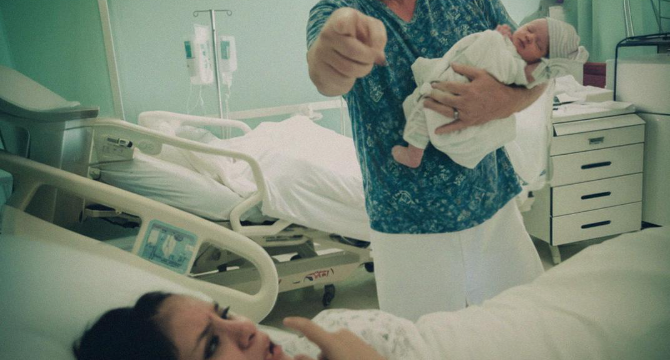
I was only 25 when I gave birth to my first child, a beautiful baby girl named Allie, whom everyone had been waiting for.
The entire family was in the hospital that day, gathered together in quiet anticipation. My husband stood beside me, nervous but proud, while relatives filled the room with soft laughter and warm smiles. Even the nurses seemed to sense how much this moment meant to us.
For years, my dad, Adam, had talked about this day. He used to joke that he would spoil his grandchild more than he ever spoiled us. He had followed every step of my pregnancy, asking questions, remembering details, counting down the days.
But the delivery did not go the way we had planned.
Because of sudden complications, I had to undergo an emergency cesarean section. Everything happened quickly, and I was too overwhelmed to fully understand what was going on around me.
We were told that, due to hospital protocol, the baby would be taken for initial assessment and monitoring before being brought to me in recovery. My husband stayed with me the entire time, which meant neither of us actually saw her immediately after she was born.
At the time, I did not question any of it. I trusted that everything was exactly as it should be.
The first time we held her was in the recovery room, just the two of us, after what felt like hours of waiting.
She was perfect.
Tiny. Warm. Peaceful.
I remember thinking that nothing in the world could ever take that moment away from us.
Now it was time to share her with everyone else.
When the nurse finally walked in, carrying our baby wrapped in a soft pink blanket, the entire room seemed to pause.
“Go on, Grandpa Adam,” my husband said with a smile. “You should be the first.”
My father stepped forward slowly. His hands trembled slightly as he reached out, like he was afraid the moment might slip away if he moved too fast.
When the nurse placed Allie in his arms, his face softened immediately.
For a second, everything felt exactly the way it was supposed to.
He looked down at her, studying her tiny features, her closed eyes, her small fingers curled into soft fists.
Then his gaze shifted.
It moved from her face… down to the small hospital band wrapped around her ankle.
He leaned in slightly, squinting as if making sure he had read it correctly.
The change in him was instant.
The warmth disappeared.
His jaw tightened.
The color drained from his face.
The room grew quiet, the kind of silence people notice before they understand why.
“What is it?” my mom, Linda, asked, her voice cautious.
He did not answer right away.
He kept staring at the band.
And then, in a voice that cut through the room, he said:
“This is not my grandchild.”
The words landed like a shockwave.
“What are you talking about?” my mother snapped, stepping closer.
My father gently lifted the baby’s ankle, just enough for the band to show.
“Her blood type,” he said, his voice steady now. “It says AB.”
He looked directly at me, then at my husband.
“That is not possible.”
The confusion spread instantly.
“What does that even mean?” someone asked.
“It means something is wrong,” he replied. “Both of you are type O. Two type O parents do not have a child with type AB. It does not happen.”
A few relatives exchanged uncertain glances.
Others reacted immediately.
“Adam, stop,” my mother said sharply. “You are not making sense.”
“It is just a hospital band,” my aunt added. “Those things can be wrong.”
“You are overthinking this,” someone else said. “Just enjoy the moment.”
I felt my chest tighten, heat rising to my face as every eye turned toward me.
“Dad, please,” I said, my voice shaking. “Not now.”
But he did not back down.
“There is a mistake,” he insisted. “You need to check this. This is not right.”
My husband stepped forward, his expression tense.
“Enough,” he said firmly. “This is not the time for this.”
The nurse quickly stepped in, clearly uncomfortable.
“We will verify everything,” she said, trying to calm the situation. “Please do not worry.”
But the damage had already been done.
The room, once filled with warmth, had turned heavy with tension.
And then the judgment came.
“You are ruining this day.”
“How could you say something like that?”
“That is your granddaughter.”
I felt something inside me break.
Not from fear.
Not from doubt.
But from humiliation.
“Please leave,” I whispered.
My father looked at me, and for a brief second, something in his expression shifted. There was pain there. Not anger. Not pride.
Pain.
But he nodded.
And without another word, he turned and walked out.
No one stopped him.
No one defended him.
And just like that, the moment we had all been waiting for was gone.
We never spoke about it again.
The hospital later assured us that everything had been properly documented. They said the band must have been mislabeled. It happens, they told us.
We chose to believe them.
We had to.
Because the alternative was unthinkable.
And so we moved on.
Allie grew into the sweetest little girl.
She had a laugh that filled every room and a kindness that made everyone around her feel safe. She was gentle, thoughtful, and endlessly loving. From the moment she could speak, she called me her best friend.
My husband adored her.
I did too.
There was never a moment when she did not feel like mine.
Ten years passed.
I was 35 when I decided to do a routine health screening. It included a genetic test, something meant to help identify potential health risks and connections within the local database.
I almost did not do it.
It felt unnecessary.
But I went anyway.
When the results came in, I sat at the kitchen table, scrolling through them without much thought.
Until I saw it.
A match.
At first, I assumed it was distant family.
But as I read further, my stomach dropped.
This was not distant.
This was direct.
Another ten-year-old girl.
Living just miles away.
Biologically mine.
My hands started to shake.
“No,” I whispered. “That is not possible.”
My husband found me sitting there, frozen, staring at the screen.
“What is it?” he asked.
I turned the laptop toward him.
He read it.
And just like me, he went completely still.
The report was clear.
There was no mistake.
Somewhere nearby, there was a child who shared our DNA completely.
Our daughter.
The next few weeks were a blur.
We contacted the hospital.
We pushed for answers.
We went through legal channels, demanding records, timelines, anything that could explain what had happened.
And slowly, painfully, the truth came out.
There had been a mix-up.
Two baby girls, born within minutes of each other.
A mistake during post-delivery handling.
One that no one had caught.
One that had gone unnoticed for ten years.
Our biological daughter had been sent home with another family.
And that family…
They had not stayed together.
The child had ended up in the foster care system.
Moving from one home to another.
Never staying long enough to feel like she belonged anywhere.
When I heard that, something inside me broke completely.
“She was alone,” I sobbed. “All this time… she was alone.”
My husband held me, but I could feel his own pain just as deeply.
Then I looked across the room.
At Allie.
She was sitting quietly, watching us with wide, worried eyes.
She did not understand what was happening.
She only knew something was wrong.
And in that moment, one truth became painfully clear.
She was ours.
Not by blood.
But by every moment, every memory, every piece of love we had given and received.
“We are not losing her,” my husband said firmly.
I shook my head immediately.
“Never.”
We made a decision that day.
We would find our daughter.
And we would bring her home.
But we would not abandon the child we had raised.
We fought for her.
It was not easy.
There were legal battles, investigations, endless paperwork.
But eventually, we found her.
She was smaller than I expected.
Quieter too.
She did not run into our arms.
She did not call us Mom or Dad.
She just looked at us carefully, like she was trying to decide if we were safe.
So we did not rush her.
We sat beside her.
We spoke gently.
We let her come to us on her own terms.
And slowly, she did.
We brought her home.
Not as a replacement.
Not as a correction.
But as part of our family.
And Allie…
Allie did something I will never forget.
She welcomed her.
Without hesitation.
She shared her room.
Her toys.
Her space.
Her heart.
As if she had always been meant to have a sister.
One night, after both girls had fallen asleep, I sat beside my husband and whispered the question that had been sitting in my chest for weeks.
“How did he know?”
My husband looked at me.
“My dad,” I said softly. “He knew from the very beginning. Why could he see it… and we could not?”
Tears filled my eyes.
“We all pushed him away. We all made him feel like he was wrong.”
There was only one thing left to do.
We went to see him.
It had been years.
Years of distance.
Years of silence.
When he opened the door and saw us standing there, with two little girls beside us, his expression changed instantly.
He understood.
Before we said a word.
“I am so sorry, Dad,” I said, my voice breaking. “I should have listened to you. I should not have dismissed you like that.”
For a moment, he said nothing.
Then he stepped forward and pulled me into his arms.
“I never wanted to be right,” he said quietly.
When he finally looked down at the girls, his eyes softened in the same way they had that day in the hospital.
But this time, the warmth stayed.
He knelt down slowly and opened his arms.
Both girls stepped forward.
And just like that, he held them close.
No hesitation.
No doubt.
Just love.
We had lost ten years.
But we had found our way back.
And this time, we were not letting go.

 admin
admin