For three years, I told myself I could handle Eleanor.
I said it every time she looked me up and down with that tiny, practiced smile, the one that never reached her eyes. I said it when she “forgot” to save me a seat at family dinners.
I said it when she complimented other women in front of me for their taste, their poise, and their pedigree, as if those were the only things that made a person worth knowing.
My mother-in-law, Eleanor, is 65 and comes from old money.
She wears designer clothes everywhere, even to brunch at home, and carries herself like the whole world should part when she enters a room. From the moment Mark introduced me to her, she made it clear that I was not what she wanted for her son.
I am Rachel, 28 years old, a public school teacher who loves paperbacks, sensible shoes, and finding joy in small things. To Eleanor, that translates to one thing.
Not being good enough.
Mark, my husband, 30 and endlessly patient, always saw through her. “You don’t have to prove anything to her,” he would tell me when we got back from another strained visit. He would take my hand, rub circles into my palm, and wait for the tightness in my chest to ease.
“I know,” I would say, even when I did not fully believe it.
Because the truth was, part of me kept hoping she would change. I thought if I stayed polite long enough, if I ignored her passive-aggressive comments, her accidental exclusions, and constant remarks about my clothes, she might eventually see me as more than a disappointment in modest heels.
She never did.
Last weekend was her lavish 40th anniversary party, and I should have known better than to expect anything different. The event was held at a country club outside the city, in a ballroom dripping with chandeliers and white roses.
Everything gleamed. The silverware sparkled. The women floated around in silk and diamonds. Even the champagne seemed expensive in a way I could not explain.
I stood near the entrance for a moment after we arrived, smoothing down my navy dress, suddenly aware of every seam and every inch of fabric.
“You look beautiful,” Mark murmured beside me.
I let out a small laugh. “I look like a public school teacher at a billionaire wedding.”
He grinned. “You look like my wife. That is the best person in the room.”
That helped. It always did.
Before the party, Mark and I had agreed on a modest gift. We had gone back and forth about it for days. Eleanor had everything money could buy, and the idea of trying to compete with her wealthy friends felt pointless.
Still, I wanted to bring something thoughtful.
Something real.
So I found a small gift, wrapped it neatly in a box, and spent $50 on it. Fifty dollars was not a fortune, but it was not nothing to me either. I chose it carefully, with more heart than Eleanor would probably ever know.
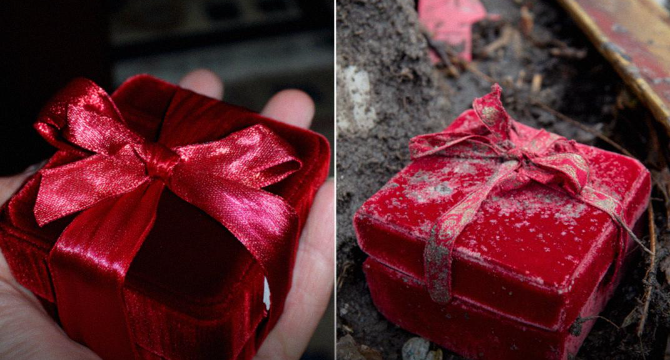
When the gift table started to overflow with glossy bags from luxury stores, I felt a knot form in my stomach. I saw velvet jewelry boxes, embossed packaging, and ribbon so crisp it looked professionally tied.
One guest loudly mentioned custom diamonds.
Another handed over what sounded like a weekend spa package at some exclusive resort.
I kept my smile in place, but I could feel myself shrinking.
Mark noticed. He leaned in and said softly, “Don’t do this to yourself.”
“I’m trying not to.”
Later, Eleanor began opening gifts in front of everyone. Of course she did. She sat in a gilded chair near the center of the room like a queen receiving tribute; guests gathered around her in a half-circle with drinks in hand.
She opened each box slowly, making a show of it.
She admired bracelets, scarves, and luxury items with delighted little gasps. People laughed, clapped, and basked in her approval.
Then she picked up mine.
I knew it the second I saw the wrapping paper in her manicured hands. My breath caught.
She weighed it, then smirked.
“Oh, how quaint,” she said loudly. “I suppose this is what a teacher’s salary affords.”
A few people chuckled.
Others stared down into their glasses.
I could not move.
And then, without even opening it, she stood, walked over to a nearby trash can, and dropped it straight into the trash.
The room went silent.
I felt the heat rush to my face so fast it almost made me dizzy. My skin burned with humiliation. For one awful second, I thought I might cry right there in front of everyone. I wanted to disappear. I wanted to run.
I was ready to leave.
I turned slightly toward Mark, already imagining the cold night air outside and the long ride home in silence.
But Mark stood up.
Calm. Silent.
He walked to the trash, pulled the gift out, unwrapped it slowly, and looked at it for a moment.
Then he turned to her.
“You know, Mom,” he said quietly, “I think you just threw away the only thing Dad would have truly cared about.”
And then he showed her what was inside…
It was a photograph.
Not just any photograph. It was an old one of Eleanor and her late husband from their earliest years together, back when they had almost nothing.
I had found it tucked into a worn album in a cabinet during one of our visits months earlier, its corners bent, its surface faded and scratched by time.
Mark had told me his father cherished that picture because it was taken in the tiny apartment where their life together began, long before wealth and appearances took over.
I had it carefully restored and framed behind simple glass.
Nothing flashy. Nothing expensive. Just beautiful, honest, and full of memory.
Mark held it up for everyone to see.
In the photo, Eleanor looked impossibly young, standing barefoot in a cramped kitchen, laughing at something her husband had clearly just said. Her hair was pinned back carelessly, and she wore no jewelry at all.
His arm was around her waist, his grin wide and proud, like he already knew he was the luckiest man in the world.
The wallpaper behind them was peeling. The lighting was poor. But the love between them was so clear it almost seemed alive.
For the first time that evening, Eleanor had nothing to say.
Her face changed as she stared at the photo in Mark’s hands. The color drained from her cheeks. Her lips parted, but no sound came out.
“Mom,” Mark said, still quiet, “Dad kept this picture for years. He said it reminded him of when you two were happiest.”
The room remained still. No one reached for a drink.
No one whispered.
Eleanor stepped forward slowly, as if she were afraid the photo might disappear. “Where did you get that?” she asked, but her voice had lost all of its sharpness.
“I found the original in the old album. It was damaged, so I had it restored.”
She looked at me then, really looked at me, and I saw something in her expression I had never seen before.
Not judgment. Not disdain.
Shame.
Her eyes filled so suddenly that it seemed to catch even her off guard. She pressed a hand to her mouth and stared at the image again. “He loved this one,” she whispered. “Oh, my God.”
Mark handed it to her.
The moment her fingers touched the frame, she broke.
A sob escaped her before she could stop it. Her shoulders shook, and she clutched the photograph to her chest like it was the only thing keeping her upright.
All the polished elegance was gone.
The perfect hostess, the woman in designer clothes who ruled every room, vanished in an instant. In her place stood a widow who had just been handed a piece of her real life back.
“He used to say,” she began, then stopped to catch her breath. “He used to say those were our richest years because we had nothing but each other.”
No one moved.
Tears slipped down her face, ruining her makeup, and she did not seem to care. “I threw it away,” she cried, looking at the frame with trembling hands. “I threw it away without even opening it.”
I stood frozen, unsure if I should say anything at all.
Then Eleanor lifted her head and turned to me. “Rachel,” she said unsteadily, “I am so sorry.”
The words hit me harder than I expected.
She took a shaky breath. “I have been cruel to you. Petty. Snobbish. I made you feel small because I could, and tonight I humiliated you in front of everyone.” Her voice cracked. “And you still gave me something more thoughtful than anything else in this room.”
I swallowed hard, my chest tightening.
“I forgot who I used to be,” she went on. “I forgot what mattered to him. To us. Somewhere along the way, I started measuring everything by price.”
She looked down at the photograph and gently traced her late husband’s face through the glass. “He would be ashamed of me tonight.”
Mark stepped closer.
“Then remember him properly.”
Eleanor let out a broken laugh through her tears. “I’m trying.”
For a moment, I saw the woman from the photograph standing in front of me. Not the sharp-tongued mother-in-law who had spent three years trying to cut me down, but a younger woman who had once built a life from scratch with someone she loved.
A woman who had known how little money mattered when love was real.
She crossed the space between us and reached for my hand.
“Can you forgive me?”
I looked at her, at the trembling fingers wrapped around that restored photo, and at the vulnerability she had never let anyone see.
I thought about every cutting remark, every exclusion, and every time I had gone home wondering what was so wrong with me. I could have held on to all of it.
Instead, I saw grief. Regret. And maybe the beginning of change.
“Yes,” I said quietly. “I can.”
She pulled me into a hug so suddenly that I almost gasped.
It was not graceful. It was not polished. It was desperate and real, and when I hugged her back, I felt her crying against my shoulder.
Later that night, as the party slowly found its rhythm again, Eleanor kept the photograph beside her and never let it out of reach. Before we left, she touched my arm and said, “Thank you for reminding me what love looks like.”
On the drive home, I stared out the window for a while, letting the night settle around me.
Mark glanced over and smiled. “Are you okay?”
I smiled back, my eyes still stinging.
“Yeah. I think your mom finally opened my gift.”
Mark reached over and intertwined his fingers with mine. “You changed something tonight.”
I looked down at our hands and smiled through the last of my tears. “No, I think your father did.”
And in the end, that was the lesson Eleanor needed most. Diamonds, designer clothes, and lavish parties could impress a room full of people, but they could never hold a candle to the kind of love that survives the hardest years.
The only gift that truly mattered was the one that reminded her who she had been, who her husband had loved, and what wealth really meant.
That night, she threw away a fifty-dollar gift.
But what she got back was priceless.

 admin
admin