For the last five years, I had poured everything I had into maintaining the property I inherited from my late grandmother. It wasn’t just a house. It was her legacy.
And nothing mattered more to her than the rose garden.
It took up the entire side yard — rows and rows of carefully cultivated blooms, each one planted with intention. These weren’t ordinary roses. They were rare heritage breeds she had spent decades collecting, grafting, and nurturing.
Some of them couldn’t even be found in commercial nurseries anymore.
People would slow down when they drove past. Some even stopped to take pictures. It wasn’t just a garden — it was a landmark.
Karen bought the massive mansion next door — a place so big it looked like it belonged in a different neighborhood entirely. Within days, contractors were coming and going, luxury cars lined her driveway, and it became clear very quickly that subtlety wasn’t part of her personality.
Her biggest problem?
Her two-car garage wasn’t “sufficient,” nor was the driveway in front of her home.
Apparently, her growing collection of oversized SUVs needed more space. And somehow, she decided the solution to her problem was my land.
Specifically, my rose garden.
The first time she approached me, she acted like it was a simple business transaction.
“I’ll buy that strip of land from you,” she said casually, pointing straight at the garden. “Name your price.”
I remember smiling politely, even though something about her tone rubbed me the wrong way.
“I’m sorry,” I told her. “That garden belonged to my grandmother. It’s not for sale.”
Her smile didn’t drop immediately — but I saw the flicker.
“Oh, come on,” she pressed. “Everything’s for sale.”
“Not this,” I said firmly.
That was the moment everything changed.
Her expression hardened, just for a second, before she forced another smile.
“Well,” she said, her voice tighter now, “you might want to reconsider. It would be a shame if things… got complicated.”
At the time, I brushed it off as arrogance.
I had no idea it was a warning.
Last weekend, I had to attend a three-day work conference out of town. I almost didn’t go as I had a strange feeling in my gut, but I told myself I was being paranoid.
Nothing could happen in three days.
Right?
I came home Sunday evening, exhausted, already thinking about a hot shower and collapsing into bed.
But the moment I turned onto my street, something felt… wrong.
There were trucks.
Heavy machinery.
Bright orange cones.
My heart started pounding before I even pulled into my driveway.
And then I saw it.
My garden was gone.
Not damaged.
Not partially destroyed.
Gone.
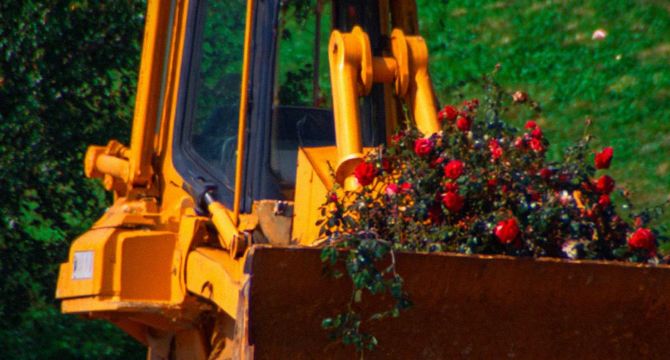
Every single rose bush — uprooted. The soil churned into mud. Decades of care erased like it meant nothing.
In its place stood a massive concrete foundation, still drying, with wooden framing rising out of it like a skeleton.
A garage.
A three-car garage.
Built directly over my property line.
For a moment, I couldn’t move.
Then the grief hit.
It felt like losing my grandmother all over again.
I don’t remember walking over, but suddenly I was there — standing at the edge of what used to be my garden.
Workers were moving around like nothing was wrong.
“Stop!” I shouted. “What are you doing?!”
A few of them paused, exchanging looks, but no one answered.
And then she appeared.
Karen walked out of the structure like she owned the entire street, sunglasses on, coffee in hand.
“Oh,” she said, feigning surprise. “You’re back.”
“What did you do?” My voice shook. “This is my property!”
She didn’t even flinch.
Instead, she reached into her designer bag, pulled out a folded document, and shoved it toward me.
“I had the land surveyed,” she said. “Turns out, this section belongs to me.”
“This isn’t right,” I said. “This has always been my land.”
“Well,” she replied coolly, “it isn’t anymore.”
“You can’t just do this.”
“I already did.”
Then her tone sharpened.
“And if you don’t leave my construction site right now, I’ll call the police.”
The police told me it was a civil matter.
The HOA stopped answering.
And the construction didn’t slow down.
If anything, it got faster.
It was like she was racing against something.
That’s when I realized — she had to be cutting corners.
So I called the city zoning office.
The inspector arrived the next morning.
Clipboard in hand.
Karen greeted him like she had nothing to worry about.
He didn’t respond.
He walked straight to the foundation.
Looked.
Paused.
And then everything changed.
“Ma’am,” he said finally, “this structure is not approved.”
Karen laughed. “That’s not possible,” she argued.
“There is no permit on file,” the man told her bluntly.
Her smile faltered.
“I have documentation.”
She handed him the survey.
He studied it.
Then frowned.
“This isn’t a registered survey,” he said.
Silence spread.
“No seal. No registration number. And this company — doesn’t exist in our records.”
Karen went pale.
The contractor stepped forward. “Is there a problem?”
“Yes,” the inspector said. “Work stops now.”
Engines shut down.
Tools went still.
The noise died instantly.
Karen’s voice rose. “You can’t just stop like that!”
“I can,” he said. “And I am.”
He posted a bright notice on the frame.
STOP WORK ORDER.
Then came the words that changed everything.
“This structure will have to be removed.”
The demolition started three days later.
The same machines that destroyed my garden returned.
But this time — they tore her garage down.
Piece by piece.
No one watched with admiration now.
Only quiet judgment.
Karen stayed inside.
And for once — she wasn’t in control.
A week later, the calls started.
From the city.
From inspectors.
From legal offices.
The conclusion was simple.
Karen was fully liable. For everything.
The illegal build.
The destroyed garden.
The land restoration.
She didn’t just lose her project.
She had to pay for what she ruined.
When she came to my door, she didn’t look like the same person.
“I’ve been advised to coordinate with you,” she said stiffly. “About restoration.”
No apology.
Just obligation.
“That’s fine,” I said.
Because that’s all it was.
The crews returned one last time.
They cleared everything.
Removed the concrete.
Replaced the soil.
Smoothed the land.
It wasn’t the same, but it was mine again.
The check came last.
Large enough to cover everything.
Even what couldn’t really be replaced.
I held it for a long time.
Because it didn’t feel like a win.
Not really.
You can’t replace years of care.
But you can start again.
The first rose I planted felt strange.
The space was too empty.
Too quiet.
But I remembered my grandmother.
She didn’t build her garden all at once.
She built it slowly.
With patience.
With care.
One rose at a time.
A neighbor stopped by later that day.
She handed me a small cutting.
“I thought you might want this.”
I smiled.
“Thank you.”
By the end of the week, only a few plants stood in the soil.
Nothing like before.
But it was a beginning.
Sometimes, I still think about what was lost.
I probably always will.
But now, when I look outside, I don’t just see the past.
I see what’s growing.
What’s coming back.
What’s mine.
Karen tried to take something that didn’t belong to her.
In the end, it cost her everything.
And me?
I got something she never understood.
A chance to rebuild.
Just like my grandmother did.

 admin
admin