My father, Caleb, was the kind of man who could fix anything. Engines, transmissions, busted radiators — you name it, he could sort it out. For over 20 years, he ran the most trusted auto repair shop in Dellwood, a small town in rural Tennessee where everybody knew everybody and your reputation was everything.
Then, 15 years ago, Sheriff Miller accused him of stealing a vintage gold pocket watch.
That was it. That was all it took.
“Caleb, I’m going to need you to come down to the station,” Sheriff Miller had told him one afternoon, standing right in the middle of the shop floor with his thumbs hooked into his belt. “There are some things we need to clear up.”
My father went willingly because he had nothing to hide.
But in a town like Dellwood, an accusation from the sheriff is as good as a conviction. Within a week, customers stopped coming, old friends stopped calling, and the bank pulled his small business loan.
By the end of that first month, my father had lost almost everything he’d spent two decades building.
He never fully recovered.
He spent his final years in a quiet kind of grief, the sort that doesn’t make noise but hollows you out all the same. Last spring, he passed away in his sleep, still carrying the weight of a crime he never committed.
Meanwhile, Sheriff Miller became a town hero.
Over the years, I watched him shake hands at church picnics, get quoted in the local paper, and stand tall at every Fourth of July parade while my father sat alone in a small rented house on the edge of town.
This month, Miller announced his retirement.
Tonight, the town of Dellwood is throwing him a lifetime achievement ceremony at the high school gymnasium. I didn’t plan on attending the ceremony. But last month, while I was cleaning out my father’s attic, everything changed.
I was pulling old boxes away from the far wall when my foot caught on a loose floorboard. Beneath it was a small metal lockbox, dusty and cold. It took me 20 minutes and a flathead screwdriver to get it open.
Inside was the gold pocket watch.
My hands were shaking as I picked it up. It was exactly as I’d always heard it described — engraved case, Roman numerals, a small crack along the crystal face. I turned it over in my hands and just sat there on the attic floor for a long time, not saying a word.
But the watch wasn’t the only thing in that box. Wrapped carefully around it was a small leather-bound diary. The name on the inside cover stopped my breath cold.
Eleanor.
The sheriff’s late wife.
I spent the next three days reading every single entry.
Eleanor had been a quiet woman — thoughtful, precise, deeply private. Her entries painted a picture of a marriage that looked fine from the outside but was crumbling from within. Sheriff Miller, it turned out, had a serious gambling problem. He owed money to the wrong people. He was desperate, cornered, and looking for a way out.
The watch had belonged to Eleanor’s family. It was a family heirloom, passed down to her from her grandmother. Miller had taken it, and when she confronted him, he blamed my father.
He chose to blame my father to cover up what he’d done.
Eleanor knew. She had always known. And the guilt of it ate at her for years, right up until her final entry, written just three weeks before she passed.
Tonight, I have that diary in my jacket pocket. And I have the watch.
Dellwood gave Sheriff Miller 15 years of applause. Tonight, I’m going to give them the truth.
The gymnasium was packed by the time I arrived.
Folding chairs filled every inch of the floor, and the bleachers were lined three rows deep. Someone had hung a banner above the stage that read, “Thank You, Sheriff Miller — 35 Years of Service.”
There were balloons and a cake table.
My friend, Tessa, found me near the back doors before I even made it inside.
“Rowan.” She grabbed my arm, her voice low and tight. “You’re really doing this?”
“I am,” I said.
She looked at me for a long moment, then nodded slowly. “Okay. I’ve got you.”
I found a seat near the aisle and waited. The program moved through speeches, slideshows, and a video tribute that made half the room misty-eyed. Sheriff Miller sat up on the stage in a pressed uniform, silver-haired and straight-backed, smiling like a man without a single regret.
Marlowe, one of the town council members, stepped up to the microphone to introduce the public remarks portion of the evening.
“We’d like to open the floor to anyone who’d like to say a few words,” he announced warmly. “Friends, colleagues, folks whose lives Sheriff Miller has touched over the years.”
I stood up.
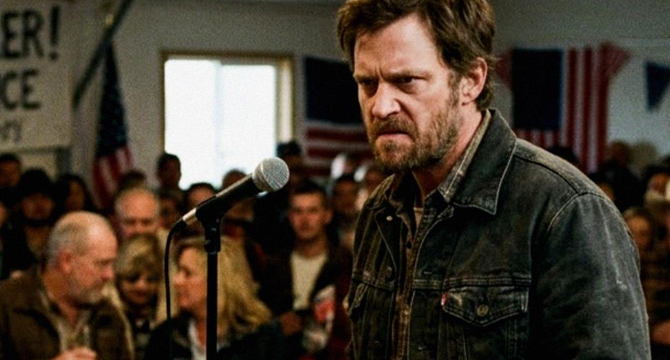
A few people glanced at me curiously as I walked to the front. I didn’t recognize most of them, and most of them didn’t recognize me. I was just some guy in a gray jacket. I kept my steps steady.
When I reached the microphone, I took a breath and looked out at the room.
“My name is Rowan,” I said. “Caleb was my father.”
The murmur started immediately.
I saw Vernon, an older man who had once been my father’s closest friend, sit up straighter in the third row. I saw Marlowe’s expression shift from pleasant to cautious.
I reached into my jacket and placed the gold watch on the podium.
The murmuring stopped.
“Fifteen years ago,” I said, “my father lost his business, his savings, and his reputation because Sheriff Miller accused him of stealing this watch.” I paused. “My father did not steal it. And I can prove that.”
I opened Eleanor’s diary to the final entry and began to read.
Her words were quiet and careful, the way Eleanor herself had always been. She wrote about the guilt that had followed her every single day. She wrote about the watch — how it had belonged to her grandmother, how Harold had taken it without telling her to pay off a gambling debt, and how, when she found out it was gone and confronted him, he told her he’d already blamed Caleb for taking it. She wrote that she had begged him to come clean. He refused. She wrote that she was leaving this entry as a record of the truth, because she could no longer carry it in silence.
“I am so sorry, Caleb,” her final line read. “You deserved better than what we did to you.”
By the time I looked up, the room was absolutely still.
Every head had turned toward the stage. Sheriff Miller’s face had gone the color of old ash. He gripped the armrests of his chair and, for a moment, said nothing at all.
Then Marlowe leaned toward the microphone.
“Sheriff,” he said carefully, “do you have something you’d like to say?”
Sheriff Miller stood slowly. He looked at the watch on the podium, then he looked at me. And then — just like that — something in him seemed to give way.
“It’s true,” Sheriff Miller said.
The words came out quietly, but in that silent gymnasium, everyone heard them.
“I made a terrible mistake.” His voice cracked at the edges. “I was in debt. I was scared. And I let an innocent man take the blame for something I did.” He paused, pressing his lips together. “There isn’t a day that’s gone by that I haven’t thought about Caleb.”
Vernon stood up from his chair. His face was red, and his jaw was set hard.
“You let us all turn our backs on him, Miller,” he said. “You let us believe he was a thief.”
Miller had no answer for that. He just stood there and took it.
And with that, the ceremony dissolved.
The banner stayed up, but nobody was looking at it anymore. People gathered in small clusters, voices low and shaken. I stayed near the podium until the room had thinned out considerably.
Tessa came and stood beside me. She didn’t say anything at first, just put her hand on my shoulder and kept it there.
“He knew the whole time,” she finally said softly.
“He knew,” I agreed.
Marlowe approached me before I left. He shook my hand firmly and held it a beat longer than necessary.
“I want you to know,” he said, “that what happens next is going to matter. We’re going to make sure of that.”
He kept his word.
In the weeks that followed, the town council opened a formal review. Miller’s retirement honors were quietly revoked. There were conversations, investigations, and more than a few difficult public meetings.
I won’t pretend the town handled it all gracefully — some people still struggled to accept what they’d heard, people who had admired Miller for decades and didn’t know what to do with that now. Change in a small town moves slowly, even when the truth is sitting right in front of you.
But something did shift.
A few months later, I got a call from Vernon. His voice was gruff, the way it always had been, but there was something softer underneath it.
“Rowan,” he said, “I’d like to do something for your father. Something right. Would you be open to talking about it?”
“Yeah, Vernon,” I said. “I would.”
What came next was his idea entirely.
The town raised a small memorial plaque and mounted it on the exterior wall of the old auto repair shop on Birch Street, the building that had once been my father’s whole world and was now a hardware store. The dedication was on a quiet Saturday morning. Maybe 40 people showed up.
The plaque read, “To a man who was unjustly accused, but whose truth eventually found its way.”
I stood in front of it for a long time after everyone else had drifted off. The morning was cool and clear, the kind of Tennessee morning my father always said was worth waking up early for.
I thought about him in that shop, hands black with grease, laughing at something on the radio. I thought about the years he lost, the friends who disappeared, the pride that got stripped away piece by piece. I thought about Eleanor, writing her confession alone in a quiet room, hoping someone would find it someday.
I pulled the collar of my jacket up and started walking back to my car.
I didn’t feel like celebrating. I didn’t feel like crying either. What I felt was something quieter — a loosening, somewhere deep in my chest, like a knot that had been there so long I’d stopped noticing it until it was finally gone.
My father never got his apology while he was alive. I can’t change that. But the town knows his name now — knows the real story behind it.
And for the first time in 15 years, so does everyone else.

 admin
admin