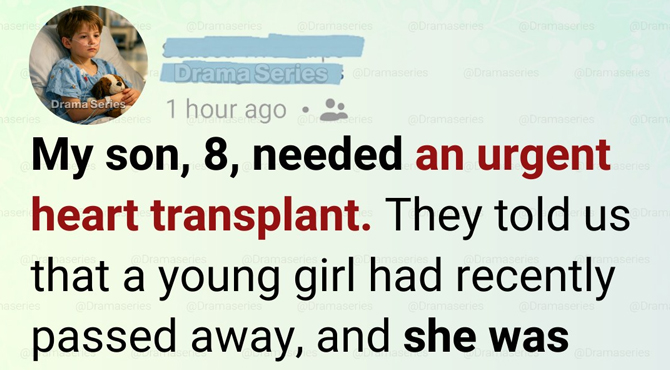
The night everything changed, the hospital hallway smelled like antiseptic and quiet desperation.
My eight-year-old son, Oliver, had been waiting for a heart transplant for nearly a year. Congenital cardiomyopathy, the doctors called it. His heart was too weak to keep up with the life an eight-year-old should have—running, laughing, chasing friends at recess. Instead, Oliver spent more time in hospital rooms than on playgrounds.
Every day felt like borrowed time.
I remember the moment the doctor walked in that evening. His face was serious, but there was something else in his eyes—hope.
“We have a match,” he said gently.
For a second I didn’t understand the words.
“A donor heart just became available. A young girl. Same blood type, same size range. It’s a very good match.”
My stomach dropped.
A young girl.
Somewhere in the city, another family had just lost everything.
But my son had a chance to live.
The surgery started just after midnight. The next ten hours stretched longer than any time I had ever lived through. I sat in the waiting room staring at the same spot on the floor, my hands locked together so tightly my fingers went numb.
Every time the operating room doors opened, my heart stopped.
Finally, the surgeon walked toward me, still wearing his cap and mask hanging around his neck.
“The surgery was a success,” he said.
The words broke something inside me. I cried in a way I didn’t know adults still could—shaking, breathless, grateful.
Oliver had a new heart.
Two weeks later, he was sitting up in bed, pale but smiling, surrounded by stuffed animals and balloons. His laughter had returned, fragile but real. The doctors said his recovery was going beautifully.
Life was slowly beginning again.
That afternoon, a nurse knocked softly on the door.
“There’s someone here asking for you,” she said. “A woman.”
I stepped into the hallway, expecting maybe a social worker or another doctor.
Instead, a woman stood near the window.
She looked tired in the way grief makes people tired—not from lack of sleep, but from carrying something too heavy to hold.
Her eyes were red, but steady.
“Are you Oliver’s mother?” she asked quietly.
“Yes.”
For a moment, neither of us spoke.
Then she held out a small wooden music box.
“I’m Emma’s mom,” she said.
The name hit me like cold water.
Emma.
The girl whose heart now beat inside my son.
I stepped forward instinctively, my arms starting to rise, wanting to hug her, to thank her, to say something meaningful.
But when she looked directly into my eyes, my blood ran cold—not because there was anger there, but because there wasn’t.
Only kindness.
She placed the music box gently into my hands.
“My daughter played this every night before bed,” she said softly.
The wood was smooth from years of use. Tiny carved flowers decorated the lid.
“She loved music,” the woman continued. “Every night she’d wind it up and listen until she fell asleep.”
Her voice trembled, but she kept going.
“One time she told me something I’ll never forget.”
She swallowed.
“She said, ‘Mom, I think my heart is too big for my body. That’s why it’s always racing.’”
My chest tightened.
The woman looked toward Oliver’s hospital room door.
Then she said something I will carry with me for the rest of my life.
“I need your son to have this.”
She gently closed my fingers around the music box.
“So when he can’t sleep… he’ll hear what her heart sounded like before it was his.”
For a moment, I couldn’t breathe.
This woman—who had buried her child just days ago—had driven across the city not to ask questions, not to demand anything…
But to give my son a piece of her daughter’s life.
Not just her heart.
Her song.
We stood there in silence, two mothers connected by something neither of us had chosen.
Finally, I managed to whisper, “Thank you.”
It felt too small for what she had done.
She nodded once, tears slipping down her cheeks.
“Take care of him,” she said.
Then she turned and walked down the hallway.
I never saw her again.
That night, after Oliver fell asleep, I opened the music box beside his bed.
A soft, delicate melody filled the room.
I imagined a little girl lying in her own bed somewhere across the city, listening to the same song, her heart beating fast with dreams and laughter.
Now that heart beats inside my son.
Oliver plays the music box every night before going to sleep.
He doesn’t fully understand where his new heart came from.
But sometimes he looks at me and says something that makes my throat tighten.
“Mom… when the music plays, my chest feels warm.”
I smile and kiss his forehead.
One day, when he’s older, I will tell him everything.
I will tell him about Emma.
About the girl whose heart was big enough to give another child a future.
And about her mother—who, even after losing her whole world, still found the strength to give more.
Because kindness like that deserves to be remembered.
Not just as a story.
But as a song that keeps playing.

 Editor1