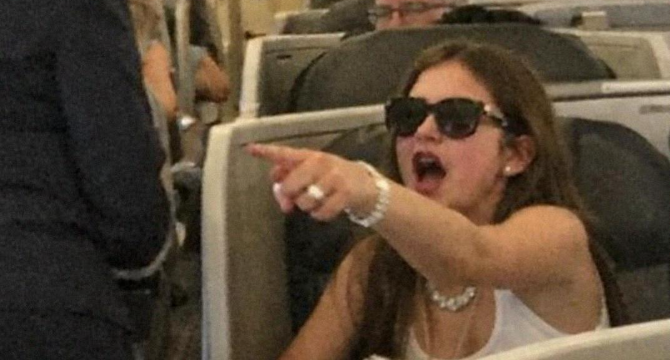
I have worked in the air for 28 years, and if that job teaches you anything, it is that people show you who they are very quickly when they think they will never see you again.
Some travelers say thank you before you even hand them a glass of water. Some apologize for asking for anything at all. Some talk to you like you are part of the furniture. And every now and then, one of them walks onto a plane carrying so much entitlement that it arrives before the luggage does.
That afternoon, I noticed her before she even reached her seat.
She could not have been more than 15. She had a cream-colored cashmere set on, white sneakers so spotless they looked untouched by the real world, and enough jewelry on both wrists to catch every light in the cabin.
The gate agent leaned in and said softly, “She’s flying alone. Her parents booked first class and left instructions that someone should keep an eye on her.”
I smiled the way I always do. “Of course.”
The girl did not smile back. She glanced at my name tag instead.
“Margaret?” she said, as if testing whether the name suited me. “Can you put this somewhere safe?”
She handed me a velvet pouch without waiting for my answer. I opened the compartment beside her seat and placed it inside.
“There you go.”
She sat down, crossed one leg over the other, and gave a small sigh. “Please make sure nobody touches my things.”
“Your things will be right there,” I said.
She lowered her sunglasses just enough to look at me directly. “That isn’t what I said.”
I had heard that tone before. Not often from someone her age, but often enough from adults who thought money gave them a different kind of blood. I kept my expression even.
“I understand.”
Once boarding was complete, I moved through the cabin checking belts, overhead bins, and seat backs. The girl — Chloe, according to the manifest — was already tapping furiously on her phone.
“Miss,” I said gently, “we’ll need your tray table up for departure.”
She did not look at me. “Then put it up.”
I reached for the table, folded it away, and stepped back.
“Anything else?” she asked.
“Not at the moment.”
She gave the smallest nod, almost triumphant, as though we had just completed some private test that she believed she had won.
After we were in the air and the first quiet stretch settled over first class, I began the beverage round. It is always my favorite part of a flight. By then, people have unclenched from departure, phones are tucked away, and the cabin finds its rhythm.
The businessman in 2A asked for sparkling water. The woman by the window in 3F wanted tea. A couple near the middle requested coffee and shared shortbread from a paper bag they had brought on board.
Then I reached Chloe.
She had taken off her sunglasses and was examining herself in the dark screen of her phone as though it were a mirror.
“Good afternoon,” I said. “Would you like something to drink?”
She held up one finger without looking at me. “What do you have that isn’t cheap?”
“Sparkling water, orange juice, apple juice, sodas, tea, coffee—”
“No, I mean actually good.”
I kept my tone warm. “We do have a premium juice blend in first class.”
She looked up then. Her gaze moved over my face, my uniform, and finally my hands. People notice my hands. There is no graceful way to say that, so I stopped trying years ago. The skin across both of them is pale and ridged in places, the result of heat that changed them forever.
My forearms carry it, too, though the long sleeves usually cover most of that. I have learned to accept the second look, the quick glance away, the curious stare when someone thinks I am not watching.
But Chloe did not glance away.
I lifted the tray slightly. “Would you like to try the juice blend?”
She stared at my hands. Then, in a voice sharp enough to cut across the whole cabin, she said, “Why are you touching my glass with those peasant hands?”
The words landed so loudly.
A woman in the row behind her lowered her book, and the businessman across the aisle looked up.
Chloe set her phone down too quickly, and it slid off the armrest onto the carpet. “Oh my God,” she snapped. “Look what you made me do.”
I had not touched the phone. We both knew that.
Still, I bent down to pick it up.
When I lifted the phone and straightened, Chloe was still glaring at me. Her chin was lifted high. Her bracelets had slipped down her wrist from the abrupt movement, and beneath the diamond bangles, almost hidden under all that glitter, I saw something small and silver.
A tiny bracelet. A little diamond star charm.
For one second, I forgot where I was.
A memory I had not touched in years rose up so fast it nearly took my breath with it: rain on asphalt, the scream of twisting metal, a child crying somewhere inside darkness and smoke.
“Miss,” I heard myself say.
Chloe folded her arms. “What now?”
I looked at the bracelet again, then I looked at her face.
I placed the phone gently on her tray and said, very quietly, “I am sorry about your phone.”
She gave a short, mocking laugh. “That’s it?”
“No,” I said. “There’s one more thing I need to say.”
The cabin had gone so still that I could hear ice shifting in the glasses on my tray.
Chloe leaned back in her seat and crossed her arms more tightly. “This should be good.”
I kept my eyes on the bracelet.
“That little silver star,” I said. “How long have you had it?”
Chloe glanced down at her wrist, then back at me. “What kind of question is that?”
“A simple one.”
“It’s mine,” she said. “I’ve had it forever.”
My hands tightened slightly around the tray handle. “Did someone give it to you?”
She let out a breath through her nose. “Why do you care?”
Because I remembered it.
A small silver band with a diamond star attached to one side, pressed against the sleeve of a little coat as I held a shivering child against me in the ditch beside the road.
I set the tray on the empty seat across the aisle.
I looked at Chloe now and saw that the color had faded from her face, though whether from boredom or some instinct she did not yet understand, I could not tell.
She said, “Why are you looking at me like that?”
Instead, I said, “Ten years ago this month, I was driving home from work when a collision happened in front of me on a road outside Chicago.”
Something flickered in her expression. Not recognition exactly, more like discomfort.
I went on.
“There was a black town car on its side. The driver never came out. People nearby were backing away because fuel had spread across the road and the heat was rising fast.”
The businessman across the aisle folded his newspaper slowly. He was listening now.
Chloe swallowed. “What does this have to do with anything?”
“There was a little girl in the back seat,” I said. “She couldn’t have been more than five.”
Her fingers moved toward her bracelets and then stopped.
“I remember her coat,” I said. “Light blue. I remember one shoe had come off. And I remember the bracelet on her wrist because the star charm caught the light even through the smoke.”
The woman behind Chloe whispered, “Oh my.”
Chloe laughed, but there was almost no sound in it now. “You’re telling some random story because of a bracelet?”
“No,” I said softly. “I’m telling you why I am not ashamed of these hands.”
She looked at them again.
“I reached into that car because the buckle on the seat wouldn’t release properly,” I said. “The metal was hot. The flames were moving faster than anyone there expected. I remember thinking only one thing: if I got to her in time, she would have a future. If I hesitated, she might not.”
Chloe’s breath had changed; it came shorter now.
I kept going, because by then I knew two things at once: first, that the bracelet could not be a coincidence, and second, that if I stopped speaking, the moment would break and scatter into denial.
“I got the seat unfastened,” I said. “I lifted her out. She was crying and clinging to me so hard I thought my uniform would tear. Then the whole back half of the car lit up. The force threw us both off the shoulder and down into the wet grass beside the road.”
“I do not remember the pain right away,” I said. “Only the weight of that little girl in my arms and the fact that she was still breathing.”
Chloe’s mouth had parted slightly. Her eyes were fixed on me now in a way that made her look much younger than 15.
She whispered, almost against her own will, “What happened to her?”
“Paramedics took her,” I said. “They were fast. Efficient. I never knew her name. I never saw her again.”
Chloe’s right hand moved at last to her left wrist and covered the silver star charm. The motion was so instinctive it felt like watching memory choose the body before the mind approved it.
Chloe shook her head once. “No.”
My voice came out gentler than I expected. “Did your family ever tell you about a highway collision when you were little?”
She stared at me. “No.”
“Did they tell you why you still wear that bracelet?”
“No.”
Her voice cracked on the single syllable.
Chloe stood so quickly her seat belt slipped to the floor. “I remember something,” she said.
Not to me. Not to anyone. Just into the cabin.
Her hand pressed harder over the bracelet.
“I remember…” She closed her eyes. “I remember rain on the windows. I remember being scared because the car was sideways. I remember—”
She stopped and drew in a shaky breath. Then she looked at my hands. And I knew she knew.
“It was you,” she said.
I did not answer right away. I was not sure I trusted my voice.
Chloe took one step into the aisle.
Then another.
By then, tears had filled her eyes so suddenly and so fully that she looked startled by them herself, as though crying were something that happened to other people and she had never expected to be included.
“I said those things to you,” she whispered. “I looked at you and I said those things.”
“You are fifteen,” I said. “Fifteen-year-olds can be careless. They can be proud. They can think the world begins and ends with the mirror.”
A tear slipped down her cheek.
“But,” I added, “this is the age when you decide whether that is the kind of person you plan to remain.”
For a moment, nobody moved.
Chloe was kneeling on the carpet with both hands over her face.
“I am so sorry,” she said into her palms. “I am so, so sorry.”
She lowered her hands then, and the sight of her undid me more than I expected. All the polish was gone.
“I didn’t know,” she said. “I swear I didn’t know.”
“I believe you,” I said.
She let out a sound somewhere between a sob and a laugh of disbelief. “That almost makes it worse.”
Across the aisle, the businessman cleared his throat and looked away, giving her the privacy of pretending he had not been listening so closely. Chloe wiped at her cheeks and then looked at my hands again. This time, there was nothing in her gaze except sorrow and wonder.
“Do they still hurt?” she asked.
“Sometimes in the cold,” I said.
She nodded, as if committing that fact to memory. Then, very carefully, she reached out.
Not impulsively. Not like someone trying to perform remorse for an audience. Like someone asking a question with her whole body. I placed my hands in hers. She held them gently, her thumbs brushing the uneven skin as if she could somehow read the past there.
“My parents always told me the bracelet stayed on because it was lucky,” she said. “They said after what happened when I was little, I refused to let anyone take it off.”
I smiled faintly. “Maybe a part of you remembered more than you realized.”
She looked up at me through wet lashes. “How do I even begin to make this right?”
“That,” I said, “depends on what you do after this flight lands.”
A silence settled between us then, not awkward, not empty, but full of something new taking shape. After a few seconds, Chloe slid one of her diamond bangles off her wrist. Then another. And another. She placed them all on the seat beside her until only the little silver bracelet remained.
“I think I’ve been wearing the wrong things to remember who I am,” she said.
Before we began our descent, she stopped me once more. “Margaret?”
“Yes?”
“When we land…” She hesitated. “Would you maybe talk to my parents with me?”
I looked at her for a long moment. Then I nodded.

 admin
admin