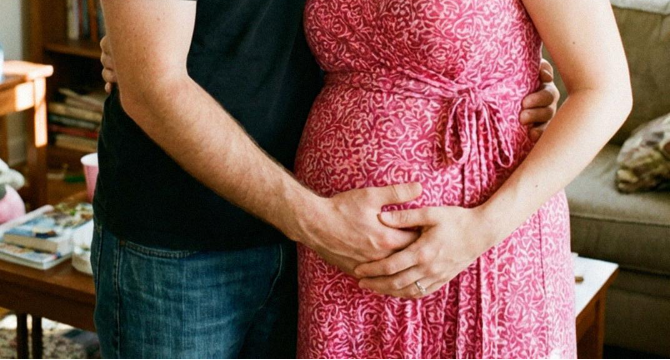
The hardest part about losing my daughter was that I never got to see her face.
I was in Denver for a three-day conference when Janet called me at one in the morning.
“Harry,” she sobbed. “The baby didn’t make it.”
The hardest part about losing my daughter was that I never got to see her face.
I sat on the edge of the hotel bed in the dark while she told me what had happened. The labor came early. The doctors did everything they could.
But our baby girl was… gone.
I told Janet that I was getting on the next flight.
She told me not to.
“My mom is here. Please, Harry. I just need a little time.”
Against everything inside me, I listened to her.
The labor came early.
By the time I made it home two weeks later, the funeral had already been held.
Small. Family only. A white casket I never saw lowered into the ground.
We had painted the nursery yellow two months earlier. Janet had picked out a mobile with tiny paper stars that hung above the crib.
I’d spent an entire Saturday afternoon assembling the crib by myself, following instructions I kept reading wrong. Janet had been sitting in the doorway the whole time, laughing at me.
We had painted the nursery yellow two months earlier.
That mobile was still turning slowly in the draft from the hallway when I got home.
I closed the nursery door.
I never went back in there after that.
For the first few weeks, Janet and I moved through the house like two people trying not to wake something.
We held each other at night. But the silence between us felt unbearable.
I never went back in there after that.
Then, about three weeks after the funeral, I noticed Janet was leaving the house more than usual.
At first, I told myself that she needed air.
But then the pattern started feeling strange.
One Saturday morning, Janet left for groceries. An hour after she got home and put everything away, she said she needed to go back to the store.
“I forgot the coffee creamer,” she said, already reaching for her keys.
Janet was gone for three hours.
The pattern started feeling strange.
On weekdays, I’d come home from work and the house would be empty. No note. No text until I sent one first.
Her reply was simple: “Out running errands. Be home soon.”
Janet wasn’t working right now. There was no reason she couldn’t be home.
I told myself she was grieving in her own way.
I really did believe that.
I’d come home from work and the house would be empty.
But then one Tuesday she came home, and when she walked past me, I caught the faint smell of baby powder.
I didn’t say anything. But I didn’t forget it either.
“How was your day, Janet?” I asked.
“Fine,” she said, without quite meeting my eyes. “Just tired.”
I couldn’t sleep that night.
I lay next to Janet in the dark, turning over every small detail in my head: the long errands. The baby powder. The way she’d stopped mentioning her mother’s name in conversations the way she used to.
I caught the faint smell of baby powder.
Around midnight, I got up, went to the garage, and took the memory card out of Janet’s dashcam.
I sat at the kitchen table with my laptop and opened the files.
I started with the most recent week and worked backward.
The same route appeared again and again.
Janet would leave our neighborhood, head down Route 9, cross the bridge on the park road, and drive straight to my mother-in-law Deborah’s house about 40 minutes away.
The same route appeared again and again.
My wife had been visiting her mother almost every day for several weeks and hadn’t mentioned it once.
I told myself there had to be a simple explanation. Maybe they were grieving together. Maybe Janet just needed her mom.
Then I found a clip from 11 days ago.
I watched it three times before I trusted what I was seeing.
Janet pulled into Deborah’s driveway. Deborah came out the front door, holding a baby wrapped in a yellow blanket. Janet hurried toward her and took the child in her arms.
I found a clip from 11 days ago.
I sat back in my chair and stared at the ceiling for a long time.
Whose baby is that? Why is Janet going there so often?
I decided to find out.
The next morning, I told Janet I had an early meeting and needed to leave by seven.
She kissed my cheek, told me to drive safely, and went to make coffee.
I drove two blocks away, parked under an oak tree at the end of the street, and waited.
I decided to find out.
Twenty minutes later, Janet’s car backed out of the driveway.
I followed her from a distance, far enough back that she wouldn’t recognize my car in the mirror but close enough that I didn’t lose her at the lights.
She took every turn the dashcam had shown me.
My heart raced with every mile.
Forty minutes later, she parked in front of Deborah’s house. She didn’t knock. She just opened the front door and walked in.
I followed her from a distance.
I sat in my car for five minutes, watching the house.
All the lights were on. There was a baby swing visible through the front window.
I got out of the car.
My hands were shaking by the time I reached the front door.
I knocked.
And the look on Deborah’s face when she opened that door told me everything I needed to know about how long this had been going on.
The look on Deborah’s face when she opened that door told me everything.
She went pale the moment she saw me. Her hand tightened on the edge of the door frame, and her eyes filled immediately.
“H-Harry?”
“What’s going on?” I demanded.
Before she could say a single word, I heard a baby crying from somewhere deeper in the house.
And then Janet’s voice, low and soft: “Shh. It’s okay, sweetheart. I’ve got you.”
I looked at Deborah. She stepped aside without speaking.
I heard a baby crying from somewhere deeper in the house.
I walked toward the sound.
The door to the back bedroom was half-open. I pushed it gently and stood in the doorway.
Janet was sitting in a wooden rocking chair by the window, holding a newborn baby wrapped in a pale yellow blanket. The morning light came in behind her. The baby had quieted down and was making small, sleepy sounds against Janet’s shoulder.
Janet looked up.
Her face went completely still when she saw me standing there.
Janet was sitting in a wooden rocking chair by the window, holding a newborn baby.
The rocking chair stopped.
For a long moment, neither of us said anything.
The baby yawned. Her tiny fist opened and closed against Janet’s collar.
I looked at my wife, then at the baby, then back at my wife.
“Janet, whose baby is that?”
Her eyes filled.
Her tiny fist opened and closed against Janet’s collar.
She looked past me to Deborah, who had followed me down the hallway and was standing just behind my shoulder.
Deborah nodded once, quiet and sad, as if she were saying: “It’s time, Janet. Tell him everything.”
We sat in Deborah’s living room.
Janet still held the baby.
Deborah made coffee that nobody touched, and then she sat across from us with her hands folded in her lap and told me what I hadn’t known.
“It’s time, Janet. Tell him everything.”
Several weeks before Janet’s labor, her younger sister, Emily, had come home.
She’d been living in Portugal for two years and had come back quietly, without much explanation, already pregnant and planning to raise the baby on her own. She didn’t want to worry anyone until she had to.
Deborah had been helping her prepare.
Then everything happened at once.
Janet, who was also pregnant, went into premature labor.
Deborah had been helping her prepare.
Emily went into labor three days later, and her baby girl arrived safely.
Deborah’s voice dropped when she reached the next part.
“Emily didn’t recover,” she said, pressing her lips together. “A complication. It came on fast and gave no warning. She was gone within a week of giving birth.”
The room was very quiet.
“Before she went,” Deborah added softly, “she asked Janet one thing.”
Her baby girl arrived safely.
Janet looked down at the baby in her arms. “My sister made me promise. If something happened to her, she wanted me to help raise her little girl.”
I sat with all of that for a long moment.
My sister-in-law, a woman I’d known for 12 years, was gone. Her funeral had been small and private, and I had been told nothing about what had really happened. And her daughter was asleep in my wife’s arms.
“Why didn’t you tell me, Janet?” I finally asked.
Her funeral had been small and private.
Janet drew a slow breath and looked down at the baby in her arms.
“You were already carrying so much, Harry. You blamed yourself for not being home when we lost our baby. I watched you fall apart and put yourself back together just enough to function.”
“So you decided to carry it alone instead? You thought lying to me every single day was protecting me, Janet? I’m your husband. Not someone you manage.”
“I didn’t know how to bring another loss into our house while we were both still just finding enough air to function.” Janet’s voice broke on the next part. “And I was terrified you’d think I was trying to replace our daughter. I didn’t want you to think that for even one second.”
“You blamed yourself for not being home when we lost our baby.”
I didn’t say anything for a long time.
Deborah quietly got up and went to the kitchen.
The baby stirred and made a small sound, and Janet automatically began rocking her again, so practiced and gentle that it was clear she’d been doing it for weeks.
“I should’ve told you,” Janet whispered. “I know that. I’m so sorry, Harry.”
I stood up and walked to the window.
It was clear she’d been doing it for weeks.
The backyard had a small garden that Deborah had always kept perfectly. It was a little overgrown, which told me everything about what kind of rough time she’d been having.
I stood there long enough to feel the anger move through me and begin to settle.
But underneath it was something else. Something that understood why Janet had done what she’d done, even if I wished she’d done it differently.
But underneath it was something else.
I turned around. Janet was watching me carefully, the way she always watched me when she couldn’t tell what I was thinking.
“Can I hold her?” I asked.
Janet stood up slowly and carried the baby across the room.
I hesitated before taking her. Holding a baby again felt like walking back into a room I’d only just managed to leave.
But I held out my arms.
I hesitated before taking her.
Janet placed her niece gently against my chest.
The baby was warm and impossibly small. She smelled of talcum and something sweet I couldn’t place.
She looked up at me with unfocused dark eyes, blinked twice, and then her tiny fingers found my thumb and held on.
Something in my chest that had been locked up tight let go, just slightly.
“She has Emily’s eyes,” I said softly.
Janet nodded. “Her name is Bella. Emily named her before she passed away.”
The baby was warm and impossibly small.
That was six weeks ago.
Janet and I visit Deborah’s house every weekend now, and most Wednesday evenings too.
Deborah started calling the three of us her “little village.”
She said it one evening when she was a little emotional and probably didn’t mean to say it out loud. But none of us corrected her.
Janet and I visit Deborah’s house every weekend.
Our daughter is still gone.
That grief sits in our house like a piece of furniture neither of us can bring ourselves to move. Some mornings, I still stop in the hallway and look at the closed nursery door.
But it feels different now.
Two weeks ago, Janet and I brought Bella home. Deborah packed a bag and moved into the guest room without either of us having to ask.
Last night, I watched Janet feeding Bella in the living room. The lamp made everything look golden, and Bella’s small hand was wrapped around Janet’s finger the way it always is when she’s halfway between awake and asleep.
It feels different now.
I sat down beside Janet on the couch.
Bella yawned, stretched her whole tiny body, and then went completely still and peaceful between us.
Janet leaned her head against my shoulder. “You okay, Harry?”
I looked at Bella’s little face.
“Yeah. I really am, Janet. I really am.”
Janet and I have already started the process to adopt Bella, and now when I look at the nursery again, it finally feels like a room waiting for someone instead of a memory I couldn’t face.

 admin
admin