The house had character. That was the polite way Mark described it whenever friends asked why he had bought it.
In truth, the place looked like it had been frozen in time.
The narrow two-story home sat at the end of a quiet street in a small Ohio town, its wooden siding faded from decades of weather. The realtor had told him it was built sometime in the 1920s.
Mark had liked that detail immediately.
He was 36 years old, worked remotely as an architectural drafter, and had always been drawn to older buildings with stories hidden in their walls.
Still, after moving in a year ago, he had quickly realized that charm often came with problems.
The backyard was the worst of it.
The yard stretched about 40 feet behind the house, but most of it was just uneven dirt mixed with stubborn weeds. The previous owners had clearly ignored it for years.
Some patches looked like they had not been touched for decades.
That Saturday morning in early April felt like the perfect time to finally fix it.
The air was cool, but the sun was bright enough to warm the ground. Mark stepped outside with a shovel, a rake, and a rough plan in his head.
“Nothing fancy,” he muttered to himself while pushing the shovel into the soil. “Just grass. Maybe some flowers.”
His neighbor, Mrs. Harriet, was already outside watering the small garden next door. She was 72, energetic, and seemed to know everything that happened on the street.
“Are you finally tackling that yard?” she called out with a smile.
Mark leaned on the shovel for a moment. “I figured it was time.”
“Well, that ground hasn’t been touched in ages,” Mrs. Harriet replied. “The last owners barely stepped outside.”
Mark laughed softly. “That explains a lot.”
She pointed toward the far corner of the yard. “Careful digging back there. You never know what old houses leave behind.”
He assumed she meant old pipes or broken bricks. Nothing unusual.
After chatting for a few minutes, Mark returned to work.
The soil was harder than he expected.
Each push of the shovel took effort, but slowly the uneven patch began to flatten. Dirt piled beside him as he worked methodically across the yard.
About 30 minutes passed.
Mark drove the shovel into the ground again, expecting the usual dull thud of dirt.
Instead, the blade struck something solid.
Clang.
The metallic sound rang clearly through the quiet yard.
Mark frowned and pulled the shovel back.
At first, he thought it was just a rock.
The ground in older yards was full of them. But something about that sharp metallic ring made him pause.
He stabbed the shovel down again.
Clang.
That was definitely not a rock.
Curiosity replaced his mild frustration. He crouched down and brushed some loose dirt aside with his glove.
A dull surface appeared beneath the soil.
Metal.
Curious now, he knelt and started clearing the soil with his hands.
The dirt was packed tightly around whatever object was buried there. Mark worked carefully, scooping the soil away piece by piece.
Slowly, edges began to form.
And slowly, the shape of a small rectangular box began to appear.
The metal was coated with rust and thick dirt, but the straight lines made it obvious that this was not junk metal or construction debris.
It was covered in rust and dirt, but it was clearly man-made.
Mark sat back on his heels and stared at it.
It looked like a lockbox.
A strange excitement flickered in his chest.
Mark’s heart started beating faster.
He wiped more dirt from the surface.
Why would someone bury a metal box in their backyard?
The thought made his imagination wander.
Maybe it was old documents.
Maybe money.
Or maybe it was nothing more than forgotten tools.
Still, the idea that something had been hidden beneath his yard for decades sent a chill of anticipation through him.
Mark grabbed the shovel again and began digging around the object carefully.
Soil loosened as he dug around it carefully and finally managed to lift it out of the ground.
The box came free with a slight sucking sound from the damp earth.
It was heavier than he had expected.
Mark wiped dirt from his hands and studied it closely.
The metal surface was rough with rust, and patches of brown corrosion spread across the lid. The edges were thick and sturdy, suggesting it had been built to last.
The hinges were rusted, and a small, old lock still hung from the latch.
The lock looked ancient, its metal darkened with age.
Mark turned the box slightly, brushing away dirt with his sleeve.
Then something caught his eye.
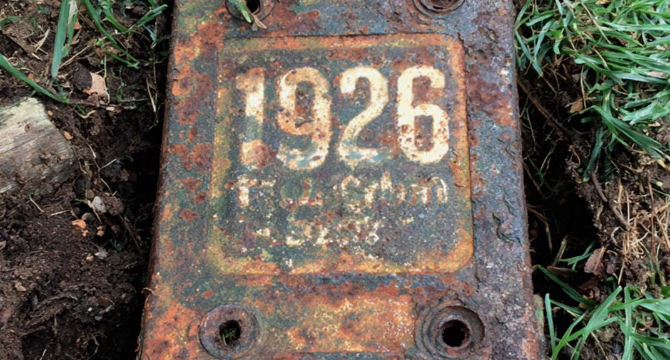
Faint lettering had been pressed into the lid itself.
He rubbed the surface harder until the numbers became clear.
Stamped into the metal lid was a single year: 1926.
Mark blinked.
The number felt unreal.
Mark stood there in silence for a moment, staring at the box that had been buried beneath his yard for nearly a century.
Ninety-eight years was a very long time.
The realization made his stomach tighten.
The house had been built around that time. Which meant whoever buried this box might have lived here when the home was brand new.
He imagined someone standing in this exact spot almost a 100 years earlier, digging a hole in the same soil.
Hiding something.
A breeze rustled through the trees behind the fence, pulling Mark out of his thoughts.
He glanced toward Mrs. Harriet’s yard.
She had gone inside.
For a moment, he considered leaving the box alone until later. Maybe even calling someone to document it properly.
But curiosity won.
Then he grabbed a screwdriver, pried the rusted lock loose, and slowly lifted the lid.
The metal creaked as it opened.
Mark leaned forward, holding his breath as the lid rose inch by inch.
Whatever had been hidden in this box had remained untouched for nearly a century.
And now he was the first person about to see it.
The lid resisted at first.
Rust flaked from the hinges as Mark pushed it higher, the metal groaning softly after nearly a century underground. He leaned closer, his curiosity outweighing the faint nervousness creeping into his chest.
Inside the box were several items wrapped carefully in a piece of yellowed cloth.
Mark blinked in surprise.
Whoever buried this had not simply tossed things inside. Everything had been folded and arranged with care.
He set the box on the patch of dirt beside the hole he had dug and slowly lifted the cloth bundle out.
“Okay,” he murmured to himself. “Let’s see what you were hiding.”
He unfolded the brittle fabric.
The first thing he saw was a small stack of old photographs.
Their edges were curled and faded, but the images were still visible. Black and white portraits of people dressed in clothing from another era filled the frames.
Mark picked up the top photo.
A young couple stood in front of what looked like the very same house behind him. The wooden porch railings and narrow windows were unmistakable.
The man wore suspenders and had neatly combed dark hair. The woman stood beside him in a long dress, her hand resting lightly on his arm.
Both were smiling.
Mark turned the photo over.
On the back, written in delicate handwriting, were two names.
“Thomas and Eleanor, 1926.”
He had seen those names before.
When he bought the house, the property documents had listed Thomas and Eleanor as the original owners. He had never thought much about it at the time.
Now he stared at the photograph again with new curiosity.
Beneath the photos sat a small leather journal.
The cover was cracked with age, but it had been protected well enough inside the metal box. Mark opened it slowly, careful not to tear the fragile pages.
The first entry was written in neat ink.
April 3, 1926.
Mark sat down on the grass as he began reading.
The journal belonged to Thomas.
The early entries described the house being built. Thomas wrote about how proud he was to finally own land. He mentioned planting trees in the yard and building the small porch with his own hands.
Mark glanced toward the house.
Those same trees still stood along the fence line.
He turned the page.
The tone of the journal slowly shifted over time.
Thomas began writing about money troubles. Work had become unpredictable, and bills were piling up. Several entries mentioned a mining company in a nearby town that had closed, leaving many families struggling.
Still, Thomas wrote often about Eleanor.
“Eleanor keeps reminding me that a home is more than money. She says as long as we are together, we will manage.”
Mark felt a quiet warmth reading those words.
But as the journal continued, something darker appeared between the lines.
One entry stood out.
November 18, 1927.
“Someone came to the house again tonight, asking about the debt. I told Eleanor not to worry, but the truth is, I do not know how we will pay them.”
Mark frowned slightly.
Debt collectors, perhaps.
He flipped a few more pages.
Then the writing suddenly stopped in early 1928.
The final entry was short.
“If anyone finds this someday, please know I tried to protect what little we had left.”
Mark slowly closed the journal.
A strange heaviness settled in his chest.
“What happened to you, Thomas?” he whispered.
He returned his attention to the box.
Underneath the journal sat a smaller object wrapped in paper.
Mark unfolded it carefully.
Inside was a small velvet pouch.
His fingers tightened slightly as he opened it.
Several gold coins spilled gently into his palm, glinting in the sunlight.
Mark let out a quiet breath.
They looked old, possibly very valuable.
But that was not the only thing inside the pouch.
A folded piece of paper rested beneath the coins.
Mark opened it.
The message was short, written in the same careful handwriting as the journal.
“To whoever finds this.
These coins were meant for Eleanor. If I fail to return from the city, this was to ensure her safety.
I buried it so the men demanding payment would never take it.
If time has already carried us away, then please do one kindness.
Tell someone our story.”
Mark stared at the note for a long moment.
The quiet backyard suddenly felt different.
He looked at the old photograph again.
Thomas and Eleanor stood side by side in front of the house, smiling as if the world ahead of them was full of promise.
Yet something had clearly gone wrong.
Later that afternoon, Mark walked next door and knocked on Mrs. Harriet’s door.
She answered quickly.
“Well?” she asked with a curious smile. “Did you find anything interesting digging out there?”
Mark hesitated before replying.
“I found something buried.”
Her eyebrows lifted. “Buried?”
“A metal lockbox,” he explained. “It had a year stamped on it. 1926.”
Mrs. Harriet’s expression slowly changed.
“Thomas and Eleanor’s time,” she said quietly.
“You know about them?” Mark asked.
She nodded and motioned for him to sit on the porch chair.
“My grandmother used to talk about them. Thomas disappeared one winter. He just vanished while traveling to the city for work. Eleanor stayed in that house for a few years after that.”
“What happened to her?”
“She eventually left town,” Mrs. Harriet replied softly. “People said she struggled after he was gone.”
Mark looked down at the small velvet pouch he had brought with him.
“These were hidden in the yard,” he said, showing her the coins and the note.
Mrs. Harriet read the message slowly.
For a moment, neither of them spoke.
“That poor man,” she murmured.
Mark nodded.
He thought about the final line of the note again.
Tell someone our story.
That evening, Mark placed the photographs, the journal, and the note carefully back inside the metal box. The coins remained inside the velvet pouch.
He did not plan to sell them.
Instead, he contacted the town’s historical society the next morning.
A few weeks later, a small display appeared in the local museum.
At the center sat the rusted metal box stamped with the year 1926.
Beside it were the photographs of Thomas and Eleanor, along with the journal that told their story.
Mark visited the exhibit one afternoon.
As he stood there quietly reading the final note again, he felt a strange sense of peace.
The box had been hidden in the ground for 98 years.
But the story inside it had finally been uncovered.

 admin
admin