At 14, Daniel already understood the weight of responsibility better than most grown men.
The alarm rang every morning at 6 a.m., sharp and unforgiving. He never hit snooze. He would lie there for a few seconds, staring at the thin crack in the ceiling of their small apartment, listening for his mother’s breathing in the next room. If he heard her soft cough, he got up immediately.
It had been just the two of them ever since the accident.
Before that day, his mother had been the kind of woman who filled a room with laughter. She worked double shifts at a diner, came home smelling of coffee and syrup, and still found the energy to help him with math homework.
Then one rainy night, a truck ran a red light. The doctors said she was lucky to be alive.
Lucky.
Daniel hated that word.
She was 42 years old when the accident left her unable to walk. His father lasted less than six months after that. At first, he tried. He pushed the wheelchair once or twice, cooked badly scrambled eggs, and made promises about things getting better.
Then the bills started piling up.
Arguments replaced promises. One morning, Daniel woke up, and his father was gone. No note. No explanation. Just debts and silence.
From that day on, Daniel stopped feeling like a child.
Every morning before school, he helped his mom out of bed. He would wrap his arms around her carefully, counting under his breath as he lifted her into the wheelchair.
“One, two, three,” he would murmur.
“I’m not a sack of potatoes, you know,” she would tease gently, trying to make it easier for him.
“I know,” he’d reply, managing a small smile.
“You’re heavier than one.”
She would swat his arm lightly, and for a moment, it almost felt normal.
He cooked her oatmeal the way she liked it, with a little cinnamon and sliced bananas when they could afford them. He made sure her medication was set out on the kitchen table. Only after she was settled would he grab his worn backpack and run to school.
Daniel didn’t talk much there. He did his assignments, answered when called on, and kept his head down. Some classmates knew about his mom. Most did not.
When boys his age argued about video games or weekend plans, Daniel stayed quiet. After classes, he didn’t meet friends or play sports.
He hurried home.
The apartment was on the edge of town, where the sidewalks cracked, and the streetlights flickered at night. He would clean, wash dishes, check on his mother, then rush to his part-time job at the grocery store three blocks away.
“You’re a good kid, Daniel,” his manager, Mrs. Thompson, once told him as he stocked shelves. “You shouldn’t have to work this hard.”
Daniel only shrugged. “It’s fine. I don’t mind.”
But he felt it deeply. He felt it when his arms ached from lifting boxes. He felt it when he studied late into the night beside his mother’s bed, fighting sleep as she pretended not to notice.
“You should rest,” she would whisper.
“So should you,” he’d reply without looking up from his textbook.
One rainy afternoon changed something in him.
School had ended early because of the storm. The sky hung low and gray, and the streets were slick with water.
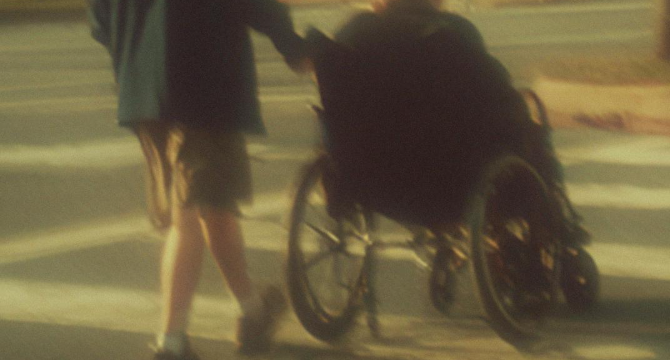
Daniel held the handles of his mother’s wheelchair tightly as he pushed her across a busy intersection near the main road. Cars lined up at the light, engines growling.
“Careful,” his mother said softly. “It’s slippery.”
“I’ve got you,” he answered.
The signal turned in their favor, and they began crossing.
Halfway through, Daniel heard the sudden screech of brakes.
The engine roared impatiently.
Daniel’s heart slammed against his ribs.
The driver’s door flew open. A sharply dressed man stepped out. He appeared to be around 40, his hair neatly styled despite the rain. A gold watch gleamed on his wrist.
“Are you blind?” the man shouted. “Move that thing faster! Some of us have important places to be!”
The words hit Daniel harder than the cold rain.
People on the sidewalk stopped and stared.
A woman gasped. Someone muttered, “Unbelievable.”
Daniel felt his face burn. He was aware of every drop of water soaking through his jacket and every pair of eyes on him. He wanted to shout back. He wanted to say, She can’t walk. He wanted to scream that they were already moving as fast as they could.
But when he glanced down, he saw his mother’s hands trembling in her lap.
“It’s okay,” she whispered, though her voice shook.
He swallowed the lump in his throat.
Without saying a word, Daniel lowered his eyes and kept pushing. Step by step, through the rain, across the remaining stretch of road.
Behind him, the man scoffed loudly.
“Unbelievable,” he muttered again, as if they were the inconvenience.
Then he got back into the car and sped off, tires splashing through puddles.
Daniel did not turn around.
When they reached the sidewalk, his mother quietly wiped away tears. She tried to hide it, but he saw.
“I’m sorry,” she murmured.
“For what?” His voice came out tighter than he intended.
“For slowing you down. For… everything.”
He stopped pushing and walked around to face her.
“You didn’t do anything wrong.”
She looked up at him with red-rimmed eyes. “You deserve a normal life, Daniel.”
He clenched his jaw. “This is my life.”
That night, as rain tapped against the window, Daniel lay awake longer than usual. The man’s voice echoed in his mind.
Move that thing faster.
Some of us have important places to be.
Important.
Daniel stared into the darkness.
He thought about the gold watch, the polished shoes, and the way the man had looked at them as if they were less than human.
Something hardened inside him.
He did not cry. He did not complain.
He made a quiet promise instead.
One day, he would be someone no one could speak to that way. One day, he would stand tall enough that no one would dare shout at him or his mother again.
Time went by, but the memory did not fade.
Twelve years later, Daniel stood in front of a massive mansion with iron gates that stretched toward the sky.
He was no longer a helpless boy soaked in the rain. His shoulders were broader now, his posture steady and confident. The cheap backpack had been replaced with a sleek leather bag slung over his shoulder.
The address in his hand matched the one engraved on the stone pillar.
It belonged to that same man.
Daniel hadn’t forgotten the gold watch. Or the voice. Or the tears in his mother’s eyes.
He pressed the intercom button calmly.
There was a pause. Then the gates creaked open.
As he walked up the long driveway, lined with trimmed hedges and marble statues, his expression remained unreadable.
The front door opened before he could knock.
The man standing there looked older, his hair touched with gray, but Daniel recognized him instantly.
“You’re Mr. Alfred, right?”
For a brief second, confusion flickered across his face.
“Yes?” he asked, impatience lurking beneath the surface.
Daniel met his eyes steadily.
“Do you remember me?” he asked, reaching slowly into his bag.
Daniel studied his face carefully. The lines were deeper now. The sharp confidence he once carried so easily seemed dulled by time.
“I doubt you remember,” Daniel replied evenly.
Alfred frowned. “Should I?”
Instead of answering, Daniel reached into his bag and pulled out a thin, weathered folder. His movements were slow and deliberate. He handed it over without breaking eye contact.
Alfred hesitated before taking it.
“What is this?”
“Open it,” Daniel said.
With visible annoyance, Alfred flipped the folder open. Inside were copies of medical reports, old photographs, and a newspaper clipping.
One photograph showed a 14-year-old boy pushing a wheelchair across a rain-soaked street. The image had been taken from a distance, grainy but clear enough to recognize the scene.
His expression shifted.
“I don’t understand,” he muttered.
“You were in a black luxury car,” Daniel said calmly. “It was raining. You stopped in the middle of the intersection and yelled, ‘Are you blind? Move that thing faster! Some of us have important places to be!'”
The words hung between them.
Color drained from Alfred’s face. He looked from the photograph back to Daniel.
“That was you?” he asked quietly.
Daniel nodded once. “I was 14. I was pushing my mother across the street.”
Silence settled over the entrance hall. The house behind him was grand, filled with polished floors and sparkling chandeliers. Yet in that moment, it felt small.
“I…” Alfred cleared his throat. “I don’t remember every incident from 12 years ago.”
Daniel gave a faint smile, but there was no warmth in it. “I do.”
Alfred glanced again at the photograph.
A flicker of shame crossed Alfred’s features. He stepped aside awkwardly. “Come in.”
Daniel walked inside, his shoes echoing against the marble floor. He did not look impressed. He had seen buildings like this before. He had built some of them.
They moved into a spacious living room. Alfred gestured toward a leather sofa. “Sit.”
Daniel remained standing.
“You humiliated us that day,” Daniel continued, his voice steady. “My mother cried the entire way home. Not because of the rain. Because she felt like a burden.”
Alfred sank slowly into a chair across from him. “I was under a lot of pressure back then,” he said weakly. “Business problems. Deadlines. That’s no excuse, but—”
“But you thought we were in your way,” Daniel finished.
Alfred looked down at his hands. The gold watch was gone.
“I was arrogant,” he admitted. “I thought money made me important.”
Daniel absorbed that without reaction.
“You drove off and forgot about it,” Daniel said. “We didn’t.”
He took a breath, remembering his mother’s trembling hands, the way she whispered, “I’m sorry.”
“That day changed something in me,” Daniel went on. “I decided no one would ever speak to us like that again.”
Alfred finally looked up.
“So you came here for revenge?”
Daniel studied him for a long moment.
“If I wanted revenge, I could have done it differently,” he answered.
Confusion creased Alfred’s brow. “What do you mean?”
Daniel reached into his bag once more. This time, he pulled out a sleek document folder embossed with a company logo.
Alfred’s eyes widened as he recognized it.
“That’s not possible,” he breathed.
“It is,” Daniel said quietly.
Twelve years had reshaped everything. After that rainy afternoon, Daniel threw himself into his studies with relentless focus. He earned scholarships, worked two jobs in college, and graduated at the top of his class in business and urban development.
He built his career step by step, remembering every insult, every tear. He specialized in acquiring struggling properties and turning them into accessible housing projects for families like his.
The mansion they were sitting in was part of a development portfolio recently acquired by Daniel’s firm.
“You sold most of your assets last year,” Daniel said gently. “Bad investments. Lawsuits. Your company has been drowning in debt.”
Alfred swallowed hard.
“How do you know that?”
“Because my firm bought the bank’s claim,” Daniel replied.
The truth settled heavily in the room.
“You own this property now,” Alfred whispered.
Daniel nodded.
The once powerful businessman leaned back as if the air had been knocked out of him. “So this is it,” he said bitterly. “You came to throw me out the way I tried to push you aside.”
Daniel shook his head slowly.
“No,” he said.
Alfred stared at him, bewildered.
“I came to give you a choice.”
“A choice?”
Daniel placed another document on the table. “This property is being converted into a rehabilitation center for accident victims. Wheelchair accessible. Physical therapy facilities. Counseling services. It will be named after my mother.”
Alfred’s lips parted slightly.
“She passed away two years ago,” Daniel added softly. “Complications from the accident.”
For the first time, emotion cracked his steady voice.
“She never stopped apologizing for slowing me down,” he continued. “Even when she could barely breathe.”
Alfred looked stricken. “I’m… I’m sorry.”
Daniel believed that he meant it.
“You can stay,” Daniel said after a pause. “Not as the owner. As the director of community outreach. You have experience, connections. You know how to run operations.”
Alfred blinked in disbelief.
“Why would you offer me that?”
“Because I don’t want you to feel what we felt that day,” Daniel answered honestly. “I want you to understand it.”
Tears gathered in Alfred’s eyes, and he did not wipe them away.
“I was cruel,” he admitted hoarsely. “I thought you were beneath me.”
Daniel finally sat down across from him.
“You were wrong,” he said simply.
The grand house felt different now. Less like a monument to ego and more like a place waiting to be transformed.
“I can’t change what I said,” Alfred murmured.
“No,” Daniel agreed. “But you can decide who you are now.”
Alfred nodded slowly, absorbing the weight of those words.
After a long silence, he extended his hand. It trembled slightly.
“I do remember,” he confessed. “Not your face. But the boy who didn’t shout back. I remember thinking he looked stronger than me.”
Daniel looked at the offered hand, then shook it firmly.
“I was just trying to get my mother home,” he said.
As he stood to leave, Alfred followed him to the door.
“Daniel,” he called quietly.
Daniel paused.
“Thank you,” he said, his voice thick with emotion. “For not choosing revenge.”
Daniel stepped outside into the open air. The iron gates no longer felt imposing.
He glanced back once at the mansion that would soon become a place of healing instead of pride.
He had come to teach a lesson.
Not about power.
Not about humiliation.
But about memory, dignity, and the quiet strength of a young boy who never forgot the rain.

 admin
admin