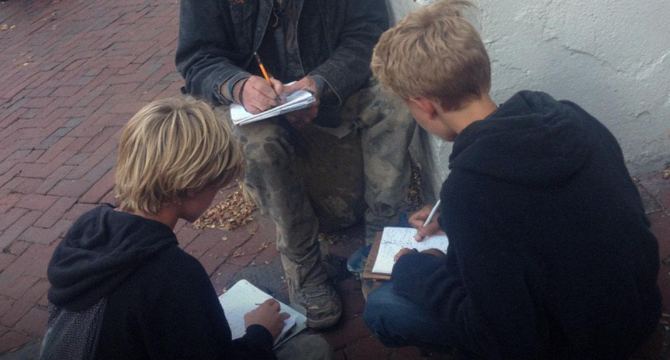
Life hadn’t always been this cruel to Paul.
Back when he had a roof over his head and a paycheck coming in every month, Paul had been the kind of teacher other teachers admired. He was the one who stayed late after the bell rang, who pulled struggling kids aside and said, “You’re not behind. You just haven’t been shown the right way yet.”
He believed that with every fiber of his being.
He’d spent over two decades in classrooms, and he loved every minute of it — the messy whiteboards, the half-finished homework, and the look on a child’s face when something finally clicked.
Teaching wasn’t just his job. It was who he was.
But then life happened, the way it sometimes does. Quietly at first, and then all at once.
Medical bills piled up after a health scare that he didn’t see coming. Then the school he worked at cut its budget, and his position was one of the first to go. He tried to find other work, but the months slipped by faster than his savings did.
Some people said it was bad luck, while others said he should’ve planned better.
Whatever the reason, it didn’t change the outcome.
Paul ended up on the streets, with nothing but a worn backpack and a mind full of knowledge he had nowhere left to put.
He got used to sleeping on the park bench, the way people get used to things they never imagined they’d have to. He learned which spots were sheltered from the wind and which fountains had the cleanest water. He learned to make himself invisible.
But one thing he didn’t stop doing was teaching.
He’d sit on his bench and quietly work through math problems in a little notebook he’d found, just to keep his mind sharp. He’d talk through history and science out loud sometimes, to no one in particular, just because thinking felt like the only thing that still belonged to him.
Then one afternoon, he heard voices nearby. Young, tensed voices.
Three boys had spread their textbooks across a nearby bench. One of them, a lanky kid in a red hoodie, was close to tears.
“I don’t get it,” the boy said, staring at a page of algebra. “My mom said we can’t afford a tutor right now. I’m just gonna fail this test.”
“We’re all gonna fail,” said another boy flatly.
Paul hesitated. He looked down at his own hands — rough, weathered, not exactly the hands of someone who looked like he had answers.
He almost stayed quiet. But then the boy in the red hoodie let out a long, defeated sigh, and something in Paul’s chest just wouldn’t let him stay still.
He cleared his throat. “What chapter is it?”
The boys looked up, suspicious.
“Chapter seven,” the tallest one said slowly. “Quadratic equations.”
Paul walked over, glanced at the page, and picked up a stick from the ground. He knelt down and scratched the equation into the dirt, working through it step by step, explaining each part in plain, simple language. By the time he reached the answer, all three boys were leaning in, watching closely.
“Wait,” the boy in the red hoodie said. “That actually makes sense.”
“Of course it does,” Paul replied.
“Math isn’t hard. It just needs a patient teacher.”
After that day, the boys — Bob, Mike, and Kyle — started showing up at that same bench every afternoon after school. Paul helped them with algebra, then science, and then essay writing. He never once asked them for money.
His only rule was simple.
“Promise me something,” he told them on the first day. “Promise me you won’t give up.”
All three of them promised.
Months passed, and their grades improved in ways that surprised even their teachers. Paul watched them grow more confident with every session, and it filled something in him that had been empty for a long time.
Then one day, they just didn’t show up.
He waited on the bench the next day and the one after that. Eventually, a woman walking her dog mentioned that a few families in the area had relocated for work.
Paul sat back down on his bench and looked out at the pigeons pecking at the ground nearby.
He wondered, not for the first time, whether any of it had truly mattered.
Seven years later…
Paul was sixty now, and the years had settled into his joints and his face in ways that told their own story. He spent the colder months at a local shelter — a modest place with cots, fluorescent lighting, and people who all had their own versions of how they’d ended up there. It wasn’t comfortable, but it was safe, and Paul had long since stopped measuring his life in comfort.
He kept mostly to himself. He’d help younger residents with reading or basic math sometimes, quietly, without making a thing of it. Old habits.
One Tuesday morning, a staff member named Donna came looking for him with an envelope in her hand and a curious look on her face.
“Paul,” she said, “this came for you. Official-looking thing.”
She handed it to him. It was a thick envelope, cream-colored, with his full name printed on the front in careful, deliberate letters.
He turned it over. There was an embossed university seal on the back.
“Must be a mistake,” he said.
“Well, it’s got your name on it,” Donna said with a shrug. “Might as well open it.”
He sat down on the edge of his cot and held the envelope for a moment. His hands moved slowly as he tore it open, half-expecting some kind of debt notice or misdirected paperwork. He pulled out the letter inside, unfolded it carefully, and read the first line.
His heart skipped a beat, and he couldn’t move.
Dear Mr. Paul,
On behalf of the faculty and students of CHNM University, it is our greatest honor to invite you as our guest of honor to the Annual Community Excellence Ceremony.
He read it again. Then a third time.
“How is this possible…” he whispered.
He kept reading, his eyes moving slowly down the page. The letter explained that the Director of Student Success — the youngest ever appointed to the position — had personally requested his presence at the ceremony. Paul’s eyes drifted to the name signed at the bottom of the letter, and his breath caught in his throat.
Kyle M.
Kyle. The boy in the red hoodie who’d been on the verge of tears over quadratic equations on a park bench seven years ago.
Paul set the letter down on his knee and just sat there for a moment, completely still.
There were more documents inside the envelope.
He picked them up one by one, with hands that had started to tremble.
The first was a legal document outlining the establishment of the Paul Endowment Fund — a permanent scholarship dedicated to providing free tutoring services to underprivileged children across three counties. It was already active and already funded.
The second document was a housing voucher, arranged through a community partnership program connected to the university.
It had Paul’s name on it and an address.
Donna appeared in the doorway again and saw his face. “Paul? You okay?”
He looked up at her, and for a moment, he couldn’t find words.
“They didn’t forget,” he finally said, his voice barely above a whisper. “Those kids — they didn’t forget.”
Donna walked over and looked at the letter in his hands, and her hand went to her mouth.
A small note was tucked between the documents.
It was handwritten, unlike the rest.
Mr. Paul, it said, You told us never to give up. We didn’t. And we never forgot the man who believed in us when nobody else did. We hope you’ll let us show you what you made possible. — Kyle, Bob, and Mike.
Paul pressed the note against his chest and closed his eyes.
He had spent seven years wondering if those afternoons on the bench had meant anything at all. Now he held the answer in his hands, and it was bigger than anything he could have imagined.
The morning of the ceremony, a driver from the university arrived at the shelter to pick Paul up.
Donna had helped him borrow a clean button-down shirt and a pair of pressed trousers from the shelter’s donation closet. He stood in front of the small mirror in the bathroom and barely recognized the man looking back at him — not because he looked different, but because, for the first time in a long time, he stood up straight.
The ceremony hall was grand and full of people.
Paul was shown to a seat near the front, and he sat quietly, taking it all in.
Then Kyle walked onto the stage.
He was tall now, broad-shouldered, wearing a dark suit with the university’s crest on the lapel.
He looked out at the audience with calm, steady eyes.
But when his gaze found Paul in the front row, something in his expression shifted, and for just a second, he was that boy again, kneeling over a dirt-scratched equation, finally understanding.
“When I was 12 years old,” Kyle began, his voice filling the hall, “I thought I was going to fail. Not just a test — everything. I thought school wasn’t for people like me. That college was a word that belonged to other kids.” He paused. “Then a man sat down next to me on a park bench and showed me how to solve a quadratic equation in the dirt.”
The hall was completely quiet.
“That man had no classroom. He had no salary. He had nowhere to sleep that night that was truly his own. But he gave us everything he had — his time, his patience, and his belief that we were worth teaching.” Kyle looked directly at Paul. “He told us never to give up. And so we didn’t.”
The applause started slowly and then rose until it filled every corner of the room. Paul gripped the armrests of his chair and tried to hold himself together.
Kyle stepped down from the podium and walked toward him, extending his hand.
“It’s good to see you, Mr. Paul,” he said simply.
Paul stood and shook his hand, and then, before either of them could say anything else, he pulled the young man into a hug. Kyle held on without hesitating.
“You did this,” Paul said, his voice rough. “You boys did all of this.”
“You started it,” Kyle said firmly.
Bob and Mike found him afterward, both of them grinning like the kids they used to be. They talked for a long time, standing in a corner of the hall while the rest of the room buzzed around them.
Paul listened as they described their careers, their families, and the things they’d built.
And all the while, he felt something unlocking in his chest that had been sealed shut for a very long time.
That evening, Paul was taken to the apartment connected to the housing voucher. It was a small place — one bedroom, a modest kitchen, and a window that looked out onto a street lined with oak trees.
The key was already in his hand before he fully processed what was happening.
He stood in the middle of the empty living room for a long moment, just breathing.
He had spent seven years on that bench, wondering if he’d made any real difference. He had watched those boys walk away and assumed that was the end of the story.
But they had taken everything he gave them and carried it far beyond the park, turning it into futures he never could have imagined — and in doing so, they had quietly, carefully, built him a way back.
In trying to give them hope, he had unknowingly secured his own.
Paul set his borrowed bag down on the floor, walked to the window, and looked out at the oak trees lining the street below.
For the first time in seven years, he finally had a place to call home.

 admin
admin