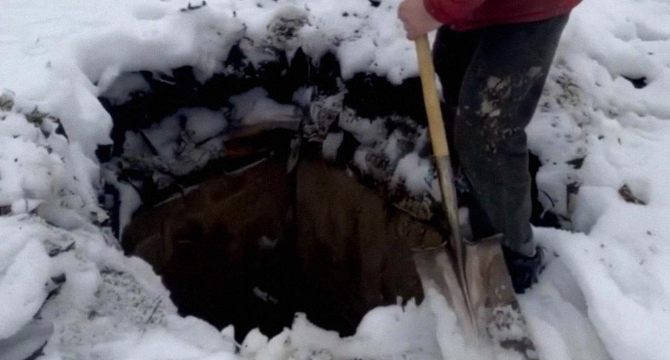
I stepped closer.
And that’s when I saw it—black plastic, half-buried in the frozen dirt.
“What have you done?”
A contractor bag.
Tied tight.
My stomach dropped.
“Dane,” I said. “What have you done?”
He jumped like I’d screamed.
“Why are you digging?”
Then he went pale. Completely.
“YOU’RE HOME?!” he blurted.
“Yes,” I said. “Why are you digging?”
He looked at the hole. Then at me. Then back at the hole.
“IT’S NOT WHAT IT LOOKS LIKE!”
I stared at him. “And what does it look like, Dane?”
“I didn’t want the kids to see it.”
He swallowed hard. “Okay. Okay. Don’t freak out.”
“Too late.”
He rubbed his hands on his jeans, smearing mud. “There was a dead animal.”
I blinked. “What?”
“A raccoon. Or a possum. Something.” He spoke fast. “I found it by the fence. I didn’t want the kids to see it.”
“You’re burying it.”
I stared at the bag again.
No smell.
No fur.
No mess.
Just… a clean black bag, tied like a gift.
I turned and walked inside.
“You’re burying it,” I said.
He nodded hard. “Yes. It’s gross. I’m trying to handle it.”
It was the kind of explanation that made me feel stupid for panicking.
I let out a shaky breath. “Okay.”
His shoulders dropped like he’d been holding up a building. “Okay?”
A manila envelope on the kitchen counter.
“Okay,” I repeated. “Finish. Then wash your hands.”
“I will,” he said quickly.
I turned and walked inside, telling myself to calm down.
Business trip. Early flight. You’re tired. You’re jumpy.
Then I saw it.
Storage unit paperwork.
A manila envelope on the kitchen counter.
Neat. Intentional.
Dane’s full name written across it, and paperwork lying next to it.
Storage unit paperwork.
A receipt.
I heard the back door open.
A key taped to a card.
My throat went tight.
Why would my husband need a storage unit?
We had a garage. An attic. A shed. A whole life of places to put things.
I heard the back door open.
He didn’t look at me.
I left the papers where I’d found them, like nothing had happened.
Dane came in, cheeks red from the cold, and scrubbed his hands at the sink like he was trying to erase the last ten minutes.
He didn’t look at me.
“How was your trip?” he asked, too casually.
“It ended early,” I said. “So I came home.”
“Right,” he said. “Surprise.”
My stomach sank lower.
His eyes flicked—quick—to the counter.
To the envelope.
Then away.
My stomach sank lower.
I forced my voice steady. “So… no smell?”
No smell at all.
He froze. “What?”
“The animal,” I said. “Dead animals smell.”
He turned the water off too fast. “It’s freezing outside. It’s… probably why.”
Sure.
Except I’d been out there.
He laughed too loudly.
No smell at all.
And that bag was tied too carefully for a mangled raccoon.
That night, he was normal in a way that felt staged.
He talked too much.
He laughed too loudly.
“I’m glad you’re home.”
He offered to order food twice.
Every time I moved, he watched my face like he was waiting for the question.
At 10, he yawned. “I’m beat. Digging is cardio.”
“Mm,” I said.
He kissed my forehead. “I’m glad you’re home.”
I stood up, grabbed a flashlight, and put on my coat.
“So am I,” I lied.
When he went upstairs, I waited.
Ten minutes.
Fifteen.
His breathing settled.
I knelt and started digging.
I stood up, grabbed a flashlight, and put on my coat.
Outside, the backyard was quiet and bright with the porch light.
The hole was filled in.
Too neat.
Like a patch someone wanted you to ignore.
My breath puffed white.
I knelt and started digging with the small shovel from the shed.
The ground was hard, but the top layer was loose.
My hands went numb.
My breath puffed white.
I kept going anyway.
I scraped dirt away, gripped the bag, and tugged.
Because if Dane was lying, I needed to know what kind of lie it was.
The shovel hit plastic.
My heart lurched.
I scraped dirt away, gripped the bag, and tugged.
Heavy.
I dug around it and felt the edge of something solid.
No smell.
Not even a hint.
I dug around it and felt the edge of something solid.
Metal.
A lockbox.
Clean.
I went inside, silent.
Not rusty. Not old. Clean.
I stared at the keyhole and thought of the key taped to the storage paperwork.
My pulse went wild.
I didn’t stop.
I went inside, silent.
I slid the key into the lockbox.
Upstairs, Dane slept on his side, back to the door.
I stared at him for a second—my husband, my partner, the man who packed lunches and fixed leaky faucets.
Then I went back down, grabbed the envelope, peeled off the key, and walked back into the cold.
I climbed into the shallow hole like I was crossing a line.
I slid the key into the lockbox.
I expected something awful.
It turned smoothly.
Like it had been used recently.
The lid popped.
I held my breath and lifted it.
I expected something awful.
A worn notebook.
Drugs.
Cash.
A weapon.
Anything that would explain the secrecy.
Instead, I found plastic-wrapped stacks of photos.
A worn notebook.
My knees went weak.
A small charm bracelet.
A pair of baby shoes.
And a sealed envelope—cream-colored, faded, and addressed in handwriting I hadn’t seen in years.
For my daughter.
My knees went weak.
I didn’t open it.
My mom’s handwriting.
My mom had been gone 11 years.
I sat back in the dirt, staring like it might disappear.
My throat burned.
I didn’t open it.
Not yet.
And I’d just dug it up like evidence.
Because now the fear changed shape.
This wasn’t a crime.
This was something personal.
Something sacred.
And I’d just dug it up like evidence.
Dane shot upright.
I carried the lockbox inside and put it on the kitchen table.
Mud on my sleeves.
Mud under my nails.
My heart punching my ribs.
Then I went upstairs and flipped on the bedroom light.
Dane shot upright.
“Kitchen. Now.”
“What—” he started, eyes wide.
“Get up,” I said.
His face drained. “What’s wrong?”
I didn’t yell. I didn’t cry. I just pointed.
“Kitchen. Now.”
He followed me down the stairs, blinking like he was walking into a nightmare.
His eyes shut for a second.
Then he saw the lockbox.
He stopped cold.
His mouth opened.
Nothing came out.
I crossed my arms. “Dead animal?”
“I didn’t want you to find it like that.”
His eyes shut for a second.
When he opened them, they were already wet.
“You dug it up,” he said hoarsely.
“Yes,” I said. “I did.”
He swallowed. “I didn’t want you to find it like that.”
“What about him?”
“Well, you lied,” I snapped. “So here we are.”
He nodded once. “You’re right.”
I tapped the envelope gently. “Explain why my mother’s handwriting is on our table.”
His throat worked. “Your dad.”
My chest tightened. “What about him?”
“We found a box. Sealed up. Hidden behind paint cans.”
“Last fall,” he said, voice low, “he asked me to help him clean out the garage.”
I stared. “He never cleans that garage.”
“I know,” Dane said. “That’s why I went.”
He rubbed his face. “We found a box. Sealed up. Hidden behind paint cans.”
My voice came out thin. “My mom’s stuff.”
“So you rented a storage unit.”
Dane nodded. “Your dad started shaking. He said he couldn’t do it. He said he was going to throw it out because it hurt too much.”
Anger flared hot. “He was going to throw it away?”
“I stopped him,” Dane said quickly. “I told him I’d take it. I told him I’d keep it safe.”
I stared at him.
“So you rented a storage unit.”
“You carry things alone.”
“Yes,” he said. “To keep it dry. To keep it away from the kids. To keep it from getting lost.”
“And you didn’t tell me?”
His eyes held mine. “Because you would’ve opened it alone.”
I froze.
He kept going, voice rough. “You would’ve cried in the bathroom while pretending you were fine. You do that. You carry things alone.”
“Did you open it?”
My throat closed.
Because he was right.
I looked down at the envelope again. “Did you open it?”
“No,” he said instantly. “Never. I swear.”
I watched him.
“Your dad told me something.”
No defensiveness. No excuses. Just a fear of disappointing me.
“Then why bury it?” I asked.
He let out a shaky breath. “I was trying to give it to you the way your mom wanted.”
My stomach flipped. “What do you mean?”
Dane hesitated, then said, “Your dad told me something. He said your mom asked him to bury one thing. Like a time capsule. Under an oak tree.”
“Your dad couldn’t do it.”
My heart slammed.
Our oak tree.
The one the kids swing from.
The one I sit under when I miss her so bad it makes me feel sick.
Dane’s voice cracked. “Your dad couldn’t do it. He just hid the box. So I—” He swallowed. “I was going to do it. For you. So you have something from her for your birthday.”
“You scared me.”
I stared at him. “My birthday?”
He nodded. “Next week. I wanted you to dig it up with me. With the kids. I wanted it to be a moment, not… a Tuesday night with laundry.”
My anger softened into something shaky and raw.
“You scared me,” I whispered. “You looked guilty.”
“I was guilty,” he said. “For lying. Even for a good reason.”
I could barely breathe.
Silence pressed in.
I looked at the envelope again.
My mom’s handwriting.
For my daughter.
I could barely breathe.
“I’m not waiting.”
Dane said quietly, “I’m sorry.”
I took a long breath. “Get the kids.”
He blinked. “What?”
“Call your sister,” I said. “We’re picking them up. Now.”
Dane stared as if he couldn’t believe it. “It’s late.”
“We’re doing something important.”
“I’m not waiting,” I said. “I’m home. I’m here. I want them here.”
His eyes filled. “Okay.”
Thirty minutes later, our kids were in the back seat, half-awake and confused.
My daughter rubbed her eyes. “Is someone hurt?”
“No,” I said. “But we’re doing something important.”
Dane spread a blanket under the oak tree.
My son squinted at Dane. “Dad looks weird.”
Dane coughed. “I’m fine.”
Back home, we went to the backyard.
Dane spread a blanket under the oak tree like he’d pictured it a hundred times.
The kids huddled close.
I broke the seal.
I held the envelope with both hands, mud still under my nails.
“This is from my mom,” I said.
Their faces changed. Softer. Quiet.
Dane sat beside me, shoulder touching mine, like he was bracing for a wave.
I broke the seal.
I read about my laugh as a little girl.
I unfolded the letter.
And my mom’s voice showed up in ink like she’d never left.
I read about my laugh as a little girl.
About my stubborn streak.
About how she wanted me to let people love me instead of doing everything alone.
Then I got to the bottom.
My daughter slid her hand into mine.
My son blinked hard, pretending he wasn’t crying.
I kept reading, breath shaky.
Then I got to the bottom.
And I froze.
I stared at the page.
Because there was a postscript.
A single line that made my whole body go cold and warm at the same time.
“P.S. If Dane is reading this over your shoulder, tell him thank you for taking care of my girl.”
I stared at the page.
Then at Dane.
Because he looked just as shocked as I felt.
He stared back like he’d been punched.
“I didn’t open it,” he whispered. “I swear.”
I believed him.
Because he looked just as shocked as I felt.
My daughter, my youngest, whispered, “Grandma knew Dad?”
We stayed under that oak tree.
I laughed through tears. “She did, honey. And it seems she knew he’d stick around for the long haul.”
Dane’s hand covered mine, trembling.
He whispered, “I tried.”
I leaned into him. “You did.”
The wind cut across the yard, sharp and cold, and Dane pulled the blanket tighter around all of us.
We dried the photos carefully.
We stayed under that oak tree until the kids stopped shivering and my voice stopped breaking.
Then we carried everything inside.
No more burying things in silence.
No more secrets meant to “protect” me from my own feelings.
We dried the photos carefully.
I came home early and caught a man trying to give me back a piece of my mother.
We stacked the notebook like it was a relic.
And I framed the letter and put it where I’d see it every day.
I didn’t come home early and catch a husband hiding something ugly.
I came home early and caught a man trying—clumsily, secretly, desperately—to give me back a piece of my mother.

 admin
admin