The alarm clock buzzed at 6:30 a.m., just like it had every morning for longer than Peter could remember. He reached over and silenced it with the practiced motion of someone who had performed the same task thousands of times.
The other side of the bed lay smooth and undisturbed, the way it always did.
He shuffled to the kitchen in his faded slippers and started the coffee maker. While it gurgled and hissed, he stood by the window and watched the sun paint the quiet street in shades of gold. One mug sat waiting on the counter. Just one. It had been that way for so long that he barely noticed anymore.
The weatherman predicted a beautiful fall day.
Perfect, Peter thought, for the short walk he would take later.
After breakfast, he grabbed the watering can and headed to his small front yard. The plants weren’t much to look at, but he tended them faithfully. Mrs. Patterson from next door waved as she retrieved her newspaper.
“Beautiful morning, Peter,” she called out.
“Sure is,” he replied with a slight smile.
By 7:30 a.m., he was dressed in his work clothes and heading to Thompson’s Hardware Store, where he had worked for 26 years. The owner, Jack, had retired five years ago and left the business to his son, but Peter remained a constant presence.
Customers knew him by name. They trusted his recommendations about paint brands and power tools.
The day passed in its usual rhythm. He helped Mrs. Chen find the right-sized screws for her kitchen cabinet and showed a young couple the best options for weatherproofing their windows before winter arrived.
Around 4:30 p.m., his coworker Danny approached him near the paint aisle.
“Hey, Pete, a few of us are grabbing beers after work. You should come,” Danny said, leaning against a shelf.
Peter checked his watch.
Five o’clock was closing time. That gave him less than an hour.
“Thanks, Danny, but I can’t tonight,” Peter said.
“You always say that,” Danny laughed, though his tone held no judgment. “Maybe another time?”
“Maybe another time,” Peter echoed.
At 5 p.m. sharp, Peter clocked out.
He drove home to his small house, the one he had bought 32 years ago when he thought his life would be different. He heated up leftover chicken and rice, ate it standing at the counter, then washed the single plate and fork he had used.
At 5:40 p.m., he changed into his light jacket. The same one he wore every evening, regardless of the season. At 5:57 p.m., he locked his front door and began walking.
The route never changed.
Peter walked down Maple Street, turned left on Oak Avenue, and followed the cracked sidewalk that the city had been promising to repair for a decade. His shoes knew every uneven slab and every tree root that had pushed through the concrete.
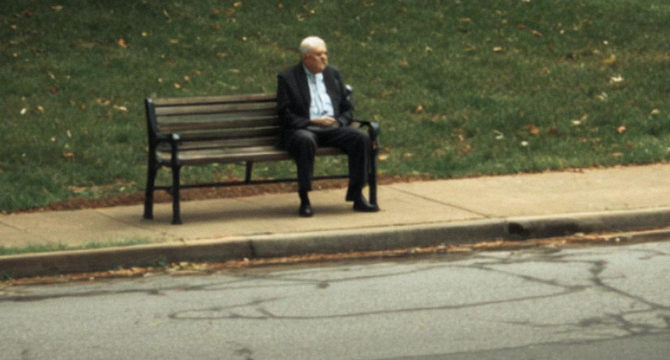
The park came into view at 5:59 p.m. He passed through the entrance gate and made his way to the third bench from the east side. The wood had weathered over the years, the green paint flaking in places, but it was still sturdy. Still there.
At exactly 6 p.m., Peter sat down.
He didn’t bring a phone to scroll through or a book to read. He simply sat, facing the entrance, watching people come and go.
He stayed for one hour. Every single day. For 30 years.
The neighborhood had noticed, of course. How could they not?
“That’s the clock man,” Mrs. Rodriguez told her husband during their evening walks. “You could set your watch by him.”
A group of teenagers had once gathered near the bench, whispering theories.
“Maybe he’s waiting for a drug deal,” one suggested.
“Nah, he’s too boring for that,” another replied. “Probably just weird.”
A little girl, no more than seven, had approached him one evening while her mother sat on a nearby bench.
“Mister, are you guarding treasure?” she asked, her eyes wide with curiosity.
Peter had smiled gently. “No treasure, sweetheart. Just sitting.”
“But why?” she persisted.
“Because I promised someone I would be here,” he said.
Her mother called her away before she could ask more questions.
Peter wasn’t guarding anything. He wasn’t hiding from anything. He was simply waiting, though most evenings he barely admitted that to himself anymore. The waiting had become more than a habit.
It had become who he was.
On the very first night, 30 years ago, he had waited past midnight. Rain had started falling around 10 p.m., soaking through his jacket, but he hadn’t moved.
He needed her to know that if she came, he would be there.
Now, all these years later, he still came, sat on the bench, and hoped. Even though his hope had become more of an echo than a feeling.
Her name was Michaela, though everyone called her Micki. Peter had met her on a spring afternoon in this very park when they were both 23. She had been reading on a bench, and he had asked if he could sit down. She had looked up, smiled, and said yes.
That simple yes had changed everything.
They talked for two hours that first day and met again the following week.
Soon, they were meeting every evening, right here on this bench. They talked about their dreams, their families, and their fears.
Their evenings didn’t always end on the bench. Sometimes they walked the long way home. Sometimes they lingered at his place when his parents were out, or in the quiet shelter of the old boathouse near the lake.
Micki wanted to be a teacher, and Peter wanted to build things with his hands, maybe start his own construction business someday.
“We could have a little house,” Micki said one evening, her head resting on his shoulder. “Nothing fancy. Just enough room for us.”
“And a garden,” Peter added. “You always said you wanted a garden.”
“With tomatoes,” she laughed. “Lots of tomatoes.”
They talked about marriage and about growing old together.
Then one evening, she didn’t come.
Peter waited until the park closed. Then, he walked to her house, which was a small cottage three blocks away, where she lived with her parents. Her mother answered the door.
“She’s not here,” her mother said.
“When will she be back?” Peter asked, confused.
“She’s gone, Peter. She left town.”
“Left? Where did she go? Did something happen?”
Her mother’s expression hardened. “She made her choice. You should respect it and move on.”
The door closed in his face.
Peter stood there, stunned. He returned the next evening to the bench, thinking maybe there had been a misunderstanding. Maybe Micki would explain everything. But she didn’t come.
Days turned into weeks and weeks turned into months.
Soon, Peter convinced himself that he hadn’t been enough. He believed that she had realized she wanted something different, someone better.
So he kept returning to the bench. Because if she ever changed her mind, if she ever wanted to find him, she would know exactly where he would be.
The ritual that had started as a desperate hope soon became routine.
And before he knew it, the ritual became his identity.
He had spent 30 years sitting, wondering, and carrying the weight of not being chosen.
It was a Tuesday evening in late October. The air had that crisp quality that made everything feel sharper and more present. Peter walked his usual route and sat down at exactly six o’clock. The park was quieter than normal.
He settled into his spot and let his gaze drift toward the entrance.
Then he heard footsteps.
It wasn’t the quick clip of a jogger or the casual shuffle of an evening walker. These footsteps were slow, deliberate, and they were getting closer. Peter’s peripheral vision caught movement, and his heart stuttered in his chest.
A woman was walking directly toward his bench.
She looked to be in her late 20s, and her dark hair was pulled back in a ponytail. She was wearing a long coat that brushed her knees.
She stopped in front of the bench and then sat down beside him.
Peter’s hands began to tremble.
In 30 years, no one had ever sat on this bench with him. Not once. People walked by, sometimes paused, but they never sat.
He stared straight ahead, afraid to look at her. Afraid to break whatever fragile moment this was.
“Is it really you?” he whispered, his voice cracking.
The woman beside him was silent for a long moment. Peter could hear her breathing, quick and nervous. Finally, she spoke.
“I think we need to talk.”
Peter turned his head slowly, almost afraid of what he would see. The woman beside him had Micki’s eyes. The same deep brown, the same shape. Her jawline was familiar too, the way it curved gently toward her chin.
But this wasn’t Micki. Micki would be 53 now, the same age as Peter. This woman was young.
Grief could play tricks on a person’s mind. Peter knew that. Thirty years of waiting could make you see things that weren’t there.
“What’s your name?” he asked.
The woman hesitated. Her fingers twisted together in her lap.
“My name is Bella,” she said finally.
Peter stiffened. That name meant nothing to him, and yet everything about this moment felt significant. The woman, Bella, turned to look at him properly. Her eyes were glassy, like she was holding back tears.
“You’ve been coming here a long time, haven’t you?” she asked.
“Yes,” Peter managed.
“Every day?”
“Every day,” he confirmed.
Bella swallowed hard. She reached into her coat pocket and pulled out a folded piece of paper, but she didn’t hand it to him yet. Instead, she looked at the bench, at the worn wood beneath their hands, as if trying to memorize it.
“My mother,” she began, then stopped. She took a breath and tried again. “My mother told me I would find you here.”
Peter looked at her with wide eyes, unable to believe what she’d just said.
Mother. Her mother.
His vision narrowed until all he could see was this young woman beside him.
“Your mother,” he repeated slowly.
Bella nodded. A single tear slipped down her cheek.
“She said you would be here at six o’clock. She said you never missed a day. She said…” Bella’s voice broke. “She said you were the most faithful man she ever knew.”
“What was her name?” Peter asked, though part of him already knew. Part of him had known the moment Bella sat down.
“Michaela,” Bella said softly.
“But everyone called her Micki.”
The world stopped. Peter couldn’t breathe or move. Thirty years of questions suddenly demanded answers all at once, but he couldn’t form the words.
Bella continued, her voice steady despite the tears now flowing freely. “She died three months ago because of cancer. Before she passed, she told me things she had never told anyone. Things she had kept secret her whole life.”
Peter gripped the edge of the bench.
“Thirty years ago, my mother was pregnant,” Bella said. “Her parents found out. They were very religious and strict. They cared more about what the neighbors thought than what their daughter needed. When they discovered she was pregnant and unmarried, they made her leave town overnight.”
“No,” Peter whispered. “No, her mother said she chose to leave.”
Bella shook her head. “They lied to you. They sent her to live with an aunt in another state. They told her if she ever contacted you, they would make sure you never saw her again. They intercepted every letter she tried to send. They monitored her calls. She was 19 and terrified, and they controlled everything.”
Bella reached into her pocket again and pulled out an old photograph.
She handed it to Peter with shaking hands.
The photo showed Peter and Micki sitting on this very bench. They were laughing, his arm around her shoulders, her head tilted toward his. They looked impossibly young and impossibly happy.
“She kept this her whole life,” Bella said. “It was in her nightstand drawer. She looked at it every day.”
Peter stared at the photograph, and something inside him broke open.
Thirty years of carefully constructed walls crumbled in an instant.
“She never stopped loving you,” Bella said. “She never married. She raised me alone and worked two jobs to give me a good life. But she said there was only ever one man for her. She said you were the kind of person who keeps promises, no matter how hard it gets.”
A sob tore from Peter’s chest. He pressed his hand over his mouth, trying to hold it back, but it was no use. Tears streamed down his face as 30 years of grief poured out.
He had built his entire life around the belief that he hadn’t been enough. That Micki had looked at their future and decided she wanted something else. He had carried that weight every single day, and it had shaped every choice he made. He never got close to anyone or took risks. He never believed he deserved more.
And it had all been a lie.
She hadn’t abandoned him. She had been torn away from him.
“She wanted you to know something else,” Bella said quietly.
Peter looked up at her through his tears.
Bella’s voice was barely a whisper. “She wanted you to know that you have a daughter.”
The world went completely silent.
Peter’s heart stopped beating for one impossible moment.
“I’m your daughter,” Bella continued, tears streaming down her own face now. “She made me promise that after she died, I would find you. That I would tell you the truth.”
Peter looked at his watch out of pure instinct. 6:58 p.m.
For 30 years, he had left this bench at exactly 7 p.m., afraid that if he left even a minute earlier, he might miss her arriving.
But she was here now. Not Micki, but the daughter they had made together. The proof that their love had been real, lasting, and strong enough to survive three decades of separation.
“Tell me about your life,” Peter said, his voice rough with emotion.
“Tell me everything.”
Bella smiled through her tears and began to talk. Seven o’clock came and went. For the first time in thirty years, Peter didn’t stand up to leave.
That evening marked the beginning of a new chapter in Peter’s life.

 admin
admin