My name is Giselle, and I am 19 years old. For as long as I can remember, my life has been built around an absence so complete that it felt almost fictional, like a character written out of a book before the first chapter was finished.
For most of my life, I believed my dad was dead.
When I was a kid, my mom told me he died suddenly.
No details. No funeral I could remember. Just a closed subject that made her angry if I asked questions. I grew up with one photo of him, a few vague stories, and a giant hole I learned to ignore.
Ten years passed. I stopped expecting answers. I built my life around the idea that he was gone forever.
Those thoughts lived in my head exactly like that, unchanged, as if I had memorized them word for word and replayed them every time someone mentioned their father too casually.
Every time a friend complained about a dad who was too strict or too loud, or too involved, I nodded politely and kept quiet. It felt easier to be the girl with no dad than the girl with questions no one wanted to answer.
My mom, Elena, raised me alone.
She was 38 now, tired in a way sleep never fixed, her patience worn thin by years of overtime shifts and unopened bills.
When I was younger, I used to study her face when she thought I was not looking, searching for cracks, for signs of grief. I never found any.
What I did find was tension. Tight lips. Sharp answers. A warning look whenever my curiosity strayed too close to forbidden territory.
“What was he like?” I once asked when I was nine.
She had frozen in the kitchen, her back to me, hands gripping the edge of the counter.
“He’s gone, Giselle,” she said. “That’s all you need to know.”
After that, I learned to stop asking.
The photo lived in the back of her dresser drawer. I found it by accident one afternoon while looking for a missing sock. It showed a man with dark hair and kind eyes, one arm slung loosely around my mom’s shoulders.
He was smiling like someone who had just been told a secret.
I stared at that picture for a long time, tracing his face with my eyes, trying to imagine his voice.
That photo became my father in full. No movement. No sound. Just a frozen moment I returned to whenever the ache felt too heavy.
By the time I turned 19, I thought I had made peace with it. I worked part-time at a clothing store downtown, took community college classes, and saved whatever I could. My life was small but predictable. I told myself that was enough.
Then, last week, everything cracked open.
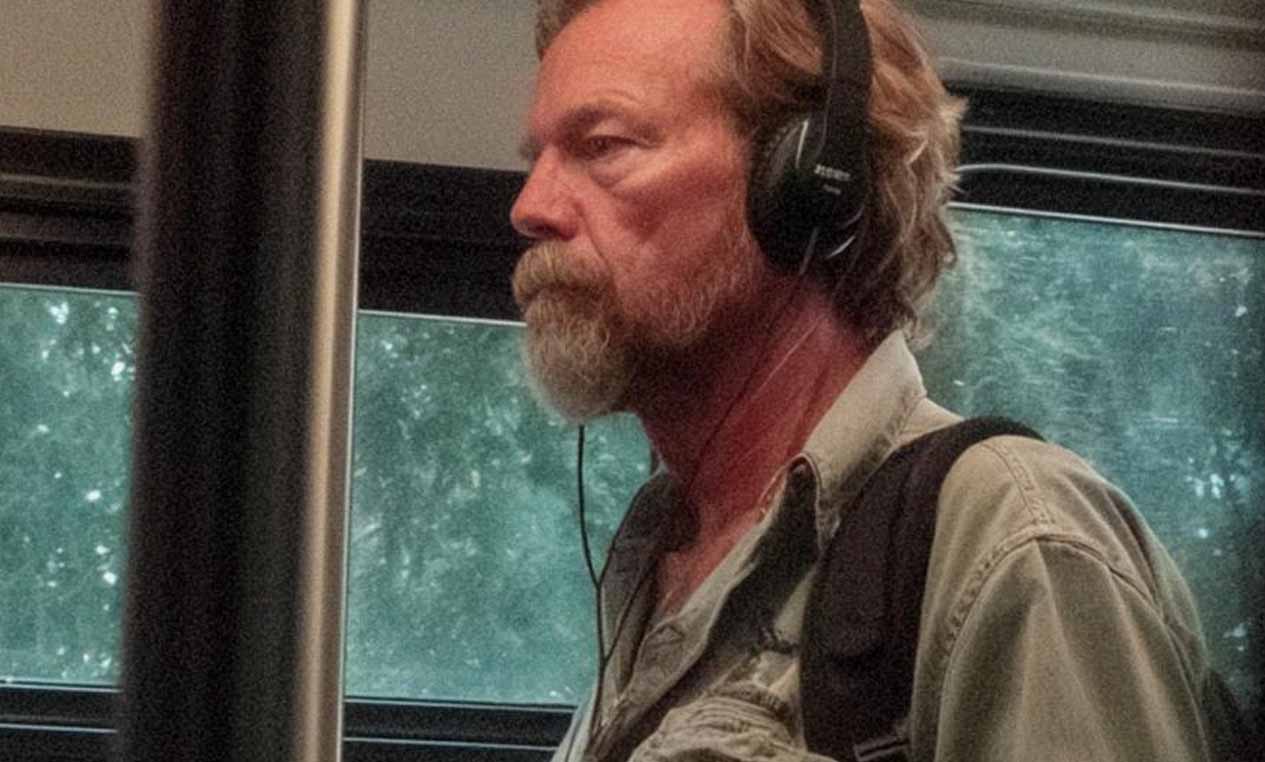
I was riding the city bus after work, half-asleep and staring out the window. The bus stopped, and a man stepped on carrying two grocery bags.
I remember the hum of the engine, the squeal of brakes, the smell of someone’s cheap cologne mixing with fried food from the bag on my lap. I remember not paying attention at all until something pulled my focus upward, sharp and sudden.
I looked up, and my heart literally stopped.
It was him.
Older, thinner, but the same face from that photo. The same eyes. The same way he tilted his head when he looked for a seat.
I felt like the air had been punched out of my chest. My fingers curled into the fabric of my jacket without me telling them to. My brain tried to correct itself, to tell me this was a coincidence, a projection, or grief playing tricks on a tired mind.
My hands went numb.
I couldn’t breathe. I watched him sit down like it was a normal day, like he hadn’t been “dead” for a decade.
He wore a faded brown jacket and scuffed shoes. His hair was streaked with gray now, and his shoulders sloped forward like life had pressed down on him over the years.
He adjusted the grocery bags at his feet carefully, as if they mattered, as if someone was waiting for him to come home.
I stared at him the way you stare at something fragile, afraid that if you blink, it will disappear.
My thoughts raced, colliding into each other.
Dead people do not buy groceries. Dead people do not ride city buses at 5:30 in the evening. Dead people do not have tired eyes that scan for an empty seat.
Every detail matched the photo I had memorized as a child. The shape of his nose. The curve of his mouth when he frowned slightly at the crowded aisle. Even the way he sat, knees angled outward, elbows tucked close.
Before I could talk myself out of it, I stood up and walked straight toward him.
My legs moved on their own, shaky but determined.
Each step felt unreal, like I was walking through water. The bus jolted forward, and I grabbed the pole to steady myself, my pulse pounding so loudly I was sure everyone could hear it.
I stopped just a few feet away from him.
Up close, the resemblance was undeniable. This was not a stranger who looked like my father. This was my father, aged by time instead of buried by it.
I wanted to say his name, though I had barely ever used it.
Daniel.
I had heard my mom say it once on the phone when she thought I was asleep. It sounded foreign in her mouth, heavy with something I could not identify.
My throat closed. A thousand questions crowded my tongue, each one fighting to be first.
Why are you here? Why are you alive? Why did you leave? Why did she lie? Why did no one tell me?
He looked up at me then, his eyes meeting mine with polite confusion.
“Yes?” he said.
That single word shattered the last of my denial. His voice was real. Not imagined. Not reconstructed from memory.
I opened my mouth, then closed it again. My hands trembled at my sides.
“I’m sorry,” I managed. “I thought… you looked like someone I knew.”
His expression softened, sympathy flickering across his face.
“Happens more than you’d think,” he said. “I’ve got one of those faces.”
I nodded, swallowing hard.
My knees felt weak. Part of me wanted to collapse into the seat across from him and demand answers. Another part wanted to run off the bus and never look back, afraid of what the truth might cost me.
The bus rattled on, stopping and starting, indifferent to the moment that had just split my life in two.
I stood there a second longer, memorizing him the way I once memorized that photograph. Then I moved past him and took an empty seat near the back, my mind spinning.
I did not get off at my stop.
I watched him instead, counting his breaths, noting the way he rubbed his thumb against the paper handle of the grocery bag, lost in thought. He did not look like a man hiding from his past. He looked like someone just trying to get through the day.
When he finally stood to exit, my heart slammed against my ribs. I stood too, my decision made without words.
The doors opened. Cold air rushed in. He stepped down onto the sidewalk, groceries in hand.
I followed him off the bus, my life trailing behind me like a loose thread, seconds away from unraveling completely.
The sidewalk felt unsteady beneath my feet as I followed him.
The bus pulled away behind us, its engine fading into the city noise, leaving me standing a few steps back from the man I had been taught to mourn.
He walked slowly, like someone used to taking his time. I stayed close enough to see him, far enough that I could still pretend I was not following him at all. My heart thudded with every step, and I kept waiting for fear to stop me. It did not.
He paused at the corner, shifting the grocery bags in his hands.
I took that as my moment.
“Daniel,” I said.
He turned around.
The sound of his name landed between us, heavy and unmistakable. His eyes searched my face, confusion giving way to something else. Recognition, maybe, or shock.
“How do you know my name?” he asked.
My mouth felt dry. “Because you’re my father.”
For a long second, he just stared at me.
Then the color drained from his face.
“That’s not possible,” he said quietly.
‘My name is Giselle,” I told him. “I’m 19 years old.’
The bags slipped from his hands and hit the ground. Apples rolled across the pavement, one stopping near my shoe. He did not notice.
“Oh God,” he whispered.
We stood there in silence, strangers and family all at once, until he bent down and began gathering the groceries with shaking hands.
I helped him without thinking.
When we stood again, he looked older than ever, like the weight of ten years had settled onto his shoulders all at once.
“Do you want to sit somewhere?” he asked. “Please.”
We ended up at a small café across the street. Neither of us ordered much. I wrapped my hands around a cup of coffee I did not drink, watching him like I was afraid he would disappear if I looked away.
“I was told you died,” I said finally. “Ten years ago.”
He closed his eyes.
“I know.”
The word landed wrong. Too calm. Too accepting.
“You knew?” My voice cracked.
“I knew she would say that,” he replied. “I just didn’t think… I didn’t think you’d ever find me.”
Anger flared in my chest, sharp and sudden. “Why? Why would she tell me that?”
He stared down at the table, tracing a crack in the wood with his finger.
“Because I left.”
The story came out slowly. No dramatic confession. No excuses wrapped in pretty language.
He and my mom had fought constantly when I was little. Money. Work. Resentment that grew quietly and then all at once. He admitted he was not strong enough to stay and not cruel enough, in his mind, to fight her for custody.
“She said it would be easier if you thought I was gone,” he said. “That you’d heal faster.”
I laughed then, a short, broken sound. “I didn’t heal. I just learned how to live with it.”
His eyes filled with tears.
“I know. I was a coward.”
I asked him why he never tried to find me. He told me he sent letters that were returned unopened. He tried calling until the number changed. After a while, the silence felt permanent.
“She made it clear she didn’t want me in your life,” he said. “And I convinced myself you’d be better off without me.”
I thought of my mom, of her anger, of the way the subject of my father turned her rigid. I saw it differently now. Not grief. Fear.
When I went home that night, my mom was sitting at the kitchen table.
She looked up the moment I walked in, her eyes narrowing.
“You’re late,” she said.
“I saw him,” I replied.
Her face went pale. “Saw who?”
“My dad.”
The room went quiet. She did not deny it. That hurt more than any lie.
“You told me he was dead,” I said. “For ten years.”
She covered her face with her hands.
When she looked up again, she was crying.
“I was trying to protect you,” she said.
“You were protecting yourself.”
The argument that followed was messy, loud, and overdue. She admitted everything. The lie. The choice. The fear that if I knew the truth, I would choose him over her.
“I was wrong,” she said. “I know that now.”
I moved out two weeks later.
Not out of spite, but out of necessity. I needed space to build something honest.
I started seeing my dad on weekends. We talked about everything and nothing. He told me stories he had rehearsed in his head for years. I told him about my life, about school, about the way I used to imagine him watching over me.
We were awkward together. Careful. Learning.
But one afternoon, as we sat on a park bench sharing fries, he laughed at something I said, and the sound felt familiar in a way I could not explain.
For most of my life, I believed my dad was dead.
Now I know the truth is more complicated than that. He was gone, yes. But he was also human. And so am I.
I am 19, and I am learning that healing does not come from believing a lie. It comes from facing the truth, even when it hurts.
And every time I see him carrying groceries or riding a bus, I remind myself of something simple and extraordinary.
My father is alive.
And so is the part of me I thought I had lost forever.

 admin
admin