I married Michael a year after we started dating.
Quick, right? That’s what everyone said. My mother actually laughed when I told her, then realized I was serious.
But here’s the thing: when you meet someone who makes you feel safe after years of not feeling that way, you don’t second-guess it.
You definitely don’t listen to your mother.
I married Michael less than a year after we started dating.
He was a widower raising his eight-year-old son, Ethan, on his own. His wife had died a few years earlier after a long battle with cancer.
I knew that going in. I thought I understood what it meant.
I didn’t.
After the wedding, I moved into Michael’s house.
Our house, I kept correcting myself. Our house.
I thought I understood what it meant.
He carried my boxes in two at a time, setting them down carefully.
I watched him move through the rooms with such familiarity, and tried not to feel like a guest.
“Tell me where you want everything,” he said, smiling at me from the doorway. “This is your home now.”
The words warmed me more than the house itself ever did.
I tried not to feel like a guest.
The place was lived-in, but tidy.
There were photos of Ethan at different ages scattered on shelves, school projects, and some drawings stuck to the fridge with alphabet magnets.
Everything had its place.
I tried to find mine.
The place was lived-in, but tidy.
Every time I hesitated, wondering where I fit in all this order, Michael seemed to sense it.
He had this way of reading me that should have felt comforting. Sometimes it did. Sometimes it felt like he was monitoring me instead.
“You okay?” he’d ask, touching my arm gently.
“Yeah,” I’d say. “Just getting used to it.”
Then I noticed the locked door.
Sometimes it felt like he was monitoring me.
It was on the first floor, tucked just past the laundry room, plain and unmarked, with a small silver lock catching the light.
“Hey,” I called out to Michael, who was in the kitchen organizing my mugs. “What’s this room?”
Michael glanced over.
His expression didn’t shift, but I swear something flickered in his eyes.
“What’s this room?”
“Oh. That’s just the basement,” he said easily. “I set it up for myself.”
“For what?” I asked.
“I like being alone down there sometimes. I keep some personal things there, nothing important. You aren’t missing anything. Trust me.”
I nodded.
“That’s just the basement.”
After all, men like having their own space. My dad had his workshop. My brother had his garage. This wasn’t strange.
Was it?
I let it go.
Or I tried to, but over the next few days, I found myself walking past that door more often than necessary, wondering what was behind it.
Men like having their own space.
Why lock a basement if there’s nothing important down there?
A few weeks later, our neighbor knocked on the door with his German shepherd, Rex, and an apologetic smile.
“Any chance you could take him for a bit?” he asked, shifting his weight. “I’ve got a work trip overseas. Two weeks.”
Michael crouched down immediately, scratching the dog behind the ears.
“Any chance you could take him for a bit?”
“Of course. Right, buddy?”
Ethan lit up beside me. “Rex! You’re staying with us?”
“Looks like it,” our neighbor said, handing over the leash. “He’s good. No trouble at all.”
That turned out to be only half true.
Michael and Ethan knew Rex. The dog settled in easily.
There was just one problem.
“Rex! You’re staying with us?”
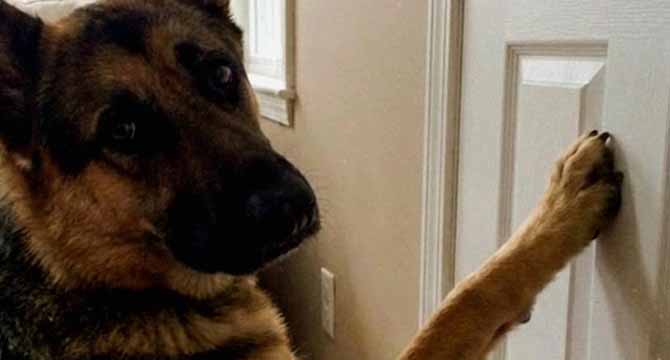
Every evening, Rex would sit in front of that locked door and whine softly.
Sometimes he’d scratch at it, nails clicking against the wood in a steady rhythm that made my skin crawl.
The first time it happened, I thought it was random. Dogs do weird things.
The second time, I mentioned it to Michael.
“Probably smells something,” he said, not looking up from his laptop.
Rex would sit in front of that locked door and whine softly.
The third time, I watched Rex more carefully.
The dog wasn’t just curious. He was agitated. Focused. Like he knew something was down there.
“Hey,” Michael would say sharply when he noticed. “Rex. No.”
He’d shoo him away with his foot, shaking his head.
“Probably just stressed,” he said one night as we got ready for bed. “New house and all.”
The dog wasn’t just curious. He was agitated.
I wanted to believe that.
So I did.
But the thing about wanting to believe something is that it only works until it doesn’t.
One evening, Michael was running late at work, and Ethan was staying overnight at a friend’s house.
The house felt bigger without them. Quieter.
I wanted to believe that.
I wandered from room to room, trying to feel settled, trying to feel like I belonged here.
I put on music, made tea, and started a book I’d been meaning to read.
None of it worked.
That was when I heard Rex again.
Louder this time. And he wasn’t just whining — he was scratching at the door harder than ever before.
I wandered from room to room, trying to feel like I belonged here.
I came out of the kitchen to see him throwing his weight against the door, pawing at the handle, his body tense and focused in a way I’d never seen before.
“Rex,” I said softly, walking toward him. “Hey. What is it?”
He glanced at me, whined once, then went back to the door.
His paws scrabbled against the wood with increasing desperation.
He was throwing his weight against the door.
That’s when I noticed it.
The latch wasn’t fully closed.
I told myself it was none of my business. That I should wait for Michael. That I didn’t want to look like the kind of woman who went searching for problems where there weren’t any.
But something inside me wouldn’t let me walk away.
I reached for the door and pulled it open.
The latch wasn’t fully closed.
Rex rushed in while I was still searching for the light switch.
I found it eventually, flicked it on, and padded down the stairs.
When I reached the bottom, I paused.
What is going on here? I slowly turned around to take it all in.
My husband had lied to me. This was clearly not just a basement filled with Michael’s “personal things.”
Rex rushed in while I was still searching for the light switch.
It was a storage space, but not the chaotic kind.
Metal shelving lined the walls, each shelf neatly packed full of clear plastic bins marked in black marker.
“Winter coats.”
“Medical records.”
“Shoes, formal.”
“Photos.”
It was a storage space, but not the chaotic kind.
Rex padded past me, nose low to the ground.
He growled softly, a low rumble in his chest, then darted toward one corner where a few cardboard boxes were stacked.
I opened one plastic bin and peeked inside.
That’s when I started to piece together the nature of the secret Michael had been keeping locked behind this door.
Rex padded past me, nose low to the ground.
By the time I reached the third bin, it was clear that the only things in storage down here belonged to his late wife.
Not just a few keepsakes, but everything. Even her socks and underwear.
Everything was clean, untouched by dust.
It felt less like storage and more like a museum.
A shrine.
The only things in storage down here belonged to his late wife.
I swallowed hard, my throat tight.
This wasn’t about forgetting.
He was trying to keep everything exactly as it was. Frozen in time.
Where did that leave me?
Then I heard the door upstairs open.
He was trying to keep everything exactly as it was.
Michael’s voice floated down.
“Hello? I’m home.”
My heart hammered. I should have moved, but I just stood there, frozen, holding a bin labeled “Scarves and gloves.”
His footsteps slowed when he reached the basement door.
Then stopped completely.
I should have moved, but I just stood there, frozen.
“Why is this door open?” he asked, his voice tight. “Rachel? Rachel! Answer me.”
I said nothing.
I set the bin down. The sound echoed around me.
His footsteps thundered as he came down the stairs.
“You kept everything, didn’t you?” I asked, not turning around.
“Why is this door open?”
“I can explain,” he said quickly.
“This speaks louder than words.” I gestured to the bins and boxes surrounding us.
“Is there room for me here at all? In your life? In your heart? Why did you even marry me?”
That landed.
His shoulders slumped. He rubbed a hand over his face, eyes darting around the room like he was seeing it for the first time.
“I can explain.”
“I love you. All of this…” He paused, struggling. “I didn’t know what to do with it. Getting rid of it felt like… like erasing her. Like telling Ethan his mother didn’t matter anymore.”
“So you locked it away instead? That’s not healthy…”
Rex suddenly snarled.
He dove into the stacked boxes, toppling them. A small animal screamed.
Michael rushed over just as Rex reemerged with a dead rat in his jaws.
“Getting rid of it felt like… like erasing her.”
Michael stared at it in horror. “Oh God. No. No, no…”
I could hear them now that I wasn’t entirely focused on the shock of finding all those bins and boxes buried in the basement. Little claws scratching against plastic and wood, soft rustling sounds coming from multiple directions.
“They’re everywhere…”
I turned to Michael. “This is what happens when you leave things too long. You’re going to have to do something about this, or the rats will do it for you.”
Michael stared at it in horror.
The metaphor wasn’t lost on either of us.
He sank onto the bottom step, head in his hands.
“I loved her, and I love you. I didn’t know how to hold both.”
I stepped back, arms crossed, trying to protect myself from the hurt. “Love isn’t the issue. Secrecy is. I won’t live in a house with locked rooms or locked grief.”
He sank onto the bottom step, head in his hands.
I took a breath, steadying myself.
“If I’m going to stay, if I’m even going to consider it, that lock comes off. And you get help. Grief counseling. Not someday. Now.”
The ultimatum hung between us.
He stood slowly and walked past me without a word.
He took a screwdriver from a nearby shelf and, without hesitating, unscrewed the lock from the door.
The ultimatum hung between us.
The metal hit the concrete floor with a sharp clatter that echoed in the small space.
The next morning, he made the call for grief counseling while I sat at the kitchen table and listened.
I didn’t unpack anything more into the house.
Not yet.
He made the call for grief counseling.
That weekend, he started going through the things in the basement.
I helped, but he took the lead. That was how it needed to be.
He decided what to keep for Ethan and what to donate.
Some things he couldn’t touch yet: a wedding dress, a jewelry box. He’d pick them up, set them down, walk away.
I gave him space for that.
That was how it needed to be.
Others he handed over without hesitation.
“She would have wanted someone to use these,” he said, folding a stack of scarves. “She hated waste.”
It was the first time he’d talked about her like she was a person, not a memory to be preserved.
By Monday, the basement was almost empty.
Only some keepsakes and a few miscellaneous items remained. Things Ethan might want someday.
By Monday, the basement was almost empty.
I didn’t know what we would become.
But I knew one thing: if we were going to move forward, it would be with the doors open or not at all.

 admin
admin