Anna had always believed that if she kept her head down and did good work, life would be fair to her. At 42, she lived alone in a cramped apartment on the east side of town.
She had no children, no husband, and barely enough money to cover rent each month.
But she had her students, and that had always been enough.
Teaching gave her life meaning in a way nothing else ever had. She remembered their faces, every single one of them, even the troublemakers who tested her patience.
She stayed late to help with homework, bought supplies with her own money when the school couldn’t provide them, and genuinely believed she was making a difference.
There had been a time when Anna thought she’d have a different life.
When she was 28, she fell in love with a man named Michael, who promised her everything. They talked about marriage, children, and a house with a backyard where their kids could play. But Michael left her for someone younger, someone who fit better into his ambitious plans.
The heartbreak had been devastating, the kind that changes you from the inside out. After that, Anna threw herself into teaching and convinced herself that loving her students was enough.
She became the teacher who never missed a day, who remembered birthdays, and showed up even when she was sick because she knew those kids needed her.
That’s why December 24 felt like the cruelest joke the universe could play.
Anna was grading papers in her classroom that afternoon, humming along to a Christmas song playing softly from her phone, when Principal Henderson knocked on her door. His face was drawn, and he wouldn’t quite meet her eyes.
“Anna, can we talk for a minute?” he asked, closing the door behind him.
She knew immediately.
Something about his tone told her this wasn’t a casual conversation.
“The district made some decisions about budget cuts,” he began, and the words that followed felt like they were coming from underwater.
Her position was being eliminated, effective immediately. There would be no warning, no time to prepare, and no severance package to cushion the blow. Just a polite apology and a cardboard box to pack up seven years of her life.
“I’m so sorry, Anna,” Henderson said, and she could tell he meant it. “You’re a wonderful teacher. This isn’t about your performance. It’s just the numbers.”
Anna nodded mechanically, not trusting herself to speak.
She packed her things while the building emptied around her, the sounds of holiday cheer echoing through the halls as other teachers headed home to their families.
She carried out her box of books, framed photos of past classes, and a coffee mug a student had given her that said “World’s Best Teacher” in crooked lettering.
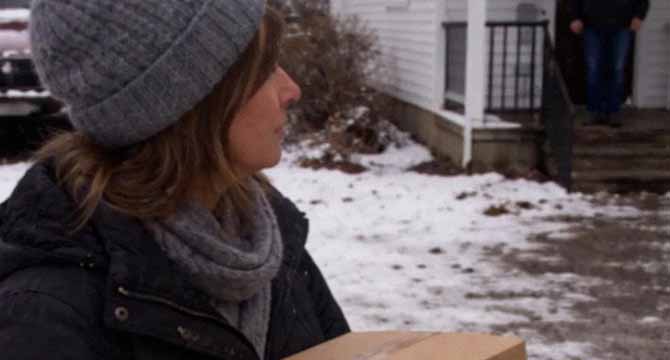
The snow had started falling by the time she stepped outside, fat flakes that would have seemed magical under different circumstances.
Instead, they just made the walk home feel longer and colder.
Anna clutched the box against her chest and tried to calculate how long she could survive on her savings. Two months, maybe three if she was careful. After that, she had no idea what she would do.
Her mind spiraled as she walked. Who would hire a 42-year-old teacher with no connections and a resume that screamed “budget liability?” How would she explain the gap in employment? What would she do if teaching, the only thing she’d ever been good at, was no longer an option?
By the time Anna reached her building, her hands were numb, and her cheeks were wet with tears she hadn’t realized she was crying. She just wanted to get inside, lock the door, and pretend this day had never happened.
That’s when she saw him.
A man stood on her doorstep, well-dressed in a charcoal wool coat and leather gloves, looking completely out of place against the chipped paint and rusted mailboxes of her building.
He was tall, maybe in his late 40s, with silver threading through his dark hair. He looked nervous, shifting his weight and glancing at his phone like he wasn’t sure he was in the right place.
When he saw her approaching, he straightened up quickly.
“I’m sorry,” he said. “You’re Anna, right?”
Anna’s first instinct was suspicion. This had to be some kind of scam, or maybe a debt collector. She took a step back, hugging the box tighter.
“Who’s asking?” she said, her voice sharper than she intended.
The man held up his hands in a gesture of peace. “I know this is weird. I’m David. We’ve uhh… we’ve been messaging on that dating site?”
Anna stared at him with wide eyes as recognition slowly dawned through her shock and exhaustion. David. The man she’d been talking to for weeks, late at night when loneliness got too heavy to bear alone.
“What are you doing here?” she whispered.
David had the decency to look embarrassed. His cheeks flushed slightly, and he shoved his hands into his coat pockets.
“I know I should have called first,” he said quickly. “I was in town for work, and I thought it might be nice to surprise you with dinner. I wanted to do something special for Christmas Eve. I know we’ve only been talking online, but I feel like I know you, you know? And I thought maybe you’d like some company tonight.”
Under any other circumstances, Anna might have been touched by the gesture.
She’d joined the dating site three months ago, more out of desperation than hope. David had been different from the other men she’d talked to. He was thoughtful, asked real questions, and seemed genuinely interested in what she had to say. They’d bonded over their shared love of old mystery novels, their terrible coffee habits, and the fact that both of them had been let down by life more than once.
But right now, standing on her doorstep with her entire world in a cardboard box, Anna just felt mortified.
“This is a really bad time,” she said.
David’s expression shifted immediately. He looked at the box in her arms, then at her face, really seeing her for the first time.
“What happened?” he asked softly.
Anna shook her head, fumbling for her keys. “It’s nothing. I just need to get inside.”
“Anna, wait.” David took a small step closer, but not close enough to crowd her. “I can see something’s wrong. You don’t have to tell me, but please don’t pretend you’re fine.”
Something about the gentleness in his voice broke through the wall she’d been trying to maintain all afternoon.
The tears started again, and she couldn’t stop them.
“I lost my job today,” she said, the words tumbling out. “Christmas Eve. They fired me on Christmas Eve because of budget cuts, and I don’t know what I’m going to do. I can barely afford rent as it is, and now I have nothing.”
David didn’t say anything right away. He just stood there, and Anna braced herself for the awkward exit, the polite excuse about needing to leave.
Instead, he reached out slowly and took the box from her arms.
“Let’s get you inside,” he said. “It’s freezing out here.”
Anna wanted to argue, but she was too tired. She unlocked the door and led him up the narrow staircase to her apartment, acutely aware of the peeling wallpaper and the smell of someone’s dinner cooking on the second floor. David didn’t seem to notice or care. He set the box down on her small dining table and waited while she hung up her coat.
“I’m sorry,” Anna said, wiping at her eyes. “This is embarrassing. Our first time meeting in person, and I’m falling apart.”
“Don’t apologize,” David said firmly. He pulled out one of her mismatched chairs and gestured for her to sit.
“Tell me what happened. All of it.”
So, she did.
Anna told him about Principal Henderson’s awkward visit and about the students she’d never see again. She told him about Michael, about the life she’d thought she’d have, and about how teaching had been the one thing that made her feel like she mattered.
David listened without interrupting, his attention never wavering. He didn’t check his phone or look around her apartment or give her the pitying looks she’d feared. He just listened as if every word she said was important.
When she finally ran out of things to say, David was quiet for a moment.
“I need to tell you something,” he said slowly. “Something I should have told you before, but I was afraid it would change things between us.”
Anna’s stomach tightened.
“I wasn’t completely honest about what I do for a living,” David continued. “I told you I was comfortable, and that’s true, but it’s an understatement. I own a company. Actually, several companies. Educational publishing, mostly. Textbooks, curriculum development, that kind of thing. And I run a foundation that supports schools in underfunded areas.”
Anna stared at him, trying to process what he was saying.
“You’re rich.”
“Yes,” David admitted. “And I didn’t tell you because I wanted you to know me first. Not my bank account. I’ve had too many people in my life who were interested in what I could give them instead of who I actually am. When we started talking, you were so real and honest. You treated me like a person. I didn’t want to lose that.”
Anna stood up abruptly, putting distance between them.
Her mind was racing, trying to reconcile the man she’d been messaging with the wealthy businessman sitting in her kitchen.
“So what is this?” she asked, her voice tight. “You felt sorry for the poor teacher and thought you’d swoop in and save her? Is that why you showed up today?”
“No.” David stood too, but he didn’t move closer. “I showed up today because I wanted to spend Christmas Eve with someone I care about. I had no idea you’d lost your job. And I’m not here to save you, Anna. You don’t need saving.”
“I think I do,” she said bitterly. “I’m unemployed with no prospects. That sounds like someone who needs saving to me.”
David shook his head slowly.
“That’s not what I see. I see someone who dedicated seven years to helping kids, who put their needs before her own, and who showed up every single day even when life kept knocking her down. You’re not broken, Anna. The system is.”
Anna wanted to believe him, but the gap between their worlds felt impossibly wide.
“You don’t understand what it’s like,” she said quietly. “To worry about every dollar, to work that hard and still barely get by. We’re from different planets.”
“Maybe,” David conceded. “But that doesn’t mean we can’t understand each other. And it doesn’t mean I can’t help in ways that actually matter.”
“I don’t want your money,” Anna said quickly.
“I’m not offering it,” David replied, and there was something almost like relief in his voice. “But I am offering something else. My company publishes textbooks for schools like the one you just left. We develop curriculum, we create educational materials, and honestly? I’ve always wondered if we’re actually helping or just churning out products that look good to administrators.”
He pulled out the chair again, inviting her to sit back down.
This time, Anna did.
“I want to know what teachers actually need,” David continued. “Not what I think they need, not what the market research says. I want to know from someone who’s been in those classrooms, who knows those kids. If you had unlimited resources and no bureaucracy, what would you change?”
Anna blinked at him, caught off guard by the question. She’d expected pity or charity, not genuine interest in her opinion.
“Are you serious?” she asked.
“Completely,” David said. “I’ve been doing this work for 15 years, and I still feel like I’m missing something. You have experience and insight that’s worth more than any consultant I could hire. I’m asking you to teach me.”
For the first time since she’d been fired that afternoon, Anna felt something other than despair. She felt useful. She felt seen.
They talked for hours that night.
Anna told him about the students who couldn’t afford basic supplies and about outdated textbooks that didn’t reflect their experiences. David asked questions, took notes on his phone, and challenged her when she said something he didn’t understand.
Over the following weeks, David kept his promise. He didn’t throw money at her problems or treat her like a charity case.
Instead, he introduced her to people in the education sector, helped her prepare for interviews, and connected her with opportunities she’d never have found on her own. When Anna said no to something, he listened.
When she needed space, he gave it to her.
By mid-January, Anna had three job offers.
She chose the position at an educational nonprofit that focused on teacher support and curriculum development. It paid more than her teaching job had, valued her classroom experience, and gave her a voice in decisions that would affect teachers like her.
The romance between them grew slowly, carefully, without the desperation of someone trying to fix the other person. They went on real dates, learned each other’s quirks, and discovered that the connection they’d built through late-night messages was even stronger in person.
One year later, on Christmas Eve, Anna stood in front of a new classroom.
Not as a teacher this time, but as a program director for a fully funded educational initiative that puts teachers first. The room was filled with supplies, updated technology, and resources that she’d only dreamed about a year ago.
David stood beside her, his hand warm in hers.
“You did this,” he said softly. “Not me. I just opened a few doors. You walked through them.”
Anna leaned against his shoulder, thinking about the woman she’d been a year ago, crying in the snow with a cardboard box. She’d thought losing her job was the end of everything. Instead, it had been the beginning of something she never could have imagined.
“Thank you for showing up that day,” she whispered.
David squeezed her hand. “Thank you for letting me in.”
As they locked up the classroom and headed out into the snowy evening, Anna realized that the man who’d appeared on her doorstep hadn’t changed her life with his wealth or his connections. He’d changed it by believing in her when she’d stopped believing in herself, by seeing her value when everyone else saw a budget cut, and by offering respect instead of rescue.
Sometimes the best gift isn’t being saved. It’s being reminded that you were never helpless to begin with.

 admin
admin