
When I married Kevin, he took my hands in his and said, “There are no secrets between us.”
I believed him.
Maybe that sounds foolish now, but back then, standing in the middle of his living room with half-unpacked boxes around us, it felt like the easiest thing in the world to believe. I was newly married and trying hard to settle into a life that already had a shape before I entered it.
Kevin’s house was neat in a way that made me feel like I was stepping into someone else’s routine. The coffee mugs had their place, the towels were folded a certain way, and even the hallway felt like it had rules I had not learned yet.
I kept telling myself that was normal.
He had lived there alone for years. I was the one joining his world, not the other way around.
For the first few weeks, I focused on being patient. I learned which floorboard creaked near the kitchen and how he liked his eggs on Sunday mornings. I found places for my books, my shoes, and my little habits. I wanted our home to feel like ours, not just his house with my clothes in the closet.
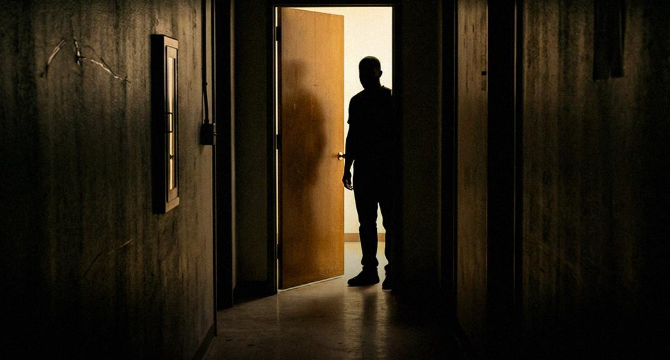
Then I noticed the door.
It was at the very end of the hallway — plain, unremarkable, and painted the same off-white as the others. There was no sign on it, no special knob, and nothing to make it stand out. And yet, every time I drifted toward it, Kevin would appear out of nowhere.
“You can’t go in there,” he would say calmly. “It’s just old stuff, nothing interesting.”
The first time, I laughed. “I wasn’t even trying to snoop.”
He smiled, kissed my forehead, and steered me back toward the bedroom like it was nothing.
At first, I didn’t think much of it.
Everyone has their own boundaries, their own private space. Besides, it had been his house long before I came into his life. If he had a storage room he wanted left alone, that hardly made him a villain.
That was what I told myself, anyway.
Still, over time, it started to feel strange.
It was not just that the door stayed locked. It was the way Kevin changed around it. He was a steady man in most things. Even when work stressed him out or traffic made him late, he kept himself together.
But near that room, something in him tightened.
If I paused in the hallway for too long, he noticed. If I glanced at the doorknob, his whole face sharpened.
Sometimes I caught a look in his eyes. Uneasy, almost afraid.
That was the part I could not explain away.
One evening, while we were folding laundry on the couch, I finally asked, “Don’t you trust me?”
He stopped matching socks and looked at me so quickly that I knew he had been expecting that question.
He hesitated.
“It’s not about trust. Just promise me you won’t go in there.”
His voice was gentle, but there was something firm under it. Not anger. Not exactly. More like fear dressed up as a request.
I studied him, hoping he would laugh and explain, and tell me that it was full of old tax papers or broken furniture or some embarrassing collection from his teenage years. Instead, he just waited.
So I promised.
After that, I tried harder not to think about it.
I told myself marriage meant respecting each other’s limits. I told myself love did not mean demanding access to every hidden corner of a person’s life on day one.
Kevin was kind to me in a hundred visible ways. He warmed up my car before work on cold mornings. He rubbed my shoulders when I had headaches. He remembered the tiny things I mentioned once and brought them back to me later, like my favorite tea or the brand of candles I liked.
And yet, that locked door sat at the end of the hallway like a thought I could not turn off.
Then everything changed.
One night, I woke up to a noise.
At first, I did not know what had pulled me from sleep. The room was dark, and the digital clock on the nightstand glowed a soft blue. I turned, half asleep, reaching for Kevin.
He wasn’t beside me.
That woke me fully.
I sat up and listened. The house was silent in that thick, unnatural way it only is in the middle of the night. Then I saw it. A faint light was coming from the end of the hallway.
My mouth went dry.
I slipped out of bed and opened the bedroom door as quietly as I could. The hallway was dim except for that narrow stripe of light in the distance. The locked door was slightly open.
For a second, I just stood there, frozen.
My heart started pounding so hard it felt painful. Every promise I had made, every excuse I had given him, every uneasy glance and half-finished answer came rushing back at once.
I slowly walked closer.
And for the first time, I saw what was inside.
The room was a child’s bedroom.
A faded blue blanket was folded at the foot. There were books lined up on a shelf, a toy dinosaur on the dresser, and framed drawings taped neatly to the wall. Nothing was dusty. Nothing looked forgotten. It felt cared for, as if someone still belonged there.
And in the middle of it, beside the bed, Kevin was sitting with his face buried in his hands.
He was crying.
The sound was so unfamiliar that it took my breath away. My husband was not a man who cried easily. Even in grief, even under stress, he always held himself together. But now his shoulders shook, and the quiet, broken sound coming from him made my chest ache.
“Kevin?” I whispered.
He jerked up and looked at me with red, stunned eyes. For a second, he seemed almost angry that I was there. Then he stood too quickly and wiped his face.
“It’s nothing,” he said hoarsely. “You shouldn’t have come in here.”
I stepped farther inside, my heart still racing.
“Nothing? Kevin, this is a child’s room.”
He turned away from me. “Gracie, please.”
“No,” I said, more softly than I felt. “No more shutting me out. Please tell me the truth.”
He stood still for a long moment. Then he sat back down on the edge of the small bed, like his legs could no longer hold him.
“I had a son,” he said at last.
The words hit me so hard I had to grip the dresser beside me.
“What?”
“I have a son,” he corrected, his voice breaking. “Drew. He’s 10 now.”
I stared at him. “You never told me.”
He gave a hollow laugh and covered his eyes again. “I know.”
Then, in fragments at first and then in a rush, he told me everything. Drew was from his first marriage to Audrey. After the divorce, things had turned ugly.
Audrey had completely cut him off, changed her number, moved away, and refused all contact. He had tried lawyers, old friends, social media, and every lead he could find. Nothing lasted.
Every trail went cold.
“This room,” he said, looking around it with a pain I could barely stand to witness, “is all I had left. I kept it the way he liked it. I know it sounds crazy.”
“It doesn’t,” I said, though tears were already burning my eyes.
“I came in here when I missed him so much I couldn’t breathe,” he admitted. “I didn’t tell you because I was ashamed. And because saying it out loud made it feel even more real.”
I sat beside him and took his hand. “You should have told me.”
“I know,” he repeated, and this time he looked at me like he expected me to leave. “I just didn’t know how.”
I could not fix his lost years, but I could not stand by and watch him live inside that grief either.
So I started searching.
I went through old documents, scrolled through old social media accounts, and reached out to mutual acquaintances whose names I found buried in old emails and paperwork.
It took weeks. More than once, I thought I had failed. Then one afternoon, I found Audrey.
I did not tell Kevin. I was afraid hope would crush him if I was wrong.
Instead, I came up with a plan.
I contacted Audrey under the pretense of a charity event at a children’s center, a family event with gifts and activities. To my surprise, she agreed to come with Drew.
Then I told Kevin the center needed help organizing and asked if he could come by for an hour.
He arrived carrying folding boxes and wearing the confused expression of a man who had no idea why I was being so secretive. Then Audrey walked in holding a boy’s hand.
Kevin went completely still.
So did the child.
For one terrifying second, no one moved. Then Drew’s face changed. His eyes widened, and he let go of his mother’s hand.
“Dad,” he cried.
He ran straight into Kevin’s arms.
Kevin dropped everything and caught him, holding him so tightly I thought he might never let go. He was crying openly now, and Drew was clinging to him, sobbing into his shoulder.
Around them, the room faded.
There was only that moment, a father and son finding each other again.
I looked at Audrey, expecting resistance. Instead, I saw her expression crumble. She watched the way Drew held onto Kevin, the way Kevin pressed his face into his son’s hair like he was afraid this was another dream.
That was when she realized the mistake she had made.
It was not simple after that, but it was honest. Slowly, they came to an agreement. Weekend by weekend, visit by visit, the distance began to heal.
And at home, the locked door changed too.
It stayed open.
Now, every weekend, that room fills with Drew’s laughter, the thud of sneakers in the hallway, and Kevin’s voice reading bedtime stories with the kind of joy that still makes me pause and listen. The house that once held only pain finally became a real home.
And sometimes, when I pass that room and see the door standing wide open, I think about the promise Kevin once asked of me.
I broke it.
And it saved us.
 admin
admin