
I’m 31, and for six years, my world had been built around one small girl with messy curls, endless questions, and a laugh that could pull me out of even the worst day. Lily was all I had, and I was all she had.
Her father left before she even took her first steps. He disappeared so completely that, after a while, I stopped expecting calls, excuses, or apologies.
I learned how to do everything alone.
I worked, paid bills, packed lunches, kissed scraped knees, and stayed up through fevers with a cool cloth in one hand and my phone in the other, just in case I needed to call for help. Help never really came, so I stopped needing it.
That was the thing about our life. It was small, but it was ours. For years, it was just the two of us. No secrets. No complicated stories.
At least, that’s what I thought.
Last week, I was making dinner while Lily sat at the kitchen table drawing with the kind of deep focus only a six-year-old can give to something important.
The smell of garlic and onions filled our little apartment, and I was half-listening to the soft scratch of her crayons against paper while trying not to burn the chicken.
“Mom?”
I barely looked up. “Hmm?”
She was quiet for a second, and then she asked, “Mom… why don’t you ever visit my other mom?”
My whole body went still.
For a moment, I honestly thought I’d misheard her. I turned off the stove and looked over my shoulder. Lily was still sitting there, swinging one leg under the chair like she’d asked me something as harmless as whether we had ice cream.
I laughed, but it came out thin and wrong.
“What do you mean, sweetheart?”
She frowned, like I was the one being strange.
“My other mom,” she repeated. “The one who comes at night.”
A cold chill ran down my spine so fast it made me grip the counter.
I told myself not to be ridiculous. Kids say odd things all the time. They dream. They imagine. They turn shadows into stories and strangers into friends.
Lily had always had a vivid mind.
She gave names to clouds and held full conversations with stuffed animals. That had to be all this was.
Still, my voice sounded too careful when I asked, “What does she look like?”
Lily smiled then, a sweet little smile that somehow made everything worse.
“She looks like you… but she’s nicer.”
I felt my stomach drop.
I stared at her, waiting for her to laugh or admit she was pretending, but she only went back to coloring as if she hadn’t just cracked something open inside me.
On the paper in front of her were three figures holding hands.
One was small, one was clearly me, and the third had the same long brown hair I had.
“Who’s that?” I asked, trying to keep my tone light.
Lily shrugged. “Us.”
I wanted to ask more. I wanted to kneel beside her and demand where she got this from, who told her that, and what exactly she meant by “comes at night.” But one look at her calm face made me stop. She didn’t seem scared. She seemed normal. Happy, even.
So I swallowed my fear and finished dinner with shaking hands.
That night, I tucked her into bed like always.
I read her favorite picture book, smoothed her blanket, and kissed her forehead.
“Good night, baby,” I whispered.
She smiled sleepily. “Good night, Mom.”
I stood in her doorway for a long moment after turning off the light. Her room looked completely ordinary. The little moon-shaped lamp on her nightstand, the stack of books beside the bed, and the socks she had kicked under the chair.
Everything was so familiar, so harmless, that I almost felt foolish for letting myself get so unsettled.
Almost.
Because when I finally lay down in my own bed, sleep wouldn’t come.
My mind kept replaying her words.
My other mom.
The one who comes at night.
She looks like you… but she’s nicer.
Every version of it sounded worse than the last.
By 1 a.m., I was still awake.
By 2 a.m., I’d checked the front door lock twice and walked past Lily’s room once just to hear her breathing. I told myself I was being paranoid, but fear doesn’t care what makes sense.
Then, around 2:40 a.m., I heard soft footsteps coming from Lily’s room.
Slow. Careful.
I sat up so fast my neck hurt. For a second, I listened, thinking maybe she was just getting up to use the bathroom. But then I heard a low murmur.
I grabbed my phone and walked toward her door.
It was slightly open.
My hand trembled as I pushed it just enough to look inside.
And my heart stopped.
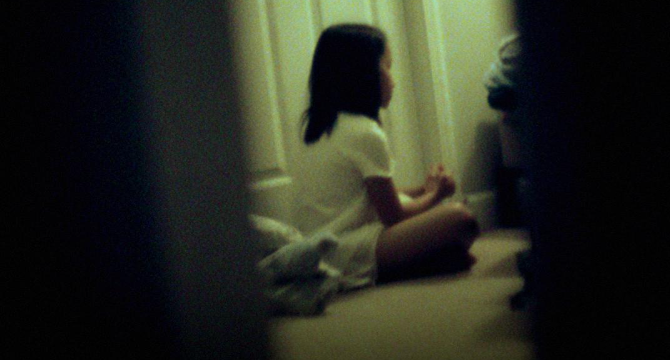
Lily was sitting up in bed, talking to someone.
I stepped in, my voice shaking.
“Lily?” I said, my voice shaking.
She turned toward me at once, blinking in the dim glow of her night-light. Her stuffed rabbit was in her lap, and she was stroking one of its ears with sleepy little fingers.
For one wild second, I thought I was losing my mind.
I had heard talking. I knew I had. The room felt wrong somehow, like I had walked in on something private and arrived a second too late.
“Who were you talking to?” I whispered.
Lily looked past me toward the doorway, then back at me. Her expression changed. She looked confused, then disappointed.
“She left,” Lily murmured.
My skin went cold. I stepped fully into the room and switched on the lamp beside her bed. Warm yellow light spilled across the walls, over the stars she had stuck to the ceiling, and over the drawings taped to her dresser.
Nothing was out of place.
No open window. No shadow in the corner. No hidden figure. Just my daughter, sitting in bed in pink pajamas, looking at me like I had interrupted a conversation.
“Who left?” I asked, more firmly this time.
“My other mom,” Lily replied, as if it were obvious. “She always leaves when you come.”
I sat down on the edge of the bed because my knees did not trust me anymore.
“Lily,” I said gently, “there is no other mom.”
Her small face crumpled in protest. “Yes, there is.”
“Sweetheart…”
“She comes when you’re sad,” Lily insisted. “She sits with me and brushes my hair back when I can’t sleep.”
I stared at her. The fear inside me had not disappeared, but something else was pushing through it now. A strange ache. A memory I could not quite touch.
“What else does she do?” I asked.
Lily sniffed and looked down at her blanket. “She sings.”
My breath caught.
There was only one song I had ever sung to Lily at bedtime, one my own mother used to sing to me when I was little. I had not sung it in years. Not since the night Lily was born, when I was exhausted and terrified and alone.
I wet my lips.
“What song?”
Lily hummed a few soft notes.
My chest tightened so hard it hurt.
I knew that lullaby.
Not because it was common. Not because it was in some cartoon or on the radio. My mother had made it up for me. She used to sit beside my bed, tuck my hair behind my ear, and hum those same notes until I fell asleep.
Lily watched my face closely. “See?” she said in a tiny voice. “I told you she was real.”
I could barely speak.
“What does she say to you?”
Lily leaned toward me, serious now, like she understood this mattered. “She says you cry when I’m asleep. She says you try very hard.” Her lower lip trembled. “She says I should be patient when you look tired, because you carry everything by yourself.”
Tears burned my eyes before I could stop them.
That explained the little things I had brushed off for months. The nights Lily had somehow known I was upset, even when I smiled through dinner. The mornings she hugged me for no reason and said, “It’s okay, Mom.”
The strange way she sometimes spoke with a gentleness no six-year-old should have had to learn.
I reached for her hand.
“Lily, did she ever tell you her name?”
She nodded.
I waited, barely breathing.
“Grandma Rose,” she said softly.
The room tilted.
My mother had died three years before Lily was born.
Lily knew her only from the framed photo on my bookshelf and the stories I told on birthdays and quiet afternoons. She had seen the picture of my mother holding me as a baby. She had once traced her finger over my mother’s smile and said, “She looks like you.”
I understood the rest.
“She looks like you… but she’s nicer.”
Not another version of me. Not some stranger. My mother. Softer. Warmer. The woman I had loved so fiercely that even after all these years, I still could not say her name without feeling that old hollow pain.
I covered my mouth and sobbed.
Lily threw her arms around me at once. “Mom, don’t cry,” she pleaded.
I held her so tightly I was afraid of hurting her. “I’m sorry,” I whispered into her hair. “I’m sorry, baby. I just miss her.”
Lily pulled back and searched my face.
“Then why don’t you visit her?”
That question, the one that had frozen me in the kitchen, landed differently now. Not terrifying. Just unbearably sad.
Because I couldn’t, I thought. Because death does not leave room for visits. Because some losses never stop aching.
But I brushed her cheek instead and said, “I do visit her. In my heart. Every day.”
Lily seemed to think about that.
Then she nodded, satisfied in the way only children can be when love is the answer.
I lay down beside her until her breathing deepened and her fingers loosened around mine. Before she drifted off, she whispered, “She says you’re doing better than you think.”
I closed my eyes, and for the first time in years, missing my mother did not feel like falling apart. It felt like being held.
When I finally left Lily’s room, I paused by the photo on my shelf. My mother’s smile met mine through the glass, calm and familiar.
I touched the frame and whispered, “I know.”
Then I stood there in the silence, crying and smiling at once, because after all this time, I realized something I should have known all along.
I had never really been raising Lily alone. My mother and her love had been around us all along.