
The invitation came printed on thick cream paper, elegant and expensive—just like everything my mother-in-law, Margaret, loved. Her 60th birthday was going to be a grand celebration. A private restaurant, dozens of guests, glittering dresses, expensive wine. The kind of event where every detail whispered wealth. We didn’t belong there. At least, I didn’t feel like I did.
Money had been tight for years. Most of what I earned went straight to therapy sessions for our son, Liam. He was eight, bright and beautiful, but needed specialized care we could barely afford. Every bill felt like a small mountain. Every month was a balancing act.
Still, I couldn’t show up empty-handed. So I spent weeks knitting Margaret a sweater. Late nights, tired fingers, counting stitches under dim light. I chose soft wool in her favorite shade—deep emerald green. It wasn’t perfect. One sleeve was slightly tighter than the other. But it was warm. Thoughtful. Made with care. Made with love.
When we arrived at the party, I felt the difference immediately. Women in silk gowns. Men in tailored suits. Laughter that sounded effortless, like no one there had ever worried about money.
My husband, Daniel, barely noticed. He adjusted his cufflinks, checked his phone, and walked ahead of me as if I were an afterthought. I clutched the gift bag tightly.
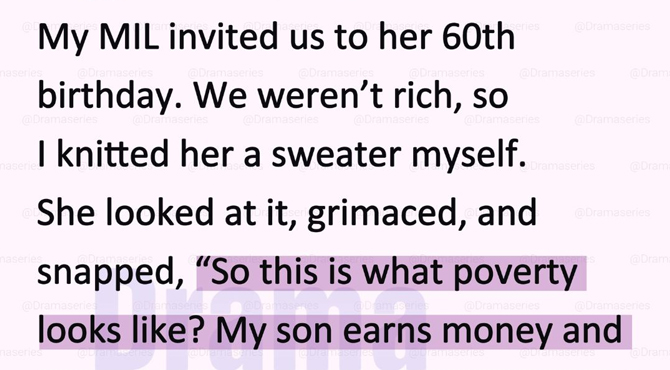
When it was time to present gifts, I stepped forward, heart pounding. “Happy birthday,” I said softly, handing it to her. Margaret opened it slowly. For a moment, there was silence.
Then her face changed. A slight grimace. A tightening around her eyes. And then, louder than necessary, she said, “So this is what poverty looks like?” The room fell quiet. My cheeks burned.
“My son earns money and you waste it,” she continued sharply. “Can’t you buy a normal gift instead of giving people trash?” A few guests looked away. Others pretended not to hear.
I stood there, frozen. Humiliated. And beside me, Daniel said nothing. Not a word. Not even a glance in my direction.
Something inside me cracked. I mumbled an apology I didn’t mean and stepped back, wishing the floor would swallow me whole. The rest of the evening passed in a blur. Laughter, music, clinking glasses—but all of it felt distant, like I was watching someone else’s life.
An hour later, a housekeeper approached me. “Mrs. Margaret would like to see you in her room.” My stomach dropped. I thought it would get worse. I thought she would humiliate me again—privately this time.
But when I entered her room, I froze for a completely different reason. The sweater. It was hanging carefully on a clothes rack inside her wardrobe. Smoothed out. Protected. Treated like something valuable.
I stared at it, confused. “Sit down,” Margaret said quietly. Her voice was… different. Gentler. I sat, my hands trembling in my lap. “I never meant to hurt you,” she said.
I looked up, stunned. “I wanted my son to feel ashamed—not you.” The words didn’t make sense at first. She sighed, her shoulders sinking as if she had been carrying something heavy for a long time.
“I know everything,” she continued. “About Liam. About the therapy. About how you’re paying for it.” My breath caught. “I’ve spoken to Daniel many times,” she said, her voice tightening. “He refuses to take responsibility. He says your child is your problem.”
The words hit me like a blow. Even though I had felt it… I had never heard it said out loud. “I couldn’t stand it,” she went on. “So I started helping.” My mind raced. “What… do you mean?” I whispered.
“The therapy bills,” she said gently. “The ones you thought Daniel paid? That was me.” I stared at her, my world tilting. All those times I had felt grateful toward my husband… all those moments I believed he cared… “They weren’t from him,” she said softly.
Tears blurred my vision. “I thought if I pushed him hard enough tonight, he would finally defend you. Or step up. Be a husband. Be a father.” Her voice broke slightly. “But he didn’t.” Silence filled the room.
“And that’s when I realized,” she said, looking at me with something close to regret, “I failed raising him.” She stood, walked to her dresser, and returned with a small envelope. Inside was a bank card.
“This is your emergency fund,” she said, placing it in my hands. “Use it for Liam. For yourself.” I shook my head instinctively. “I can’t—” “You can,” she interrupted firmly. “And you will.”
Her gaze softened. “I will support you until my son becomes a real man,” she said. “And if he doesn’t…” She paused. “I’ll support you after the divorce too.” My heart stopped. “I won’t fail you,” she added quietly.
In that moment, everything I thought I knew about her shifted. She wasn’t cruel. She was desperate. Desperate to fix what she couldn’t undo.
Months later, I stood in a courtroom. The air was heavy with finality. Daniel sat across from me, distant as ever. Detached. Unmoved. But I wasn’t alone. Margaret sat beside me. Calm. Steady.
And wrapped around her shoulders… Was the sweater I had made. Carefully worn. Proudly displayed.
When the judge finalized the divorce, I felt a strange mix of grief and relief. But as we stepped outside, Margaret reached for my hand. And in that simple gesture, I understood something profound. She wasn’t losing a daughter-in-law. She was choosing a daughter.