
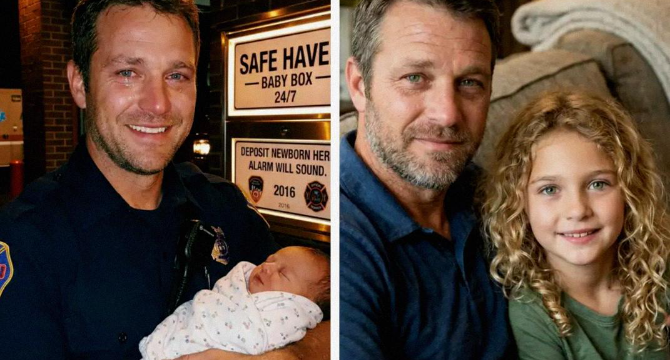
It was 3:07 a.m. when the Safe Haven alarm cut through the station, sharp enough to lift every head in the room. I was already moving before my partner finished calling it.
“Safe Haven just activated.”
The hatch sat in the wall with its small status light glowing green, the heater inside humming steadily. I reached for the latch and opened it.
Inside, wrapped in a pale cashmere blanket, was a newborn baby girl.
She wasn’t crying.
Inside, wrapped in a pale cashmere blanket, was a newborn baby girl.
Most babies left in those boxes arrived in distress. This little girl just lay there, her tiny chest rising and falling with calm, steady breaths. When I leaned down, she opened her eyes and looked right at me with a stillness that made my breath catch.
“She’s not crying,” I whispered.
My partner came up beside me. “No, buddy, she’s not.”
I reached in and lifted her. She was lighter, and her fingers curled against my sleeve as though she were holding on.
My partner looked at me and said, “Call Sarah.”
“At 3:30 in the morning?”
He shrugged. “You know you’re going to.”
He was right. When Sarah picked up, thick with sleep, I told her everything. She sat up so fast I could hear the sheets shift through the phone.
“She’s not crying.”
“I think you need to come see her,” I added, and I already knew what that sentence was going to cost us both if things didn’t go the way we were hoping.
By the time Sarah arrived, dawn was just starting to stretch pale light across the bay doors. We had spent seven years trying for a child. Seven years of appointments and bad news. Seven years of sitting in parking lots afterward because Sarah couldn’t bring herself to cry until the car doors were closed.
She came into the medical room and stopped when she saw the baby in my arms.
“Oh my God,” she whispered. “Can I?”
I nodded and placed the baby into her arms.
Sarah looked down, and tears filled her eyes. Her fingers adjusted the blanket with a tenderness that came from some place grief had been sitting on for years. When her hands began to tremble, I knew exactly what was happening.
We had spent seven years trying for a child.
“She’s so small,” Sarah murmured. Then she looked up at me. “Arthur, can we keep her?”
I crouched beside her chair and looked at the little one again. The baby had one hand tucked near her cheek. She looked warm and safe.
“She looks like she belongs with you,” I replied, my eyes blurry.
Seeing Sarah with that baby… it felt like my chest might give out, but in the best possible way.
“I know we might not get her,” Sarah said. “But if there’s even the smallest chance, I need you to tell me we’re taking it.”
“We’re taking it,” I replied, and that was the moment the paperwork stopped being paperwork and started being our life.
“She looks like she belongs with you.”
No one came forward. No one called.
The days became weeks, and whether the baby would become ours shifted into the reality that she already was. A few months later, we adopted her.
We named her Betty.
Our daughter grew into the kind of child who rearranged the house just by existing in it. She had opinions about breakfast before she could tie her shoes. She collected rocks from every park we ever crossed.
When Betty was six, she climbed into my lap and said, “Daddy, if I had a hundred dads, I’d still pick you.”
“What if one of the others had better snacks?” I joked.
Betty thought about that seriously for a moment. Then she said, “But they can’t be you.”
No one came forward. No one called.
Those 10 years passed the way good years do: quickly while you’re inside them. And for all the certainty of those years, one quiet question never fully left me.
Who had chosen our station to leave Betty there… and why us?
It was just after sunset when the knock came last Thursday.
“I’ll get it,” I told Sarah, heading for the door.
A woman stood on the porch in a dark coat and sunglasses she no longer needed in the evening light. Her fingers were pale where they gripped the strap of her bag.
“I need to talk to you about the baby from 10 years ago,” she said without warning.
A woman stood on the porch in a dark coat and sunglasses.
Every muscle in my body locked. Behind me, I heard Sarah’s chair scrape.
“Because I left her there,” the woman finished. “And I didn’t leave her to chance.” Her hand trembled as she lifted her sunglasses. “I chose exactly you.”
The second I saw her face, a memory hit me.
Rain. An alley. A 17-year-old girl, half-frozen and trying not to look like she needed help.
“Amy?” I whispered.
Amy looked relieved and heartbroken at once. “You remember me.”
Sarah stepped up beside me. “Arthur, who is this?”
I stared at Amy and said, “She’s someone I met a long time ago.”
The second I saw her face, a memory hit me.
It had been pouring rain back then. I was leaving the station after a long shift when I saw Amy in an alley, sitting on an overturned milk crate with her arms wrapped around herself so tightly it looked painful. I stopped. I gave her my jacket, bought her coffee and a sandwich, and sat with her for three hours while the rain pounded the street.
At one point she asked, “Why are you doing this?”
I said, “Because sometimes it helps when someone notices.”
Amy stared at me for a long moment. Then she nodded.
Standing on my porch now, she recounted, “You told me I was worth more than what the world was giving me.”
Sarah folded her arms. “Arthur, you never told me any of this.”
“I didn’t think it was a story that belonged to me,” I answered.
“You told me I was worth more than what the world was giving me.”
Amy shook her head. “It belonged to me. And I never stopped carrying it.”
Sarah looked at her carefully. “What does this have to do with Betty?”
Amy drew in a slow breath and said, “Everything.”
We sat in the living room, Sarah positioned near the hallway, close enough to hear the kitchen.
“I did get my life together after that night,” Amy revealed. “Not immediately. But I did. And then I got sick. A heart condition. And around that same time, I found out I was pregnant.”
“Where was the father?” I asked.
Amy closed her eyes for a second. “He was gone not long after. A bike crash. I was grieving. And scared. I couldn’t give my baby what she deserved while I was fighting to keep my own body in line.”
“What does this have to do with Betty?”
Sarah cut in softly, “So you chose Safe Haven.”
Amy looked right at me and said, “Yes. But not at random. I saw you again, Arthur… at the hospital. I was leaving cardiology. You and your wife were walking out of fertility.”
Sarah’s hand rose to her mouth. “We had just gotten bad news.”
“I could see that.” Amy looked at her hands. “And I remembered you. So I started asking questions, quietly and carefully.”
Sarah’s voice sharpened. “About us?”
“I watched from a distance. I know how that sounds.”
“It sounds frightening,” Sarah said, glancing at me.
“We had just gotten bad news.”
“I know. I’m sorry. But I had one chance to choose where my daughter would go. I needed proof that the man who sat in the rain with a forgotten girl would still be that man years later. And that the woman beside him would love a child with her whole heart, even if that child didn’t come to her the way she had hoped.”
Sarah didn’t speak. She just stood there as tears gathered in her eyes.Then she swallowed and looked at Amy. “How do we know? How do we know she’s yours?”
Amy gave a small, knowing smile, like she had been waiting for that. “I figured you’d ask.”
She reached into her bag and pulled out a worn photograph, holding it out carefully.
I took it, and my hand stilled.
“How do we know she’s yours?”
It was a picture of a newborn, wrapped in that same pale blanket… the one I carried out of the Safe Haven box 10 years ago.
Sarah leaned in beside me, her breath catching as she recognized it too. And for a second, neither of us said a word.
Amy continued, “I chose your station because I believed the two of you would raise my daughter like she was the most wanted child in the world.”
“You’re not here to take Betty,” Sarah immediately asked, her panic evident. “Are you?”
“No.”
My wife’s shoulders dropped an inch.
“You’re not here to take Betty.”
“I came because I needed to know I hadn’t destroyed my daughter’s life,” Amy revealed. “I saw her last week outside school, laughing with her friends. I realized I couldn’t keep living off the picture in my head. There were years I almost came earlier. When she was one. Then three. Then five. But I kept stopping myself. What if I walked in and ruined the only stable thing I ever gave her?”
Sarah wiped under one eye. “Did you ever get better?”
“A sponsor from work helped with the surgery. I’ve been healthy for a long time now.”
Amy then reached into her bag and brought out a sealed envelope. “A trust fund,” she said. “The deed, the account documents, everything. I’ve been building it for years. There’s also a letter for when Betty turns 18. Just the truth, if you decide she should have it.”
“What if I walked in and ruined the only stable thing I ever gave her?”
She then looked toward the kitchen, and I already knew what Amy was about to ask.
Almost on cue, Betty’s chair scraped.
“Dad, can I use the good scissors? Mom said no, and I think you’ll be more reasonable.”
Betty stopped when she saw Amy and looked from face to face.
“Dad… Mom… Who is she?”
“She’s a friend,” Sarah said quickly.
Amy crouched to Betty’s eye level and brought out a small teddy bear, cream-colored with a blue ribbon around its neck.
“I brought this for you, sweetheart.”
“She’s a friend.”
Betty took it and pressed it to her chest. “Thank you. What’s his name?”
Amy blinked hard. “You tell me.”
Betty thought for exactly one second. “Waffles!”
That got a real laugh out of Sarah, the first since Amy arrived.
Then Amy looked at Sarah, silently asking something she couldn’t say out loud. Sarah looked at me, and I nodded once.
Amy took Betty’s hands gently in both of hers. Our daughter allowed this with total curiosity.
Betty tilted her head. “Have we met before?”
“No, sweetie, but I’ve wanted to for a very long time,” Amy replied.
“Have we met before?”
All three of us were trying to hold ourselves together for completely different reasons.
After Betty went upstairs to show Waffles her room, Amy just looked down.
Sarah handed her a tissue. “You loved her enough to leave her somewhere safe. That is not a small thing.”
Amy looked up. “I’ve spent 10 years wondering if it was the worst thing I ever did.”
Sarah shook her head. “It was the hardest thing you ever did. That’s not the same.”
“I watched you once at the park when Betty was little,” Amy admitted. “She fell and scraped her knee. You picked her up before she had even decided whether to cry.”
Sarah let out a shaky laugh. “That sounds like her.”
“You loved her enough to leave her somewhere safe.”
“That was the day I stopped thinking I should come back sooner.” Amy looked at both of us. “I did not come here to enter Betty’s life. I came here to thank you for giving her one.”
And in that moment, every question I had carried for a decade finally had its answer.
Amy turned and walked down the porch steps. I called after her. She turned.
“You gave us our daughter,” I said.
Amy’s mouth trembled. She nodded once and kept walking.
“You gave us our daughter.”
That night, Betty fell asleep on the couch with Waffles under one arm. The envelope lay open on the coffee table. Trust documents. A letter in Amy’s handwriting, still sealed.
Sarah rested her head against my shoulder. “She trusted us with everything.”
“No,” I said softly. “She trusted what one small moment told her we might be.”
Betty shifted in her sleep and tightened her arm around the bear.
Sarah whispered, “She was always ours.”
Betty was. And that moment taught me something I won’t ever unlearn: we don’t just raise our children. Sometimes, without realizing it, we become the reason someone else believes their child deserves a better life.
Amy gave me a daughter because a kind word in the rain told her I was safe. Sometimes that is how a family begins.
 admin
admin