
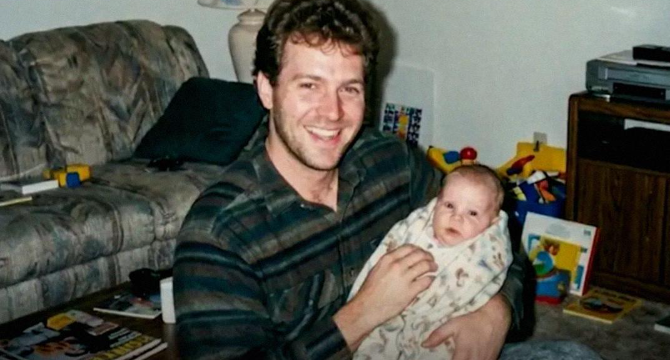
When I was little, I used to write letters to a father I had never seen.
My mom always told me the same thing. He was far away and couldn’t come back. She said it in a calm voice, like it was a fact I was supposed to accept, the same way other kids accepted rain or homework or the end of summer.
But I never really accepted it.
I was a child, and children have a dangerous kind of hope. Mine told me that if I just kept writing, one day he would answer.
So I wrote.
I wrote at the kitchen table with my elbows planted on old plastic place mats. I wrote on lined notebook paper torn from school binders. I folded the pages as neatly as I could and slipped them into envelopes with my messy handwriting across the front.
At first, the letters were simple.
“Hi, Dad.
I’m Dayna. Mom says you are far away. I am seven now.”
Later, they became everything I did not know how to say out loud.
I told him how afraid I was at school when the bigger girls laughed at my shoes. I told him when I won a school scientific competition and carried home the little certificate so carefully that I did not even bend the corners.
I told him how much I envied kids who had dads waiting in car lines, dads who clapped at school plays, and dads who showed up to take family pictures on sports day.
Sometimes I tried to sound cheerful, as if that would make him want to write back sooner.
Sometimes I did not bother.
I asked questions too. What was his favorite color? Did he ever think about me? Did he know I liked astronomy and hated boiled carrots? Did he miss me, even a little?
Every time I finished, I gave the letter to my mom.
She would smile in that tired way she had, smooth my hair, and say, “I’ll make sure it goes out.”
For years, I believed her.
There was no reply. Not after a year. Not after two. Not after five. By the time I was 14, the hope inside me had worn thin. It did not break all at once. It faded, slowly, like a shirt washed too many times.
At 14, I stopped writing.
I told myself I was done embarrassing myself over someone who clearly did not want me. That was the age I learned anger was easier to carry than sadness.
Anger gave me shape. It gave me answers. If my father had wanted me, he would have found me. If he had cared, he would have written. If he had loved me, he would not have stayed away.
So I built a life around that story.
Years passed.
Then one afternoon, when I was home alone, I decided to go through some old things. I do not even know what pushed me to do it. Maybe it was boredom. Maybe it was the strange pull of old memories.
The house was quiet, and the silence made every small sound sharper. Closet door sliding. Hangers knocking together. Cardboard scraping wood.
That was when I found the box.
It sat in the back of the closet, tucked behind winter blankets and a broken lamp my mom had refused to throw away. It was plain, taped shut, and lighter than I expected. I carried it to the bed and opened it without thinking.
Inside were my letters.
All of them.
Every single one.
The childish ones with crooked handwriting. The angry ones. The hopeful ones. The ones where I told him everything I had never told anyone else.
Never sent.
For a second, I just stared. Then it felt like I had been hit. My chest tightened so hard I could barely breathe. My fingers shook as I picked up envelope after envelope, each one addressed to a man who had never received them.
A sound escaped me, something between a laugh and a sob.
“No,” I whispered. “No, no, no.”
But underneath them was another stack.
These were different. Older envelopes, worn at the edges. My name was written across them in a hand I did not recognize.
I opened the first one.
“I don’t know if my letters reach you, but I keep writing anyway…”
My hands started shaking harder.
I opened them one after another.
He had been writing.
All this time.
Not knowing I wasn’t receiving anything.
I do not remember grabbing my keys. I only remember clutching one of the envelopes so tightly it bent in my hand as I drove to the sender’s address. My heart pounded the whole way there. Rage, confusion, grief, hope, all of it crashed through me so fast I could barely think.
When I reached the building, I ran up to the door and knocked.
A woman opened it.
She looked at me for a long time, her eyes moving over my face like she already knew exactly who I was.
Then she said quietly, “You’re his daughter… He’s in the hospital.”
My breath caught.
“He’s… alive?”
She nodded.
“But there’s not much time left.”
I didn’t listen anymore.
I just turned and ran down the stairs. I had to make it on time.
I drove like I was outrunning the last ten years.
By the time I reached the hospital, my hands were shaking so badly I could barely speak at the front desk. I repeated my father’s name twice before the nurse finally understood me and pointed me toward the right floor.
The hallway smelled like antiseptic and stale coffee. Everything was too bright, too quiet, and too normal for a moment that felt like it was splitting my life in two.
A doctor met me outside his room.
“Are you family?”
I swallowed hard. “I’m his daughter.”
Even saying it felt strange.
The doctor’s expression softened. He explained that my father’s condition was critical. He needed surgery, but there was a problem. They urgently needed a donor.
He spoke carefully, professionally, but all I heard was that I had found my father, only to stand on the edge of losing him.
“There may be a chance,” he added. “But we would need to test you immediately.”
I did not hesitate.
“Do it.”
The next few hours passed in a blur of forms, blood draws, questions, and white walls. I sat alone in a plastic chair, staring at the floor, trying not to fall apart.
My whole childhood had been built around the ache of not being wanted. Then in a single afternoon, I learned that my father had been writing to me all along, that he was alive, and that I might be the one person who could help save him.
It felt unreal.
When the doctor returned, his face was serious enough to make my stomach drop. Then he said, “You’re a match.”
I let out a breath that sounded more like a sob.
He explained the risks. He told me I needed time to think. But there was nothing to think about.
“Yes,” I said. “Whatever he needs, I’ll do it.”
Before they took me away, I asked if I could see him.
The room was dim, and for a moment I just stood in the doorway, staring at the man in the bed. He looked older than I had imagined, thinner too. His face was pale, and machines breathed and blinked around him.
But even then, I could see pieces of myself in him.
The shape of his jaw. The line of his brow. Familiar things I had somehow carried all my life without knowing where they came from.
His eyes opened slowly when I stepped closer.
He looked confused at first, then stunned.
“Who is it?” he whispered.
My throat tightened.
“Dad, it’s me. Dayna. Your daughter.”
His eyes filled immediately. “I wrote to you. I wrote for years.”
“I know,” I replied, my voice breaking. “I found them.”
A tear slipped down his cheek. “I thought you hated me.”
“I thought you forgot me.”
He shut his eyes like the words hurt. “Never. Not one day.”
I reached for his hand.
It was weak, but his fingers curled around mine.
“You need surgery,” I told him softly. “And I’m a match.”
His eyes flew open. “No,” he rasped. “No, I can’t ask that of you.”
“You didn’t ask,” I said, holding on tighter. “I’m offering.”
He stared at me, overwhelmed and helpless and full of something that looked so much like love that I had to look away for a second just to steady myself.
“I don’t deserve that,” he murmured.
“Maybe not,” I said, and then I gave a shaky laugh through my tears. “But I’m still doing it.”
The surgery was the longest day of my life.
When I woke up afterward, sore and exhausted, the first thing I asked was whether he had made it. A nurse smiled and told me the operation had been successful. His condition had stabilized. He was recovering.
I cried so hard I startled myself.
Recovery was slow for both of us, but he got stronger.
So did I. Once he was discharged, we did not try to force some perfect version of a father-daughter bond. There was too much lost time for that, too much pain sitting quietly between us. So we started small.
Coffee once a week.
Phone calls that began awkwardly and ended too soon.
Stories exchanged in pieces.
He told me about the letters he wrote and how each one felt like tossing a bottle into the ocean. I told him about school, about the scientific competition I had won, and about how scared and lonely I had been as a kid.
Sometimes he cried.
Sometimes I did. Sometimes we laughed over how strange it was to learn about each other as adults.
Little by little, he stopped feeling like a ghost. He became my father.
Not the one I should have had from the beginning, and not one who could ever give back the years we lost. But a real man, flawed and tender, who kept showing up. And I became more than the daughter he imagined in letters. I became someone he knew.
Over time, our bond grew strong.
We met regularly. We celebrated birthdays, shared meals, argued lightly over silly things, and made room for each other in our lives. We could never change what had been stolen from us, but we stopped letting it define the rest of our story.
For ten years, I thought my father had forgotten me.
The truth was far crueler, and far kinder.
He had been searching for me in words the whole time.
And in the end, against everything that tried to keep us apart, we still found our way back to each other.
 admin
admin