
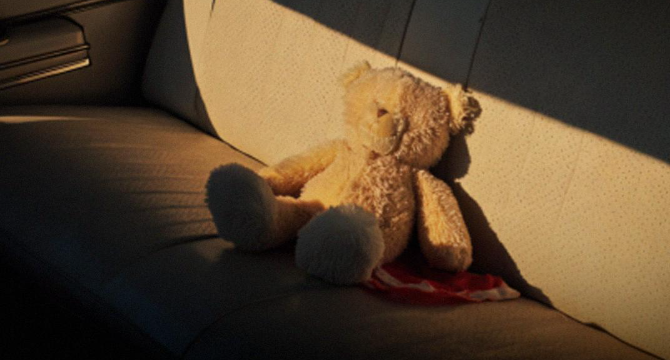
I never thought a cheap little toy could make my whole body go cold.
Arnold and I had been married for eight years. In most ways, we were the kind of couple people liked to point to when they said, “See? Good marriages still exist.”
We laughed a lot and had inside jokes so old they barely made sense anymore. He still reached for my hand without thinking, and I still knew the exact sound of his footsteps before he opened the front door.
And for eight years, we had been trying to have a child.
That sentence looks so simple when written down. But it’s nothing close to simple.
We’d been through years of ovulation tests lined up in bathroom drawers. Through specialists, blood work, awkward appointments, and bad news delivered in soft voices. I can never forget how I’ve cried in parking lots with sunglasses on so strangers would not see.
I can also never forget how Arnold was holding me when the doctor finally said the word “infertile.” It was as if I might not break apart if he held me tightly enough.
He never blamed me for not being able to have a child.
And that almost made it worse.
Whenever I apologized, and I did that more times than I want to admit, he would cup my face and say, “Clara, stop. We are in this together. You are not failing me.”
I wanted to believe him. Most days, I did.
So when things started changing, I noticed right away.
At first, it was small. Arnold would text that he was running late. Then it became a pattern. Nine o’clock. Ten. Once, almost 11.
He always had a reason.
He’d tell me he was stuck in traffic or that he had extra work. Sometimes, he’d tell me he was helping a friend with something. The excuses were normal enough, but he said them with a distracted look that didn’t sit right with me.
He seemed tired, too, but not in the usual way. Not like a man worn out by long days and too little sleep. More like someone carrying something around inside his chest.
He would stare into space while eating dinner. He smiled less. When I asked if he was okay, he would answer too quickly.
“Yeah. Just exhausted.”
I told myself not to turn into one of those suspicious wives who built a whole affair out of a late dinner and a weird mood. Arnold was kind and dependable. He was not cruel.
But fear does not care what kind of man your husband is. Fear only cares where it can grow.
And mine grew fast.
One afternoon, my car would not start, and I had to take Arnold’s to run a quick errand. I remember being annoyed more than anything. I grabbed his keys, got in, and tossed my purse onto the passenger seat.
On the back seat, half tucked near the floor mat, was a child’s toy.
It was a little plastic dinosaur with one wheel missing, like it had once been attached to some pull-along set. I stared at it for a full ten seconds before I even reached for it.
My fingers felt numb.
We did not have children. We never had guests with children. There was no harmless explanation sitting there waiting for me.
I picked it up and just looked at it.
That was the moment my brain betrayed me.
Every fear I had fought down for years came rushing up at once. What if there was another woman? What if she had a child? What if Arnold had met someone who had already built the life I could never give him?
And then, because pain has a cruel imagination, my mind went somewhere even darker.
What if it was his child?
I actually laughed out loud when that thought hit me, but it was not a normal laugh. It was sharp and ugly.
My chest felt tight.
Suddenly, all his late nights had a shape. All the distant looks. All the half answers. They lined up in my head so neatly it scared me.
He had always wanted to be a father. He never said it with bitterness, but I knew. I saw it every time he lingered by the baby aisle in stores. Every time his expression softened when he saw dads with kids on their shoulders. Every time he said, “Maybe someday,” before we ran out of someday.
I sat in that car gripping that ridiculous plastic dinosaur so hard it left a mark in my palm.
By the time I got home, I was shaking.
I put the toy on the kitchen counter and stared at it the rest of the afternoon, like it might confess something. I tried to calm down and be reasonable. But reason had left me hours ago.
When Arnold finally came home that night, he looked surprised to see me sitting at the table in the dark.
“Clara?” he said, setting down his keys. “Why are the lights off?”
I stood up, grabbed the toy, and threw it across the table. It skidded to a stop right in front of him.
He flinched.
And that tiny reaction lit every fuse inside me.
“What is this?” I shouted.
His face changed instantly.
“Clara, I can explain.”
“No, you can start by not lying to me,” I said. “Whose child is this from?”
He stared at me. “What?”
“The toy, Arnold. The late nights. The way you’ve been acting. Do not stand there and pretend you don’t know what this looks like.”
He ran a hand over his face. “It is not what you think.”
People always say that, and it is almost never comforting.
“Really? Because from where I’m standing, it looks exactly like my husband has been sneaking around with a woman who has a kid. Or maybe with your own kid. I do not know anymore.”
His expression snapped. “Clara.”
“What?” I yelled. “Say it. Tell me I’m crazy. Tell me why there’s a child’s toy in your car when we don’t have children.”
For a second, he just stood there. Then he pulled out a chair and sat down hard, like his legs had given up on him.
“I met a boy,” he said quietly.
I felt the blood drain from my face. “You met a boy.”
He nodded, eyes fixed on the table. “A few months ago. It was raining. I saw him walking near the main road alone. He looked soaked, and I stopped because… I don’t know. He was just a kid. I asked if he was okay.”
I crossed my arms so tightly it hurt.
“He told me he was trying to get back to the orphanage. He had gone farther than he was supposed to. I gave him a ride.”
The word orphanage landed strangely in the room.
Arnold kept talking. “His name is Henry. He’s ten. I dropped him off, and that should’ve been it. But a few days later, I saw him again when I was passing by. Then again. He remembered me.”
I could feel tears burning behind my eyes, but anger kept them there.
“So what? You became friends with a child and forgot to mention it to your wife?”
His jaw tightened. “I brought him food sometimes. I spent time with him. I helped with school supplies. That’s all.”
“That’s all?” I said. “That is not all, Arnold. That is a whole secret life.”
“It wasn’t like that.”
“Then what was it like?”
He finally looked at me, and what I saw in his face only made me more furious. He looked ashamed.
“I didn’t tell you because I knew what it would do to you,” he said. “Every time I tried, I stopped. I couldn’t bear the thought of making your pain worse.”
I stared at him. “So you decided to live out some father fantasy behind my back instead?”
“No. Clara, no. That is not what this was.”
“Then tell me what it was.”
His voice broke. “It was a lonely kid who needed somebody.”
That should have moved me. Maybe on another day, it would have. But all I heard was that while I was drowning in the grief of not being able to have a child, my husband had found one anyway.
He had found a child without me. Without even trusting me enough to tell me.
It felt like betrayal, even if he had not meant it that way.
“You should have told me,” I said, lower now, but colder.
“I know.”
“No, I don’t think you do.” The tears finally came then. “We were supposed to face this together. All of it. And instead you went and built something… without me?”
He opened his mouth, then closed it.
I wiped at my face angrily. “You need to stop seeing him.”
He looked stunned. “Clara-“
“I mean it.”
His eyes filled then, and I had almost never seen Arnold cry. “He has nobody.”
“And what do I have right now?” I shot back. “Because it does not feel like I have my husband.”
“Okay,” he said.
I should have felt relieved. I had won, if you want to call it that. Instead, I felt hollow.
The next two weeks were awful.
Arnold kept his word. He came home on time. He stayed close. He tried to be gentle with me, and I hated that too, because it made me feel like the villain in my own marriage.
Then one Saturday afternoon, the doorbell rang. Arnold was in the shower, so I answered it.
A boy stood on our porch.
He was thin, with messy brown hair and a jacket one size too big. His sneakers were scuffed nearly white at the toes. He looked nervous, but he was trying very hard to stand straight.
“Hi,” he said. “Um… is Arnold here?”
Before I could answer, his eyes shifted past me into the house, then back to my face.
“I think I left my toy in his car,” he said, almost apologetically. “The green dinosaur. I know it’s dumb because I’m too old for it, but it was my mom’s before…” He stopped and swallowed. “Before I got here.”
Every ounce of anger I had been clinging to lost its shape right then.
This was Henry.
He was just a boy standing on my porch, trying not to look scared. I do not know what showed on my face, but his expression changed immediately.
“I can go,” he said quickly. “Sorry. I just thought maybe-“
“Wait,” I said.
I stepped back and let him in.
He hovered awkwardly near the doorway while I went to get the toy from the kitchen drawer where I had hidden it like it was evidence in a crime. When I placed it in his hand, his whole face lit up for half a second before he remembered to be careful.
“Thanks,” he said.
Arnold came down the hall, still toweling off his hair, then froze when he saw him.
“Henry?”
The boy smiled a little. “Hi.”
And then I saw two people who had found comfort in each other because both of them had been carrying something lonely.
Henry looked at Arnold the way kids look at adults they trust completely. Arnold looked at Henry like he mattered.
I had been so buried in my own pain that I had turned that into something ugly.
“Did you walk here alone?” I asked.
Henry nodded. “It’s not that far.”
“You shouldn’t be walking around by yourself.”
He shrugged, and that shrug said more about his life than words could have.
I asked if he was hungry. He said no. Then, after a pause, “Maybe a little.”
So I made grilled cheese sandwiches.
That was how it started.
Henry came back the next weekend.
This time, I invited him. Then again, the weekend after that. Slowly, the sharp edges inside me changed.
He was funny in a dry, unexpected way. He loved science facts and hated tomatoes. He tried to act tougher than he was, but every now and then his age showed in a way that broke my heart.
One evening, while Arnold was washing dishes, Henry looked at the framed wedding photo in our living room and asked, “Were you always gonna be together?”
I smiled. “That was the plan.”
He nodded like he was studying something important. “That’s nice.”
Months later, after visits, paperwork, home studies, and long conversations that left us drained but hopeful, Arnold and I sat across from each other at the kitchen table, where I had once thrown that toy at him.
He reached for my hand.
“You sure?” he asked softly.
I laughed through tears. “Arnold, I have never been more sure of anything.”
When Henry finally came home for good, he carried one duffel bag, a stack of books, and that same ridiculous green dinosaur.
The first night, he stood in the doorway of his room as if he did not quite believe it was his.
“You can paint it if you want,” I told him. “Or leave it exactly like this.”
He looked at me and said, “Can I really stay?”
I walked over, touched his shoulder, and said, “Yes. You can really stay.”
I used to think motherhood had one locked door, and my body had lost the key.
I was wrong.
Sometimes love comes in through the front door, holding a broken toy, asking for it back. And sometimes, if you are brave enough to open that door, it stays.
 admin
admin