
I am Jessica, 32, and in the three years I have been married to Mark, 34, I have learned that grief does not always look like tears.
Sometimes it looks like rage.
Mark lost his mother three weeks ago, and ever since the funeral, he has moved through her house like a man trying to erase a fire after it has already burned everything down.
He worked fast, almost mechanically, hauling boxes to donation centers, dragging furniture to the curb, and stuffing black trash bags until they split at the seams.
Things most people would have set aside and held for a while, old photo albums, hand-stitched linens, porcelain figurines, letters tied with ribbon, he tossed without a second glance.
It unsettled me.
His relationship with his mother had always been complicated. He never spoke about her with warmth. If anything, his voice went flat whenever her name came up.
“She wasn’t cruel in the obvious ways,” he told me once, late at night when sleep would not come. “She was just cold. Dutiful. Like being my mother was a job she had to perform, not something she wanted. I always felt like an obligation to her. A box to be checked.”
I remembered that sentence every time I watched him empty another shelf in her home.
Still, this was different.
There was something ruthless in the way he was doing it, as if every object he threw away had offended him just by surviving her.
Yesterday morning, I woke up at 5 a.m. to a bed that felt wrong.
Cold on one side.
I blinked at the darkness, instantly aware that Mark was gone. At first, I thought he might be in the bathroom or downstairs making coffee, but the house was silent. Then I noticed a faint glow outside the bedroom window.
I pulled the curtain back and saw him at the curb.
The sky was still black-blue with the last stretch of night, and the cold looked sharp enough to cut skin. Mark stood in the freezing air in an old sweatshirt and jeans, his shoulders tense as he shoved something large and reflective toward the municipal trash bin.
It took me a second to understand what I was looking at.
Then my stomach dropped.
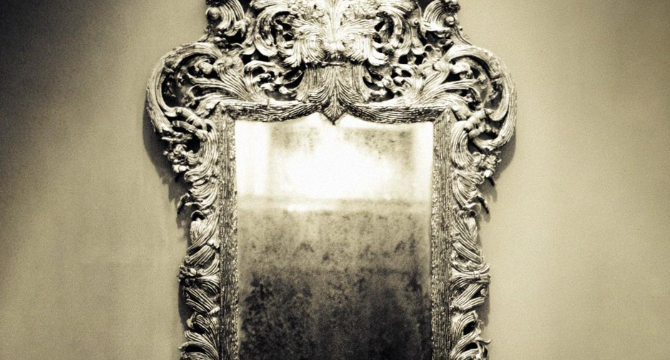
It was his mother’s mirror.
A massive antique silver mirror, the one that had been in her family for generations.
I had seen it hanging in her front hall, tall and ornate, its silver frame curling with flowers and vines darkened by age. It was the kind of piece people built rooms around.
The kind of heirloom that carried history in silence.
And Mark was trying to throw it away like broken lawn furniture.
I flew downstairs, barely stopping to jam my feet into shoes before running out into the cold.
“Mark!” I shouted. “What are you doing?”
He turned, breathing hard, his face tight with anger. Up close, he looked almost wild, like he had not slept at all.
“What does it look like?” he muttered.
I stared at the mirror, half lodged against the trash bin. “You can’t be serious. That was your mother’s prized possession.”
His jaw clenched.
“Exactly.”
I stepped closer. “Mark, this has been in her family for generations.”
“I know,” he snapped, then lowered his voice and rubbed a hand over his face. “I can’t stand looking at it anymore, Jessica. Every time I see that thing, all I can think about is her. Those icy stares. The way she used to look at me like I was in the way.”
The wind bit through my pajama shirt, but I barely felt it. “So you’re throwing it in the trash?”
He did not answer right away. He just looked at the mirror with such naked fury that it made me shiver.
Finally, he said, “I have to go to work.”
“Mark…”
But he was already walking back toward his car.
A moment later, he pulled out of the driveway and disappeared down the street, leaving me standing there beside the trash bin with that huge silver mirror catching the weak gray light of dawn.
I could not let an heirloom go to the landfill.
So I dragged it back inside, straining under its weight, and wrestled it into the garage. I told myself I would clean it up and donate it.
At the very least, it deserved better than garbage.
A few hours later, with a rag and metal polish in hand, I started wiping down the heavy silver frame. As I worked, I noticed something odd. The wooden backing was loose. One of the old iron nails had rusted through, leaving one corner slightly lifted.
My curiosity got the better of me.
I grabbed a flathead screwdriver and gently pried the backing away, thinking maybe there was an old photograph tucked inside. The wood suddenly gave way with a loud crack, and a thick, yellowed envelope slid out from behind the glass and hit the concrete floor.
I froze.
My heart started pounding as I bent to pick it up. The envelope was sealed with red wax, and Mark’s name was written across the front in his mother’s elegant handwriting.
My hands were shaking as I broke the seal and pulled out the fragile papers inside.
As I read the first few lines, the air left my lungs.
I had to sit down right there on the cold garage floor because my knees would not hold me.
The first document was old enough to feel brittle at the edges.
It was a set of adoption papers, faded and stamped, with names typed in ink that had softened with time. I read them once, then again, certain I had misunderstood. But the words did not change.
Mark was not his mother’s biological son.
He had been born to her sister.
My eyes darted over the page, trying to make sense of the dates, the signatures, and the official seal pressed into the paper. It said he had been taken in quietly, without public explanation, when he was just an infant.
The wording was formal, but the meaning was devastatingly clear.
His mother had raised him as her own to hide a family scandal and protect their reputation.
I swallowed hard and reached for the letter that had come with the papers.
The handwriting was elegant and careful, the same hand that had addressed the envelope. I unfolded the pages slowly, already feeling as if I were trespassing into something sacred.
“My dearest Mark,
If you are reading this, then I am gone, and the truth has found you at last.”
I pressed a hand over my mouth and kept reading.
“She was my younger sister, and you were her child. I know those words may wound you before anything else I say has the chance to heal. But I beg you, keep reading.
By the time she came to me, frightened and ashamed, our parents had already decided what mattered most. Not her fear. Not your life. Only the family name. There was no husband, no story respectable enough to survive the whispers, and in the world we lived in, reputation was treated like something holy.
She was not ready to raise you. She was barely able to hold herself together. Our parents were harsher than I can bear to describe. So I made the choice they never could. I took you in my arms, and I told them I would raise you as my own.”
My chest tightened, and I read on.
“I know what sort of mother I must have seemed to you. I know I was not soft. I know there were times when my silence must have felt like judgment, and my distance must have felt like rejection.
For that, I am deeply sorry.
Love lived in me more strongly than it ever lived in my voice. That is not an excuse. It is only the truth. You needed warmth, and too often I gave you structure. You needed comfort, and too often I gave you discipline.
I told myself that protecting you, feeding you, educating you, and standing between you and the cruelty of others would be enough.
It was not enough. Not for a child who deserved to feel cherished.”
There was one line that broke me completely.
“You were never a duty, Mark. You were the one wholly beautiful thing that came into my life, and I loved you fiercely, even when I did not know how to show it.”
I just sat there staring at those words.
All this time, Mark had believed he had been an obligation. A burden. A box to be checked. And here, hidden behind the one thing he could not bear to look at, was proof that his mother had chosen him at the cost of her own life as she knew it.
I forced myself to finish the letter.
“When I placed this letter behind the mirror, I did it because it was the one possession I knew no one would move carelessly. That mirror belonged to the women in our family for generations.
It reflected every face before mine, and still I chose to hide the truth behind it, because I had become a coward about the one thing that mattered most.
Perhaps I feared that if I told you while I lived, you would look at me and see only the lie. Perhaps I feared you would turn from me before I could explain that every hard choice I made began and ended with trying to keep you safe.
If I have any wish left in this world, it is that you do not measure my love only by the ways I failed to show it.
Measure it also by what I gave up to keep you.
Measure it by the life I chose, and the life I could have had, and know that I would still choose you again.
Always,
Mom.”
When I heard Mark’s car pull into the driveway that evening, my whole body went tense.
He came into the garage a minute later, still in his work clothes, and stopped short when he saw me sitting beside the mirror with the papers in my lap. His expression changed instantly.
“What is that?” he asked, his voice low.
I stood up slowly. “Mark, you need to read this.”
His eyes narrowed, and for a second, he looked annoyed, almost defensive. “Jessica, I really don’t want anything else from that house.”
“This isn’t just anything,” I said softly.
Something in my face must have reached him, because he stepped forward and took the documents from my hand. I watched him read the adoption papers first. His forehead creased. Then all the color drained from his face.
“No,” he whispered. “No, that’s not possible.”
He grabbed the letter and read faster, his breathing turning shallow.
By the middle of the second page, his hand was shaking. By the end, he sank onto the workbench behind him like all the strength had gone out of him.
For a long moment, he said nothing.
Then he looked up at me with tears in his eyes that I had never seen before.
“She knew,” he said hoarsely. “She knew I thought she didn’t love me.”
I moved closer, my own throat aching. “She did love you, Mark.”
He let out a broken laugh that sounded nothing like humor.
“All those years, Jess. All those years, I hated that mirror because she used to stand in front of it and fix me with that look. I thought she was judging me. I thought she regretted having me.”
He looked back down at the letter.
“And all this time,” he whispered, “she chose me.”
I knelt in front of him and took his free hand. He gripped mine so tightly it hurt.
“She may not have known how to say it,” I murmured, “but she spent her whole life proving it.”
That was when he broke.
Not loudly. Not dramatically. He just folded forward and cried the kind of grief that had been waiting for him for decades, not weeks. I held him there in the garage, beside the silver mirror he had tried to throw away, while the truth settled over both of us.
Later that night, we carried the mirror inside together.
We did not clean it up right away. We did not decide where to hang it. We just leaned it carefully against the living room wall and left it there, no longer as a monument to coldness, but as the keeper of a love that had been hidden badly, imperfectly, and too long.
Some truths ruin what you thought you knew.
But sometimes, they also give back something you did not realize you had lost.
 admin
admin