
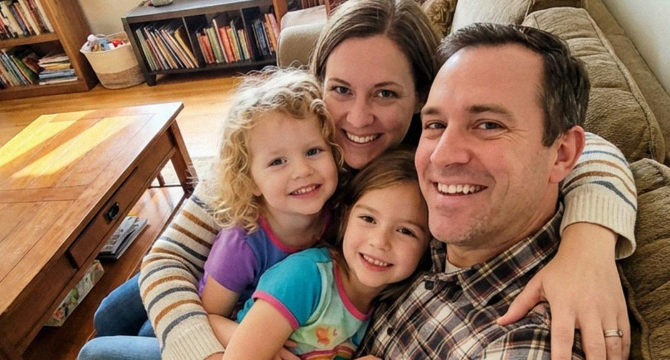
When I started dating Daniel, he told me the hardest part on the second date.
“I have two daughters,” he said. “Grace is six. Emily is four. Their mom died three years ago.”
He said it in that careful, even tone people use when they are trying not to fall apart in public.
I reached across the table and touched his hand.
The girls were easy to love, though they were nothing alike.
“Thank you for telling me.”
He gave me a tired smile. “Some people hear that and decide dinner is over.”
“I’m still here,” I said.
And I was.
The girls were easy to love, though they were nothing alike.
I never tried to be their mother.
Grace was sharp, watchful, and serious in a way that made her seem older than six. She asked questions like she expected real answers, not soft nonsense. If something did not make sense, she kept looking at you until you explained yourself or admitted you were guessing.
Emily was sunshine and static. At first she hid behind Daniel’s leg and peered at me like I might be a suspicious squirrel. A month later she was climbing into my lap with a picture book, declaring, “I sit here now,” like the matter had been settled by law.
I never tried to be their mother, but I wanted them to trust me.
We had a small wedding by a lake.
I made grilled cheese, watched cartoons, and sat through fevers, tantrums, glue disasters, and long pretend games where a plastic horse somehow became a doctor, a queen, and a school bus.
Daniel and I dated for a year before we got married.
We had a small wedding by a lake.
Nothing fancy.
Just family, a few friends, and two little girls who cared a lot more about cake than vows.
I noticed it during my first week there.
Grace wore a flower crown and asked every ten minutes when dessert was happening.
Emily made it halfway through dinner before falling asleep in a chair with frosting on her cheek.
Daniel looked happy that day, but careful too, like he did not fully trust happiness to stay once it arrived.
After the wedding, I moved into his house.
It was warm, and beautiful, and slightly messy. Big kitchen. Wraparound porch. Crayon drawings on the fridge. Tiny shoes by the door. Toys under furniture no matter how often you cleaned.
Still, little things kept catching my attention.
And one locked basement door.
I noticed it during my first week there.
“Why is that always locked?” I asked one night while we cleaned up after dinner.
Daniel kept drying dishes.
“Storage,” he said. “Old tools, boxes, paint cans, all that stuff. I don’t want the girls getting into something dangerous.”
That made sense, so I let it go.
Once, I found Grace sitting on the floor, staring at the knob.
Still, little things kept catching my attention.
Sometimes Grace would pause in the hallway and glance at the basement door when she thought nobody noticed. Sometimes Emily would drift near it, then hurry away with that guilty look children get when they think they have almost spoiled a surprise.
Once, I found Grace sitting on the floor, staring at the knob.
“What are you doing?” I asked.
Then she ran off before I could ask another question.
She looked up. “Thinking.”
“About what?”
She stood right away. “Nothing.”
Then she ran off before I could ask another question.
It was strange, but not strange enough to start a fight over. Families carry odd habits the way houses carry drafts. You notice them, then learn to walk around them.
They were droopy and dramatic for about an hour.
Then came the day everything changed.
Both girls had little colds, so I stayed home with them while Daniel went to work.
They were droopy and dramatic for about an hour.
After that, they turned into loud, sniffly chaos with no respect for illness or furniture.
“I’m fading fast,” Grace announced from the couch, one hand pressed to her forehead.
“You have a runny nose,” I told her.
I was heating soup when Grace came into the kitchen and tugged my sleeve.
Emily sneezed into a blanket and said, “I also am fading. Maybe forever.”
“Very sad,” I said. “Drink your juice.”
By noon they were racing around the house playing hide and seek like two tiny maniacs.
“No running,” I called.
They ran.
“No jumping off furniture.”
From the stairs Grace yelled, “That was Emily!”
“Do you want to meet my mom?”
Emily yelled back, “I’m baby! I know nothing!”
I was heating soup when Grace came into the kitchen and tugged my sleeve.
Her face was solemn enough to make me stop stirring.
“What is it?” I asked.
She looked up at me and said, very quietly, “Do you want to meet my mom?”
Something cold moved through me.
For a second, I thought I had misunderstood her.
“What?”
She said it again, slow and clear, like maybe I was the one having trouble keeping up.
“Do you want to meet my mom? She liked hide and seek too.”
Something cold moved through me.
“Grace,” I said carefully, “what do you mean?”
My heart started pounding hard enough that I could hear it.
She frowned, like the answer should have been obvious.
“Do you want to see where she lives?”
Emily wandered in behind her, dragging her stuffed rabbit by one ear.
“Mommy is downstairs,” she said.
My heart started pounding hard enough that I could hear it.
“Downstairs where?” I asked.
Every bad thought hit me at once.
Grace took my hand.
“The basement. Come on.”
Every bad thought hit me at once.
The locked door.
The secrecy.
The way the girls watched it.
Grace tugged me down the hall with increasing insistence.
A dead wife.
A basement Daniel never opened around me.
Grace tugged me down the hall with increasing insistence.
At the door, she looked up and said, “You just have to open it.”
My mouth went dry.
“Does Daddy take you down there?”
She nodded. “Sometimes. When he misses her.”
Emily stood beside me, sniffling into her rabbit.
That did not help.
I should have waited.
I know that now.
I should have called Daniel. Or my sister. Or maybe just walked outside and breathed until my brain worked again.
Instead, I pulled two hairpins from my bun and knelt by the lock with shaking hands.
Emily stood beside me, sniffling into her rabbit.
The smell hit first.
Grace bounced on her toes, excited, like she had finally gotten permission to show me something important.
Then the lock clicked.
I froze.
Grace whispered, “See?”
I opened the door.
The smell hit first.
The room came into view slowly.
Dampness.
Mildew.
That sour, closed up smell basements get when they are trying too hard to hold onto old air.
I took one step down, then another.
The room came into view slowly.
And then my fear changed.
A pipe dripped into a bucket in one corner.
It was not a body.
It was not some hidden crime.
It was a shrine.
An old couch sat against the wall with a blanket folded over one arm. Shelves held photo albums, framed pictures, candles, and children’s drawings. There were labeled boxes, a little tea set on a child sized table, a cardigan over a chair, women’s rain boots by the wall, and an old television beside stacks of DVDs.
She pointed around the room.
A pipe dripped into a bucket in one corner.
Water had stained part of the wall.
I just stood there, staring.
Grace smiled up at me. “This is where Mom lives.”
I looked at her. “What do you mean, sweetheart?”
She pointed around the room.
“Daddy brings us here so we can be with her.”
Emily hugged her rabbit tighter.
“We watch Mommy on TV.”
Grace nodded.
“And Daddy talks to her. Sometimes he cries, but he says that’s okay because she already knows.”
I walked toward the television cabinet.
I looked back at the room.
Not a prison.
Not a secret affair.
Something sadder than either.
Daniel’s grief had a locked room, and the girls had been taught to step inside it with him.
I walked toward the television cabinet.
I wish you were here for this.
The top DVD said Zoo Trip.
Another said Grace Birthday.
There was a notebook on the table, left open.
I did not mean to read it, but my eyes caught one line anyway.
I wish you were here for this.
I shut it at once.
The footsteps stopped.
Then I heard the front door open upstairs.
Daniel was home early.
His voice carried through the hall.
“Girls?”
Grace lit up. “Daddy! I showed her Mommy!”
The footsteps stopped.
His tone made Grace flinch.
Then they came fast.
Daniel appeared at the basement door and went white when he saw it standing open.
For one awful second, nobody said a word.
Then he looked at me and asked, “What did you do?”
His tone made Grace flinch.
I stepped in front of the girls.
The anger drained right out of it, leaving something raw and ashamed.
“Do not speak to me like that.”
He pressed both hands to his head.
“Why is this open?”
“Because your daughter told me her mother lives down here.”
His face changed.
The anger drained right out of it, leaving something raw and ashamed.
He looked at her like his heart had split open.
Grace’s voice shook.
“Did I do bad?”
He looked at her like his heart had split open.
“No, baby. No.”
I crouched and said, “Why don’t you two go watch cartoons? I’ll bring soup in a minute.”
They hesitated, then went upstairs, Emily still dragging the rabbit, Grace looking back twice.
“I was going to tell you.”
When they were gone, I turned to Daniel.
“Talk.”
He looked around the basement like he hated every single thing I was seeing.
“I was going to tell you.”
“When?”
Silence.
“It’s not what you think.”
I laughed once, but there was no humor in it.
“Exactly.”
He came down the steps slowly.
“It’s not what you think.”
“I don’t even know what to think.”
His voice cracked.
He sat on the bottom step and stared at the floor.
“It’s all I had left.”
That took some of the heat out of me.
Not all of it.
Enough.
He sat on the bottom step and stared at the floor.
“After she died, everybody told me to be strong. So I was. I got up. I worked. I packed lunches. I kept the girls clean and fed and moving. People kept telling me I was incredible.”
“I put her things down here because I couldn’t bear to throw them away.”
He let out a bitter laugh.
“I could only do ahead because of the girls. I was numb.”
I said nothing.
“I put her things down here because I couldn’t bear to throw them away,” he said. “Then the girls started asking about her, so sometimes we came down. We looked at pictures. We watched videos. We talked.”
“Grace thinks her mother lives in the basement.”
“That is not a little mistake, Daniel.”
He closed his eyes. “I know.”
That hit hard.
“You knew?”
“Not at first. But then she kept saying it, and I did not correct her the way I should have.”
“That is not a little mistake, Daniel.”
“I know.”
His answer came quick, honest, and terrible.
I looked around the room again.
The cardigan.
The boots.
The little tea set laid out like someone might come back and use it.
“Why keep it like this?”
His answer came quick, honest, and terrible.
“Why did you marry me if you were still living like this?”
“Because down here, she was still part of the house.”
That sat between us for a long time.
Then I asked the question I had been trying not to form.
“Why did you marry me if you were still living like this?”
He went still.
“Because I love you,” he said.
I hated how much I respected the truth of that answer.
“Do you?”
His face fell.
I stepped closer.
“Do you love me, or do you love that I can help you carry the life she left behind?”
He opened his mouth, closed it, and looked away.
Finally he said, “Both.”
“I was ashamed.”
I hated how much I respected the truth of that answer.
I folded my arms.
“You asked me to build a life with you while hiding a locked room full of grief.”
“I was ashamed.”
“You should have been honest.”
“I know.”
I pointed upstairs.
“Those girls need memories. They do not need a basement they think their mother is living in.”
His voice dropped.
“I know.”
“This is not healthy. Not for them. Not for you.”
He sat there looking emptied out.
“I don’t know how to let go,” he said anymore.
“For now, you need to let the girls know that they don’t need a shrine to remember their mother.”
Daniel looked up at that, as if things finally made sense. For the next week, they spent time in the room, after the leak was fixed, of course. I never intruded, but I did listen from the top of the stairs.
Eventually, Daniel started to empty the room slowly. We don’t have plans for the space yet, but I know Daniel will do something good. And in the meantime, we’re keeping the girls’ mother’s memory alive in any way we can.