
I’m Kate, 30 years old, and until recently, I believed my life was pleasantly ordinary.
I live in a quiet suburban neighborhood where most houses look the same, and everyone waves politely when they walk their dogs in the evening.
My daughter Hazel, who is seven, and I moved here almost two years ago after my divorce. It felt like the kind of place where nothing truly strange ever happened.
For a long time, that seemed true.
Hazel has always loved drawing. Ever since she could hold a crayon, she filled pages with color and crooked shapes that slowly turned into recognizable things.
Our refrigerator door is practically buried under her artwork. Flowers with oversized petals, houses with bright red roofs, and stick-figure families holding hands under yellow suns.
Sometimes she taped the pictures up herself, climbing onto the kitchen chair to reach the top corner of the fridge.
“Look, Mommy,” she would say proudly, pointing at a drawing of three stick figures. “That’s you, me, and Grandma.”
Her grandmother, my mother, lives two states away, but Hazel still included her in almost every picture.
I kept all the drawings.
Some parents eventually toss them out, but I could never bring myself to do it. Each one felt like a tiny snapshot of who Hazel was becoming.
I never thought much about them.
Until a few months ago.
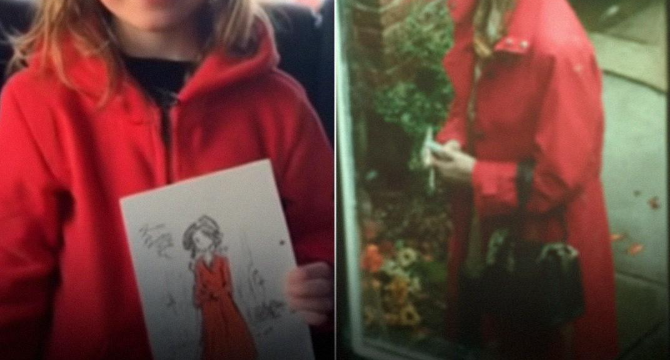
That was when Hazel started drawing the same woman.
At first, I barely noticed it.
One evening after work, I was making dinner while Hazel colored quietly at the kitchen table behind me.
When she finished, she proudly brought the paper over.
“Another picture for the fridge,” she said with a grin.
I glanced down. It looked like one of her usual drawings, except there was only one person in it.
A tall figure with long dark hair and a bright blue coat.
“Very nice,” I told her, giving her a quick hug before sticking it to the refrigerator with a magnet.
I did not think about it again.
A few days later, she handed me another drawing.
This one also had a tall woman with long dark hair.
And a blue coat.
Again, I assumed nothing of it. Children often repeat ideas that interest them.
But about a week later, something caught my attention.
I was packing Hazel’s lunch for school when I noticed three of the drawings lined up side by side on the fridge. Each one showed the same woman.
Same long dark hair.
Same blue coat.
Same simple oval face.
I studied them a little closer.
Every drawing was almost identical.
Even stranger, the woman’s face looked… sad.
It was not the happy smile Hazel usually gave her characters. Instead, the mouth curved slightly downward, like someone quietly disappointed.
That evening, Hazel was sitting at the kitchen table again, coloring with her box of crayons spread out around her. I leaned against the counter and watched her for a moment.
She hummed softly to herself as she worked.
“Who is this?”
She didn’t even look up.
“That’s the lady who watches the house,” she said casually.
A chill ran through me.
I tried not to let it show in my voice.
“What lady?”
“The one outside sometimes,” she replied, as if it were the most normal thing in the world.
I stared at her.
Hazel continued coloring, carefully filling in the long coat with a blue crayon.
“You mean like a neighbor?” I asked slowly.
She shrugged.
“I don’t know. She just stands there.”
My stomach tightened.
“Where does she stand?”
Hazel pointed vaguely toward the front of the house without lifting her eyes from the page.
“Outside.”
Her answer was so simple that it almost sounded innocent.
Still, that night I found myself checking the windows before bed.
I stood in the living room with the lights turned off so I could see outside more clearly. The streetlights cast pale yellow circles across the pavement. A soft breeze moved the branches of the trees lining the road.
Everything looked completely normal.
No one was there.
I told myself it was nothing.
Kids have vivid imaginations. Maybe Hazel had seen someone walking past the house once and turned it into a little story. Children sometimes invent characters the way adults invent worries.
For weeks, I tried to brush it off.
Life continued the way it always had.
Every morning, I dropped Hazel off at school before going to my job at a small insurance office downtown. In the evenings, we ate dinner together, worked on her homework, and usually ended the night on the couch watching cartoons before bedtime.
Yet the drawings kept coming.
At first, the woman stood right in front of our house.
Then the next drawing showed her a little farther away.
And the next one placed her near the sidewalk.
Each picture moved her farther from the house.
I noticed the pattern one Saturday afternoon while cleaning the kitchen.
Hazel sat nearby, drawing quietly, her tongue peeking out slightly in concentration.
I walked over to the fridge and pulled down several pictures, spreading them across the table.
My chest tightened as I lined them up in order.
I glanced at Hazel.
“Honey,” I said gently, “why is the lady moving?”
Hazel shrugged without looking up.
“She just is.”
That was all she said.
Something about her calmness unsettled me more than if she had acted scared.
Over the next few weeks, I began glancing out the front windows more often. Every time I walked past the living room or stepped onto the porch to collect the mail, my eyes drifted toward the street. But I never saw anyone strange.
Eventually, I convinced myself I was being ridiculous.
Hazel was seven years old. Seven-year-olds imagine all kinds of things.
Still, the drawings continued.
And yesterday evening, everything changed.
I was standing at the kitchen sink washing dishes while Hazel worked on her homework at the table behind me.
The sun had already begun to set, casting a soft orange glow across the neighborhood. The quiet hum of the dishwasher filled the kitchen.
I reached for another plate and glanced out the window.
And my hands froze.
Standing across the street was the woman from the drawings.
Same long hair.
Same blue coat.
Same face.
My breath caught in my throat.
For a moment, I could not move.
The woman stood perfectly still beneath the streetlight, staring directly at our house.
I slowly set the plate down in the sink, my heart pounding in my chest.
“Hazel,” I whispered without turning around, “stay at the table, okay?”
“Okay,” she answered casually.
I wiped my wet hands on a towel and walked toward the front door.
Each step felt heavier than the last.
The house was quiet except for the ticking of the hallway clock.
When I reached the door, I paused for a second, trying to steady my breathing.
Then I opened it and stepped outside.
The cool evening air hit my face as I looked across the street.
The woman had not moved.
Fear and anger twisted together inside me.
I took a few steps forward onto the porch.
Then I stepped outside and shouted,
“WHO ARE YOU?!”
The moment the words left my mouth, the quiet street seemed to tighten around us.
For a few seconds, the woman did not move. The evening breeze shifted her long, dark hair slightly, but she stayed exactly where she was across the road.
Then she slowly stepped forward.
My heart pounded as she crossed the street, the blue coat unmistakable under the streetlight. Every instinct told me to go back inside and lock the door, but something kept me rooted to the porch.
When she reached the edge of my yard, she stopped.
Up close, she looked younger than I expected, maybe in her early 30s. Her face was pale, and the sadness Hazel had captured in every drawing was clearly visible in her eyes.
“Why are you watching my house?” I demanded, trying to keep my voice steady.
She hesitated and glanced briefly toward the front door.
“Is Hazel inside?” she asked softly.
The sound of my daughter’s name made my stomach tighten.
“How do you know my daughter’s name?”
The woman looked back at me, her expression careful.
“Because she’s my niece.”
I stared at her.
“My name is Claire,” she continued. “I’m Michael’s sister.”
Michael.
Hazel’s father.
For a second, my mind refused to process the words.
“You’re lying,” I said automatically.
Claire shook her head gently.
“No. I understand why you’d think that. Michael probably never mentioned me.”
She paused before adding quietly, “We haven’t spoken in years.”
I let out a short breath.
“Well, for what it’s worth,” I said, “Michael and I aren’t together anymore. We divorced three years ago.”
Claire blinked in surprise.
“You did?”
“Yes,” I replied. “We still talk sometimes because of Hazel, but that’s it.”
She nodded slowly.
“That explains why I couldn’t find him at the address I had,” she murmured.
I folded my arms.
“You expect me to believe you’re Hazel’s aunt when you’ve just been standing across the street watching our house?”
Claire lowered her gaze.
“I know how it looks.”
“Then explain it.”
She seemed to search for the right words.
“Michael and I had a falling out a long time ago, before Hazel was born.”
“What kind of falling out?”
Her jaw tightened slightly.
“The kind where you say things you can’t take back.”
The streetlight reflected faintly in her eyes.
“We stopped speaking after that.”
“So how did you end up here?”
Claire glanced toward the house again.
“I found out a few months ago that Michael had a daughter,” she said quietly. “Hazel.”
My pulse quickened.
“How?”
“A mutual friend mentioned it by accident,” she replied. “I didn’t even know you existed before that.”
She drew a slow breath.
“It took me weeks to track down your address.”
“And then instead of knocking, you just started watching the house?”
Her expression tightened with embarrassment.
“I didn’t know if I had the right.”
“What does that mean?”
Claire looked directly at me now.
“Michael and I didn’t just stop speaking. We ended things badly. Really badly.”
Her voice softened.
“If he ever mentioned me, it probably wasn’t in a good way.”
I thought back through every conversation I had ever had with Michael about his family.
There was nothing.
He had never mentioned a sister.
Not once.
“You could have at least knocked.”
“I tried.”
My eyebrows lifted.
“What do you mean you tried?”
“The first time I came here, I walked all the way to your gate,” she admitted.
Her fingers tightened around the sleeve of her blue coat.
“But I froze.”
“Why?”
Her answer came quietly.
“Because I didn’t know if I’d be welcome anywhere near my brother’s daughter.”
That caught me off guard.
She quickly added, “I wasn’t sure what kind of life Michael had built after we stopped speaking. I didn’t want to create problems for you or for Hazel.”
I studied her face more carefully now.
The sadness Hazel had drawn suddenly made sense.
“You’ve been standing out here trying to work up the courage,” I said slowly.
Claire nodded.
“A few times.”
A small pause settled between us.
“Hazel saw you.”
Claire blinked.
“She did?”
“She’s been drawing you.”
Her eyebrows lifted in surprise.
“Drawing me?”
“Yes. Over and over again.”
I gestured back toward the house.
“She calls you ‘the lady who watches the house.'”
Claire let out a quiet breath.
“I didn’t realize she noticed me that much.”
“She noticed you before I did.”
That thought still unsettled me.
Kids see things adults miss.
“I never meant to frighten her,” Claire said softly. “Or you.”
“You did both.”
“I’m sorry.”
The sincerity in her voice softened something inside me, though I was still cautious.
“Why now?” I asked.
Claire’s answer came immediately.
“Because she’s my family.”
Her voice was simple but firm.
“I lost my relationship with my brother years ago because of our fight. I didn’t want to miss the chance to know my niece, too.”
Inside the house, I heard Hazel’s chair scrape lightly against the kitchen floor.
Claire heard it as well.
“That’s her, isn’t it?” she asked.
“Yes.”
Her expression softened.
For a moment, she looked exactly like the sad woman Hazel had been drawing for months. Someone standing outside a home, unsure if she was allowed to walk inside.
I sighed and rubbed my forehead.
“This is a lot to process.”
“I understand,” Claire said quickly. “If you want me to leave, I will.”
I looked at her for a long moment.
Then I thought about the refrigerator covered in Hazel’s drawings.
The same blue coat.
The same long dark hair.
The same sad face.
Hazel had been seeing this long before I had.
Finally, I stepped aside from the doorway.
“You should probably come inside.”
Claire blinked in surprise.
“Are you sure?”
“No,” I admitted honestly. “But Hazel already knows you exist. And if you really are her aunt, then we should figure this out the right way.”
For the first time since she appeared across the street, the sadness in her face eased slightly.
She walked slowly up the path toward the porch.
And as she reached the door, I realized something unexpected.
My daughter had not been drawing a stranger all this time.
She had been drawing her family.