
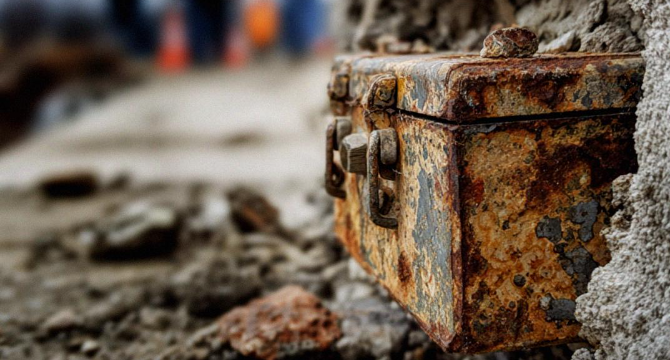
I’ve been breaking open walls for almost 20 years. Old houses hide things. That’s just the truth of the job. Most of the time, it’s nothing special — old newspapers, rusted tools, and the occasional toy a kid dropped decades ago. Once, I opened a wall in a crumbling duplex and found six empty soda bottles lined up neatly like trophies.
My crew thought we’d discovered buried treasure.
I told them the same thing I always say.
“Relax,” I said, brushing dust off my hands. “Old houses are like old people. They keep things.”
But the house on Hawthorn Lane felt different the moment I stepped inside.
It wasn’t falling apart. In fact, the structure was solid; the kind of house that had been built slowly and carefully back when people expected their homes to outlive them. The tall windows let sunlight pour into the living room, lighting up the dust floating in the air.
The homeowner stood near the kitchen doorway, watching us set up.
Daniel looked about 40, maybe a little older. He held a coffee mug with both hands like it was the only warm thing in the room. His eyes kept drifting to the wall we were about to tear down.
“You’re sure this wall can come out?” he asked me.
I walked over and pressed my palm against the plaster. “Should be fine,” I told him. “We’ll know more once we open it up.”
He nodded, but he didn’t look relieved.
“My grandparents built this house,” he said after a moment.
Luis, one of the guys on my crew, glanced up from laying plastic sheets across the floor.
“You grew up here?” he asked.
Daniel shook his head. “No. My family lost it before I was born.”
He looked around the living room slowly, like someone seeing a place from their childhood dreams.
“I only managed to buy it back a few months ago.”
That explained the way he was staring at everything. Buying a family house back wasn’t just a renovation. It was reopening something that had been closed for a long time.
Daniel cleared his throat. “If you find anything in the walls… anything old… please don’t throw it away right away.”
I ignored him. After 20 years of renovation work, I’d learned not to laugh at people’s instincts about old houses.
Sometimes people felt things before they had any reason to.
“Alright,” I said, picking up my hammer. “Let’s see what this wall’s hiding.”
The first swing cracked the plaster with a loud pop. The room filled with the steady rhythm of demolition—hammer, crack, scrape. Just another day on the job until the sound changed.
My hammer hit the wall again — and instead of the solid thud of brick, it made a hollow knock.
I stopped.
“Hold up,” I said.
The room went quiet behind me.
Luis lowered his pry bar. “What?”
I leaned closer and brushed loose plaster away with my glove. Behind the broken surface was something dark sitting between the bricks.
Not insulation. Not wood.
A box.
I carefully chipped away more plaster until it was fully visible.
It was small, the size of a shoebox, wrapped in brittle cloth. The bricks around it weren’t broken or patched like the rest of the wall.
They’d been arranged carefully and deliberately.
Someone had sealed the box inside.
Not by accident.
“Daniel,” I called.
He was already walking toward me.
“What is it?”
“I’m not sure yet.”
I reached into the wall and slowly pulled the box free. Dust coated my hands as I wiped the lid with my sleeve. That’s when I saw the words scratched into the surface.
“Hope you found it,” I read the carved letters out loud.
No one spoke.
Daniel stepped beside me, staring at the box like it might explain something he’d been wondering about for years.
“Open it,” he said quietly.
I ran my thumb along the edge of the lid.
I looked at Daniel, “you ready?”
He nodded slowly.
So I lifted the lid.
For a second, I just stared into the box.
“What is it?” Luis asked behind me.
I didn’t answer right away. I tilted the box slightly so the light from the window could reach inside. At the very top was an old photograph.
Beneath it sat a bundle of letters tied together with a thin string. And taped to the inside of the lid was a small brass key.
Daniel stepped closer, almost cautiously, like the box might disappear if he moved too fast.
“Can I see?” he asked.
I lifted the photograph out first. The paper was thick and worn at the edges. Black and white. The kind of photograph you only see in history books.
It showed a young couple standing in front of a house.
Not just any house. This house.
The brick was fresh and clean in the picture. The steps weren’t worn down yet, and the trees in the yard were tiny saplings instead of the tall ones that shaded the street now.
Daniel reached for the photograph.
“Let me—”
I handed it to him.
The moment he saw it, his expression changed. His eyes widened just slightly.
“That’s… unbelievable,” he whispered.
“You recognize them?” I asked.
He didn’t answer immediately. He just stared at the photo like it had reached out of the past and grabbed him.
“I think I do,” he said finally.
He pointed to the man in the photograph.
“My grandmother had a picture of her father that looked exactly like him.”
Luis blinked. “You mean the guy who built the house?”
Daniel nodded slowly. “I think that’s my great-grandfather.”
A quiet weight settled over the room.
“Well,” I said, “looks like we should read the letters.”
I untied the thin string holding the bundle together. The paper was yellowed and fragile, but the handwriting was still clear. I unfolded the first letter, and the crew gathered around as I began reading.
“If someone is reading this,” I said aloud, “then the wall has finally been opened.”
Luis chuckled nervously. “Okay, that’s a little creepy.”
I kept reading.
“My name is Samuel. My wife Eleanor and I built this house together in 1934. I placed this box inside the wall the night before we left.”
Daniel’s head snapped up.
“Wait,” he said. “What name did you say?”
“Samuel.”
Daniel sat down on a nearby chair.
“That’s him,” he murmured. “That’s my great-grandfather.”
The room went quiet again as I continued reading.
“We never planned to leave this house. It was meant to be the place where our family would grow. But sometimes life forces you to walk away from things you love.”
The words felt heavier the more I read them. “If this message is ever found, then the house is still standing. And if the house is still standing, then perhaps someone from our family has returned to it.”
Daniel rubbed a hand over his face.
“My grandmother used to talk about this house all the time,” he said softly. “She said they lost it somehow. Nobody ever knew the full story.”
I reached back into the box and picked up the brass key. It was small but surprisingly heavy. I couldn’t wait any longer, so I flipped to the final page of the letter.
The answer was written there.
“The key opens a wooden chest hidden beneath a loose floorboard in the attic. We left it there because it belonged to this house as much as it belonged to us.”
Daniel stared at the key in my hand like it had suddenly become the most important object in the world.
“My grandmother used to say she played in the attic when she was little,” he said quietly.
Luis clapped his hands together. “Well, I don’t know about you guys, but now I have to see this.”
I handed the key to Daniel. “You want to do the honors?”
“Yeah,” he said.
A few minutes later, we were climbing the narrow staircase to the attic as the steps creaked under our weight. I pushed open the attic door.
Dust drifted through the beam of light coming from a small, round window at the far end of the room. The attic was mostly empty, just wooden beams, old floorboards, and decades of quiet.
Luis stepped inside first.
“So,” he said, rubbing his hands together, “which board are we looking for?”
I crouched and ran my hand slowly across the floor. Old boards always told you where they were loose. You just had to feel for it.
A few seconds passed.
Then I felt it.
One plank dipped slightly under my palm.
“Here,” I said.
The others gathered around as I slid my pry bar under the edge of the board. The wood creaked as it lifted. And we all leaned closer. Underneath the floorboard sat a small wooden chest. It was darker than the surrounding wood, like it had been waiting there for decades.
Daniel knelt beside it, his hands trembling.
I stepped back and nodded toward the lock. “Looks like Samuel kept his promise.”
Daniel inserted the brass key, and the metal turned with a soft click.
And the moment he looked inside—
He covered his mouth with his hand.
For a moment, Daniel didn’t say anything. He just stared into the chest.
Luis leaned forward first. “Okay… now you’re scaring me,” he said. “What’s in there?”
Daniel lowered his hand slowly.
“Letters,” he said.
I crouched beside him and looked inside the chest.
He was right.
Dozens of envelopes filled the small wooden box, stacked neatly in rows. Every single one of them had the same careful handwriting on the front.
Daniel picked up the top envelope. His fingers moved slowly across the paper, almost like he was afraid to tear it.
“What does it say?” I asked.
He turned the envelope toward us.
On the front were two simple words.
To our family.
Daniel swallowed.
“My great-grandfather wrote these,” he said quietly.
He slid a finger under the seal and opened the envelope.
For a moment, he read silently. Then his eyebrows pulled together.
Daniel looked up at us, confused. “They didn’t lose the house.”
The words hung in the attic like dust in sunlight.
“What do you mean?” I asked.
“My grandmother always believed the family lost the house during hard times,” Daniel said slowly. “That’s what everyone thought.”
He held up the letter. “But that’s not what happened.”
Daniel read the next part aloud.
“My brother Arthur’s family lost everything after the factory closed. They had five children and nowhere to go. Selling this house was the only way I could keep them fed and in school.”
Daniel stared at the page again. “He didn’t lose the house,” he repeated quietly.
“He sold it.”
He flipped the page and kept reading.
“I never told my daughter the truth. It would have broken her heart to know the home we built together was something I chose to give away. It was easier for her to believe it was taken from us.”
Daniel let out a slow breath.
“My grandmother spent her whole life believing something had been stolen from their family,” he said.
“What about the other letters?” I asked.
Daniel glanced back inside the chest.
“There are dozens more.”
He pulled another envelope from the stack and opened it. This one made him laugh quietly. Not a big laugh. More like the kind that slips out when something hits you right in the chest.
“What does this one say?” Luis asked.
Daniel turned the paper toward us and read the last lines aloud.