
Everything about that day felt perfect.
I remember standing at the top of the aisle, my father’s arm tucked firmly in mine, breathing in the scent of fresh roses and polished wood.
The venue was glowing with warm lights. Soft music played in the background. My fiancé stood at the altar, smiling at me like I was the only person in the world.
Carter was 30, tall, and usually steady as a rock.
He had always been the calm one in our relationship. The voice of reason. The one who never panicked.
That was why I ignored the signs.
But there had been strange signs all week.
Missed calls from unknown numbers.
At first, I thought they were spam. I declined them while sitting at my desk at work, rolling my eyes. When they kept coming, sometimes late at night, sometimes early in the morning, around 6 a.m., a flicker of unease crept in. Still, I brushed it off.
Then there was the envelope.
It had no return address. Just my name written in careful, deliberate handwriting. I found it in our mailbox three days before the wedding.
I remember standing in the kitchen, sunlight spilling across the counter, my hands slightly damp as I opened it.
Inside, there was only one sentence.
“Ask him about the past.”
That was it.
No signature. No explanation.
I laughed it off.
Cold feet. Wedding nerves.
That’s what I told myself.
Carter and I had been together for four years. We had met at a friend’s birthday party, where he spilled red wine on my dress and spent the next 20 minutes apologizing like he had committed a crime.
He was gentle, attentive, and patient with my stubborn streak. He knew I hated mushrooms, that I cried at dog rescue videos, and that I needed silence when I was overwhelmed.
He knew me.
So what “past” was I supposed to ask about?
When I showed him the note, his reaction was subtle, but now that I replay it in my mind, I see it more clearly. He stared at the paper a second too long. His jaw tightened.
“Probably some prank,” he said lightly.
“You know how people get before weddings.”
I studied him. “You don’t think it’s weird?”
He smiled, but it didn’t quite reach his eyes. “Natasha, we’re about to get married. Let’s not let some anonymous creep ruin that.”
He kissed my forehead, and I let it go.
Even that morning, I noticed something off.
The bridal suite buzzed with energy. My bridesmaids fluttered around me. My mother dabbed at her eyes. I was 28 years old, wearing the white dress I had dreamed about since I was a teenager. I should have felt nothing but joy.
Instead, there was a small knot in my stomach.
Through the half-open door, I caught a glimpse of Carter pacing in the hallway. He kept checking his phone. His hands trembled slightly when he thought no one was watching.
That was not like him.
Carter hated looking nervous. He was the kind of man who practiced his speeches, planned his surprises weeks ahead, and double-checked reservations. Seeing his hands shake made something inside me shift.
When I asked if everything was okay, he smiled too quickly.
“Of course,” he said.
I searched his face. “You seem stressed.”
He stepped closer and cupped my cheek.
His palm was warm, but damp. “It’s just a big day. I don’t want to mess up my vows.”
I laughed softly. “You won’t.”
“I love you,” he added, almost urgently.
“I love you too,” I replied.
If there was doubt in my heart, I buried it beneath layers of hope.
The ceremony began.
Guests stood. I walked down the aisle. He looked pale, but I thought it was the emotions.
The music wrapped around us like something sacred.
My heels clicked gently against the floor. I could feel every pair of eyes on me, but I only saw him.
Carter.
He swallowed hard as I reached him. Up close, I noticed the faint sheen of sweat along his hairline. His smile trembled at the edges.
“Hey,” I whispered.
“You look beautiful,” he breathed.
The officiant began speaking about love, commitment, and partnership, painting a picture of the future we were about to build together.
I tried to focus on them, but a strange tension hung in the air. It was subtle, like the pressure before a storm.
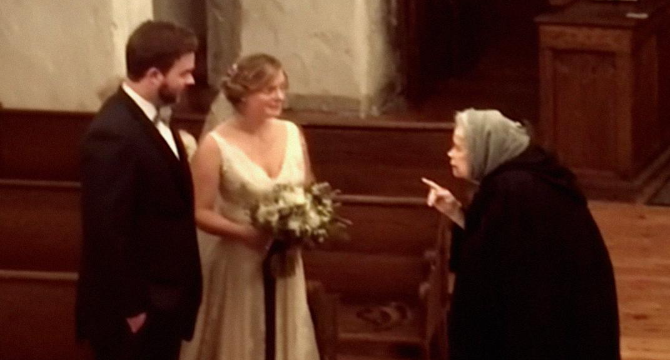
Then the doors to the hall slowly opened.
At first, I thought it was a late guest.
To my surprise, an elderly woman stepped inside.
She looked about 70 years old, dressed in a long black cloak, her face barely visible beneath the hood.
The music stopped.
The room went silent.
Even the officiant froze mid-sentence.
A murmur rippled through the guests. My mother turned in her seat. Carter’s grip on my hands tightened painfully.
She walked slowly toward the center of the hall.
Every step echoed.
I could hear the faint scrape of her shoes against the polished floor. No one moved to stop her. It was as if the entire room had been placed under a spell.
My heart pounded so loudly I thought I might faint.
“Do you know her?” I whispered to Carter.
He didn’t answer.
His breathing had grown shallow. His eyes were locked on the woman as if he were seeing a ghost.
She stopped in front of us and slowly raised her hand.
Her skin looked pale and thin, almost translucent beneath the lights. Her sleeve slipped slightly, revealing a wrist marked with faint blue veins.
Her finger pointed directly at Carter.
“This can’t be…” he whispered.
The words barely left his lips, but I heard them clearly.
A cold washed over me.
“What is happening?” I asked.
No one responded.
The elderly woman’s gaze shifted briefly to me. I could not fully see her eyes beneath the hood, but I felt them. Sharp. Certain.
The silence stretched.
I realized, standing there in my white dress, that the knot in my stomach had not been nerves.
It had been a warning.
And whatever Carter’s “past” was, it had just walked through the doors of our wedding.
I could hear my own breathing, shallow and uneven. My wedding bouquet slipped slightly in my grasp, petals brushing against my wrist.
Carter’s hand fell from mine.
He looked ten years older in that moment. The color had drained from his face completely.
I swallowed. “Carter,” I said carefully, forcing steadiness into my voice, “who is she?”
The woman slowly lowered her hand. With deliberate movements, she pushed back her hood.
A collective gasp filled the room.
Her face was lined with deep wrinkles, but her eyes were sharp and clear. Gray. The same shade as Carter’s.
She studied him, not with anger, but with something heavier. Disappointment. Grief.
“Hello, Daniel,” she said.
The name sliced through the air.
My heart skipped. I stared at Carter. “Daniel?”
His jaw clenched. He did not look at me.
The guests began whispering. I saw my mother stand up halfway, confused. The officiant shifted awkwardly to the side.
“My name is Carter,” he said hoarsely.
The woman’s lips pressed together. “You were born Daniel. Do not insult me by pretending otherwise.”
The room tilted.
I felt like I was watching someone else’s life unravel.
I turned to him slowly. “What is she talking about?”
He ran a hand through his hair. His fingers were shaking harder now. “Natasha, I can explain.”
“Then explain,” I demanded, my voice breaking despite my effort to stay composed.
The woman took a step closer.
“You owe her the truth,” she said firmly.
He closed his eyes for a second, as if gathering strength. When he opened them, they were glassy.
“She’s my grandmother,” he admitted.
The word grandmother echoed in my mind.
I looked at her again. “Grandma Agnes?”
Her gaze softened slightly when it landed on me. “Yes,” she replied gently. “Agnes.”
I felt foolish for not seeing it. The resemblance was there. In the eyes. In the shape of the mouth.
“But Carter told me his grandparents passed away years ago,” I said quietly.
Agnes inhaled slowly.
“His grandfather died. I did not.”
I looked back at the man I loved. “Why would you lie about that?”
He let out a shaky breath. “Because it was easier.”
“Easier than what?” I asked.
His shoulders sagged. “Easier than explaining where I came from.”
Agnes’ expression hardened again. “Tell her everything.”
He nodded faintly.
“I changed my name when I was 21,” he began. “I left home. I cut ties with my family.”
“Why?” I asked.
He hesitated.
Agnes answered instead. “Because he was ashamed.”
“That’s not fair,” he snapped, finally looking at her.
“Then correct me,” she replied calmly.
He turned back to me. “I grew up in a very strict household. Controlling. Religious to the extreme. My father believed in obedience above all else. There was no room for mistakes. No room for independence.”
His voice trembled, but he kept going.
“When I told them I wanted to leave, to study art instead of joining the family business, my father called me a disgrace. We fought constantly. It became unbearable.”
Agnes watched him closely, her face unreadable.
“So I left,” he continued. “I legally changed my name. I stopped answering calls. I wanted a clean slate.”
The missed calls.
The envelope.
My stomach dropped.
“The envelope,” I whispered. “Was that you?”
Agnes shook her head.
Carter looked at her sharply. “You promised you wouldn’t.”
“I promised nothing,” she replied. “I asked you to tell her before the wedding.”
I felt heat rise to my cheeks. “Tell me what?”
Silence fell again, thick and suffocating.
Carter’s eyes filled with tears. “That my father is dying.”
The words hit me like a physical blow.
“He was diagnosed with a terminal illness six months ago,” Agnes said quietly. “He has weeks left.”
I stared at Carter.
“Six months?”
He nodded.
“And you didn’t tell me?”
“I didn’t know how,” he said helplessly. “After everything that happened, after the way he treated me, I told myself I didn’t care. But when I got the call…” His voice cracked. “I didn’t know what I felt.”
Agnes’ shoulders softened. “Your father asks for you every day.”
Carter covered his face with his hands.
The guests were still watching, but they felt far away now.
It was just the three of us in that moment.
“You were going to marry me without telling me your father is dying?” I asked, my voice barely above a whisper.
“I was going to tell you,” he insisted. “I just needed time.”
“Six months is time,” I said.
Tears spilled down his cheeks. I had never seen him cry before. Not once in four years.
“I was ashamed that I still cared,” he admitted. “Ashamed that part of me wanted to go back. I didn’t want you to see that weakness.”
My anger wavered.
Agnes stepped closer to me.
“He is not a bad man,” she said softly. “He is a wounded one.”
I looked at her, really looked at her. She had not come to ruin my wedding. She had come because she was desperate.
“I tried calling him,” she continued. “He would not answer. I sent the letter because you deserved the truth before you married him.”
The sentence from the envelope echoed in my mind.
“Ask him about the past.”
I exhaled slowly.
“Why today?” I asked her.
“Because his father may not survive the week,” she replied. “And because secrets grow heavier with vows.”
Her words settled deep inside me.
I turned back to Carter. He looked small, vulnerable in a way I had never seen.
“You should have trusted me,” I said.
“I know,” he whispered.
Love is strange. It does not disappear in a moment, even when hurt seeps in. But it changes shape.
“Do you want to see him?” I asked.
He hesitated. Then he nodded.
“Go,” I said gently.
His head snapped up. “What?”
“Go to your father.”
“And the wedding?” he asked, voice trembling.
I glanced down at my dress, then at the flowers in my hands, and finally at the guests who had come to celebrate us.
“We can postpone a wedding,” I said. “We cannot postpone goodbye.”
A sob escaped him.
He pulled me into his arms. “I don’t deserve you.”
“Just don’t lie to me again,” I replied.
Agnes wiped at her eyes. “Thank you,” she murmured.
Carter turned to the guests, his voice unsteady but clear. He explained briefly, apologizing. Some looked shocked. Others nodded with quiet understanding.
Within minutes, the perfect ceremony had dissolved into something raw and human.
As Carter walked down the aisle beside his grandmother, not as a groom but as a son, I felt something inside me shift.
Our story was not as polished as I had imagined.
It carried scars and unfinished chapters.
But for the first time that day, no secrets were standing between us.
The venue was still glowing with warm lights. The music had long stopped. Yet in the silence, I felt a different kind of clarity.
Love was not about perfection.
It was about choosing each other, even when the past tried to follow us down the aisle.
And this time, we would face it together.
But here is the real question: when the man you are about to marry is suddenly called by another name, and his past walks into the room uninvited, how do you decide whether love is strong enough to hold the truth?
And once the vows are paused and the secret is no longer hidden, do you cling to the wedding you planned, or step into the future you never saw coming?
 admin
admin