
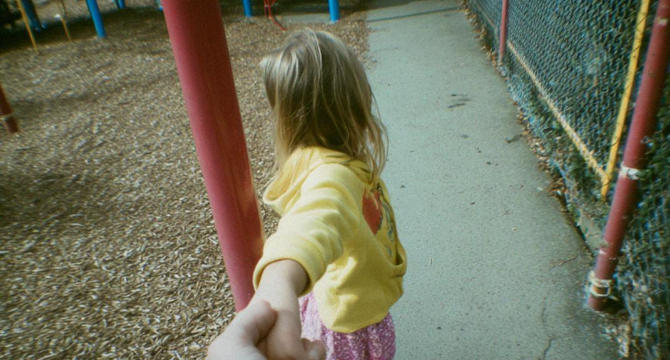
I was sitting on a bench at the playground, scrolling through my phone and pretending not to think about how quiet my apartment had been lately.
The quiet had weight. It pressed against the walls. It followed me from room to room. Some nights, I left the television on just to hear another voice.
I told myself I liked my independence.
I was 29, financially stable, with a decent marketing job and a tidy one-bedroom apartment. I had friends. I had hobbies. I had plans.
I didn’t have kids. I never did. Life just… went a different direction.
That afternoon, the air smelled like fresh-cut grass and sunscreen. The playground was crowded with parents pushing swings, toddlers wobbling across wood chips, and older kids shrieking as they chased each other.
I came there sometimes with a coffee just to sit in the sun and feel like part of something louder than my own thoughts.
I told myself I liked observing.
That’s when I felt a small hand wrap around mine.
It wasn’t a tug. It wasn’t frantic. It was gentle. Familiar.
I looked down and saw a little girl, maybe five years old, staring up at me with wide, certain eyes. Her dark hair was tied into two uneven pigtails, and there was a faint smudge of dirt on her cheek.
“Mom,” she said softly. “You came back.”
The word hit me like cold water.
I pulled my hand away gently, careful not to scare her. “Sweetheart, I think you’re confusing me with someone else.”
She frowned, almost annoyed. “No. It’s you.”
There was no hesitation in her voice.
No doubt. Just certainty.
I scanned the playground for a panicked parent. I expected someone to come running, calling her name, apologizing. But no one seemed to be looking for her.
A couple argued quietly near the swings. A dad was filming his son on the slide. Two women chatted by the sandbox.
No one was searching.
“Where’s your mom?” I asked carefully.
The girl’s expression changed. Not sad. Not dramatic. Just matter-of-fact.
“She died,” she said. “But you’re here now.”
My chest tightened.
Children that age were not supposed to speak about death like that. There was no tremble in her voice. No confusion. Just a statement.
“I’m not your mom,” I whispered.
She squeezed my hand again, like she didn’t hear me. Or maybe like she didn’t accept it.
Her palm was warm. Trusting.
I swallowed. “What’s your name?”
“Emily.”
“Okay, Emily,” I said softly, forcing calm into my tone. “Do you know who brought you here today?”
She tilted her head as if I had asked something silly.
“You did.”
A chill ran down my spine.
“No,” I said, my voice thinner now. “I just got here. I was sitting on that bench.”
She shook her head, those crooked pigtails bouncing. “You left. Then you came back.”
I opened my mouth to respond, but nothing came out.
Left.
Came back.
Emily’s words made no sense at all, even though she said them with such assurance.
I lived alone.
I worked too much. I spent most evenings reading or scrolling until my eyes hurt. There was no child in my life. No secret visits to playgrounds with a daughter I had somehow forgotten.
“Emily,” I tried again, crouching down so we were eye level. “Listen to me. I don’t have any children.”
She studied my face with unsettling focus, like she was memorizing it.
“Yes, you do,” she said quietly.
My throat tightened. Around us, laughter burst from the monkey bars. A dog barked somewhere near the entrance. The world felt normal. Too normal.
“Where do you live?” I asked. “Is your house close?”
She nodded once.
“Who takes care of you?”
“You,” she replied.
My hands began to tremble. I stood up too quickly and nearly lost my balance.
This wasn’t possible. It had to be a misunderstanding. Maybe her mother looked like me. Maybe we had the same hair color. Similar features. Children mixed things up all the time.
“Emily, can you show me your dad? Or maybe your grandma? Anyone you’re here with?”
She was quiet for a moment.
Then she leaned closer and said quietly, “Come with me.”
The way she said it made my stomach twist.
It wasn’t a request. It wasn’t playful. It was calm. Intentional.
Before I could decide whether to call someone or walk away, I stood up… and followed her.
I don’t know why I did.
Part of me knew it was reckless. You don’t follow strangers. You don’t let strange children lead you away from public spaces. I could have found a park employee. I could have called out to the other parents. I could have dialed 911 and reported an unattended child.
Instead, I walked.
Emily’s hand slipped into mine again as if it belonged there.
She guided me across the playground, past the swings, and toward a narrow path that led behind a row of trees.
“Emily,” I said gently as we stepped onto the path, “where are we going?”
“Home,” she answered.
My pulse pounded in my ears.
We exited the playground through a small side gate I hadn’t noticed before. The noise faded behind us, replaced by the distant hum of traffic. The path curved along a quiet residential street lined with modest houses and trimmed hedges.
I hesitated.
“Emily,” I tried one more time, “I think we should find a grown-up whom you know.”
She looked up at me with those same steady eyes. “You know me.”
Something about her confidence unsettled me more than if she had been crying.
We stopped in front of a pale blue house with white shutters. It looked ordinary. A bicycle lay on its side near the porch steps. A wind chime swayed lightly in the breeze.
She pointed. “We live here.”
We.
My mouth went dry.
“Emily,” I whispered, “I have never been here before.”
She stared at me as if I had just told her the sky was green.
“Yes, you have.”
Before I could respond, the front door creaked open.
A man stepped out.
He was in his early 30s, tall, with tired eyes and stubble along his jaw. He froze when he saw us standing by the walkway.
His gaze moved from Emily’s hand in mine… up to my face.
For a long second, none of us spoke.
Then, in a voice that sounded like it had been scraped raw, he said, “It can’t be.”
My heart slammed against my ribs.
Emily squeezed my hand tighter and smiled up at him.
“I told you she’d come back,” she said.
“This is impossible!” The man’s voice trembled, like he had seen a ghost.
I let go of Emily’s hand without meaning to.
My fingers felt numb.
“I’m sorry,” I began, my words tangling together. “I think there’s been some kind of mistake. She came up to me at the playground and called me ‘Mom.’ I tried to explain, but she insisted on bringing me here.”
The man stepped down from the porch slowly, as if approaching something fragile. His eyes never left my face.
“Emily,” he said carefully, “go inside for a minute, sweetheart.”
She shook her head and tightened her grip on my coat. “No. She’ll leave again.”
The word again made his jaw clench.
“I’m not going anywhere,” I said quickly, though I had no idea if that was true.
He crouched in front of his daughter.
“Em, please. Daddy needs to talk to her.”
After a moment of hesitation, Emily studied my face one more time, searching for something. I forced a small smile.
“I’ll be right here,” I assured her.
She nodded slowly, then walked up the porch steps and disappeared inside, glancing back twice before closing the door.
Silence fell between us.
The man ran a hand through his hair.
“I’m sorry,” he said. “You must think this is insane.”
“I do not understand what is happening,” I replied honestly. “She said her mom died.”
His eyes flickered with pain. “She did.”
The air felt heavier.
“I’m Ian. My wife, Alina, passed away eight months ago. Car accident.”
I swallowed. “I’m so sorry.”
He studied me again, and this time, there was no confusion in his gaze. Only shock. “You look exactly like her.”
The words landed softly, but they echoed.
I shook my head. “That is not possible.”
“It is,” he insisted, though his tone was not aggressive. It was tired. “Same eyes. Same smile. Even the way you tilt your head when you’re confused.”
I stepped back instinctively. “I have never been here before. I do not know you. I have never met your wife.”
Ian nodded slowly, as if convincing himself. “I know that. I mean, I think I know that. But when you walked up with Emily, I felt like I was losing my mind.”
He gestured toward the house. “Would you mind coming inside for a minute? I can show you.”
Every instinct told me to leave.
To apologize again and run back to the safety of my quiet apartment.
But I also saw something else in his face. Grief. Exhaustion. Desperation.
“I will stay for a few minutes,” I agreed softly.
Inside, the house smelled faintly of laundry detergent and something sweet, like vanilla candles. Toys were scattered near the couch. A framed photo hung above the fireplace.
I stopped breathing.
The woman in the picture looked like me.
Not similar. Not vaguely familiar.
Exactly like me.
Same dark hair. Same sharp cheekbones. Same small dimple on the left side when she smiled.
My knees felt weak. “That is… your wife?”
Ian nodded. “That is Alina.”
I stepped closer to the photograph. Even the way she stood, slightly angled, felt natural to my body.
“This is not possible,” I whispered.
Emily appeared in the hallway, clutching a stuffed rabbit. “See?” she said softly. “I told you.”
I turned toward her, my chest aching. “Emily, I am not your mom.”
She looked at me with calm certainty. “You went away. Daddy said you went to heaven. But you came back.”
Ian’s voice broke. “She’s been saying that for weeks. That you would come back.”
I felt tears sting my eyes. “Why me? There must be many women who look similar.”
He shook his head slowly. “Not like this.”
He walked to a shelf and picked up another photo. In it, Alina held a newborn Emily.
The resemblance was undeniable.
“I thought I was losing it,” he admitted. “When Emily first pointed at a stranger in the grocery store and whispered, ‘Mom.’ But today, when I saw you holding her hand…”
He did not finish.
I pressed my fingers to my temple, trying to steady my thoughts. “I was adopted,” I said suddenly, the words surprising even me.
He looked up sharply. “What?”
“I never knew my biological parents. I do not have many details. Just that I was born in this city.”
His face went pale.
“Where was your wife born?” I asked carefully.
He named a hospital across town. The same hospital was listed on the only document I had from my adoption file.
My heart began to pound.
“What was her birthday?” I whispered.
He told me.
The room seemed to tilt.
“That is my birthday,” I said.
Silence swallowed us whole.
Emily’s small voice broke it. “Mom?”
I sat down slowly on the couch. My mind raced through years of questions I had buried. I had never searched for my biological family. I told myself it did not matter.
But now.
“She never talked about siblings,” he said faintly. “Her parents passed away when she was young. There were some gaps in her history, but I never pushed.”
I let out a shaky breath. “It is possible,” I said quietly. “Maybe we were twins.”
The word felt unreal.
His eyes filled with tears.
“That would mean…”
“That would mean I did not come back from heaven,” I finished gently. “I was just somewhere else all along.”
Emily walked toward me slowly, as if approaching something sacred. She climbed onto the couch beside me without asking.
“You smell like her,” she whispered.
I wrapped my arms around her before I could stop myself.
She fit there too easily.
I looked at Ian. “I cannot replace her,” I said firmly. “I am not Alina.”
“I know,” he replied, his voice raw. “But maybe… maybe you are family.”
Family.
The word settled into the hollow space inside me.
I had spent years telling myself I was fine alone. That my quiet apartment was enough.
But sitting there, with Emily’s small heartbeat against my chest and a man grieving the woman who shared my face, I felt something shift.
Not fate. Not destiny.
Connection.
“I would like to take a DNA test,” I said carefully. “If you are willing.”
He nodded without hesitation. “Of course.”
Emily looked up at me.
“You’re not leaving?”
I brushed her hair back gently. “No,” I promised. “I am not leaving.”
And for the first time in a long while, the word felt true.
Three months later, the results confirmed what we already felt in our bones.
Alina had been my twin sister.
We had been separated at birth after our parents died in a car accident. Different relatives. Different lives. No one had thought to tell us.
I stood at her grave the first time I visited, Emily’s small hand in mine.
“I am sorry I did not find you sooner,” I whispered.
The wind rustled through the trees, soft and steady.
Emily squeezed my hand. “She found you,” she said.
I smiled through my tears.
Maybe she had.
My apartment is no longer quiet. There are drawings on my fridge and tiny shoes by my door. I am still not Emily’s mother.
But I am her aunt.
And somehow, that feels like coming home.
 admin
admin