
I turned 35 last week, and I tried to pretend it didn’t bother me.
At work, I smiled through meetings and answered emails like a robot. Outside of work, I nodded at neighbors and kept things light.
“Busy month,” I’d say, and people would laugh like that explained everything.
It didn’t.
A month of deadlines had chewed me up, and I could feel it in my jaw, in my shoulders, in the way my thoughts kept looping back to the same thing I never talked about.
My dad left when I was five. I’d grown up with my mom, Sylvia, and she did what she had to do. She worked long hours, stretched every dollar, and raised me like a one-woman army.
But turning 35 felt like stepping into a shadow.
Because 35 was the age my father had been when he disappeared from my life.
That morning, Mom called while I was making coffee.
“Henry, you sound tired,” she said. She always said my name like it was something she could protect.
“I’m fine, Mom.”
“No, you’re not. You’ve been ‘fine’ for weeks,” she replied. “Did you eat? Tell me you ate.”
I leaned my hip against the counter and stared at the sink. “I’m going on a hike.”
There was a pause on the line. “Alone?”
“Yeah. I just need a break from everything.”
“Okay,” she said softly. “Text me when you get there. And when you leave. And don’t take the risky trails.”
I smiled despite myself. “Yes, ma’am.”
“And Henry?”
“Yeah?”
“Don’t let your mind drag you places you don’t need to go today.”
“I’ll be okay,” I said, because it was the only thing I knew how to give her.
The trail was an hour outside town. It was one of those places where the trees got tall enough to swallow cell service, and the air smelled clean in a way you can’t fake. I parked, shouldered my small pack, and started walking.
At first, it worked. I loved how the leaves crunched under my boots and how there was no one to disturb me.
My mind still tried to drift, though.
I kept seeing fragments of childhood like broken film: my mom’s hands counting bills at the kitchen table, the way she’d tuck me in and stay until I fell asleep, the empty space in family photos where a second adult should have been.
And my father’s name, Ronnie, floating around like a word nobody wanted to touch.
Mom never talked about him unless I asked, and when I did, her answers were short.
“He left.”
“Why?”
“Because he did.”
It was like she’d built a wall and expected me to live behind it.
About an hour into the trail, I noticed something unusual.
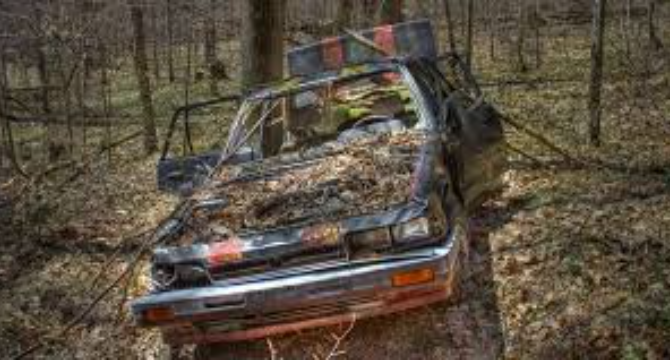
A rusted car was parked between bushes, tucked off the path like the forest had tried to hide it. Its windows were stained, and one tire was already flat. From a distance, it looked like it had been sitting there for years.
I slowed down, scanning the trees for a person, a campsite, or anything that explained why a car would be out here.
There was nothing but trunks and shadows.
I stepped off the trail and walked toward the car. When I got closer, my skin prickled because the driver’s door was slightly open.
That alone should’ve made me turn around. I’m not the kind of guy who pokes at weird things in the woods.
But curiosity has its own gravity. I leaned toward the open door and peeked inside.
The interior was too clean.
Not “new car clean,” but clean enough that it didn’t match the rust and grime outside. If someone had left the car here years ago, the seats would’ve been coated in dust. There would’ve been leaves, spiderwebs, maybe even little nests built in the corners.
Instead, the seats looked wiped down, and there was no musty smell of long neglect.
My heart started doing that slow, heavy beat it does when my body knows something my brain is still trying to deny.
At that point, I should’ve walked away and continued my hike.
But something told me to inspect the car. After all, I wanted to know why someone would park their car in the middle of the forest.
I circled it carefully, eyes scanning the ground. There were no fresh footprints that I could see and no signs of a struggle.
When I reached the back, my gaze landed on the trunk. For a second, I told myself it would be locked. Then, I wrapped my fingers around the handle and tested it.
It wasn’t locked.
My heart skipped a beat.
I looked around again, suddenly aware of how alone I was. Then, I grabbed the handle and slowly lifted the trunk.
It opened with a soft creak.
Inside was a cardboard box, taped shut like someone cared about it. On top of the box was a stack of photos, held together with a rubber band.
My mouth went dry.
The first photo was me as a kid holding a birthday cake with crooked candles. The next one was me in a tiny soccer jersey, missing one front tooth.
And then I saw a photo I’d never seen before.
It was a picture of me at five years old, sitting on a man’s shoulders, my hands gripping his forehead like a little steering wheel. The man’s face was turned slightly, but I recognized him anyway.
It was my father.
My throat tightened so fast it felt like I couldn’t swallow.
Under the photos were envelopes, all addressed to me. Henry, written in a handwriting I knew even though I hadn’t seen it in decades. A birthday card from long ago had shown the same slant, the same hard pressure on the letters.
My hands shook as I lifted one envelope.
I stared at the box, at the photos, at the letters, and my brain tried to build a story that didn’t make sense. Maybe someone stole these. Maybe this was some sick joke. Maybe—
That’s when a voice interrupted my thoughts.
“I didn’t think you’d ever open it,” a man said from behind.
For half a second, I didn’t turn. I couldn’t. My mind kept screaming, Run, but my feet didn’t move.
Then I slowly straightened and looked over my shoulder.
The man stood a few steps away, just beyond the back bumper. His hair was mostly gray, and his face had that thin, worn look like life had taken more than it gave back. He held his hands out slightly, palms open, like he didn’t want to startle me.
My chest burned. “Who are you?”
He swallowed, and I watched his throat bob. “Henry.”
The way he said my name didn’t feel like a stranger’s.
My vision narrowed. I pointed at him, then at the trunk. “Is this yours?”
He nodded once. “Yes.”
A sharp laugh escaped me. “So you just… leave a car in the woods? You leave this in the trunk like it’s some kind of treasure hunt?”
His eyes flickered, and I saw pain there, plain as day. “I didn’t know how else to do it.”
“How else to do what?”
“To reach you.”
My stomach dropped, even though I already knew.
“Ronnie,” I said, and the name tasted like metal.
“Yeah,” he whispered. “It’s me.”
A thousand thoughts tried to speak at once, but only one came out.
“You left.”
His shoulders sagged. “I didn’t mean to.”
I shook my head fast. “Don’t do that. Don’t stand there and say you didn’t mean to. You don’t get to rewrite my childhood in the middle of the woods.”
“I’m not trying to rewrite anything,” he said. “I’m trying to tell you what happened.”
“What happened is you bailed when I was five.”
“I fought for you,” he said, and the words came out stronger, like he’d been holding them back for years. “I fought for custody. I went to court, got a lawyer, and even paid child support.”
I stared at him. “No, you didn’t.”
“Yes, I did.”
My laugh turned bitter. “My mom worked doubles. She borrowed money from her sister. She cried in the bathroom when she thought I couldn’t hear. If you were paying child support, where was it?”
Ronnie’s face tightened. “Ask her.”
I didn’t like how he said that.
“Don’t talk about my mother. You don’t get to do that, okay?”
“I’m not attacking her,” he said quickly. “I’m telling you… she cut off contact. I sent letters… birthday cards… I even tried calling. But every time I tried, it went nowhere.”
“Because you didn’t try hard enough,” I snapped.
He shook his head, then reached into his jacket pocket and pulled out an envelope.
“I kept everything,” he said, voice shaking now. “Because if I didn’t, I’d go crazy. I’d start wondering if I imagined it.”
He opened the envelope and held out a stack of papers. They were legal documents, copies of letters, and receipts.
I didn’t want to take them, but my hand moved anyway.
The first thing I saw was a copy of a letter addressed to me, dated years ago. The second thing I saw was a big stamp in red ink on the corner of another envelope: RETURN TO SENDER.
I flipped through more and found the same stamp again and again.
My throat worked. “This… this could be fake.”
Ronnie’s eyes watered. “You think I made fake court paperwork to impress you in the woods?”
I glared at him, but the anger felt less solid than it had a minute ago. Like it was cracking down the middle.
“I was told you didn’t want to see me,” he said quietly. “That you asked her not to give you my letters. That you didn’t want to be confused.”
I stared down at the papers, heart pounding. “I was five.”
“I know,” he whispered. “That’s what killed me.”
I looked back at the car. “Why keep it clean?”
His lips trembled like he was trying not to fall apart. “Because I come here every year.”
My eyes snapped to his. “What?”
“On your birthday,” he said. “I park it here, and I sit for a while. This is where I last took you hiking. You were small enough to ride on my shoulders. You kept pointing at birds and asking if they had homes.”
My chest tightened so hard it hurt.
“You’ve been doing this… every year?” I asked.
He nodded. “It’s the only place I feel like I’m close to you without risking making things worse.”
He rubbed his mouth like he was gathering courage. “I didn’t come to your door because I was ashamed. And because…” He swallowed. “Because I’m sick.”
“Sick how?” I asked, voice low.
He exhaled slowly. “It’s my lungs. They found it late. I’m doing treatment, but…” He gave a small, helpless shrug. “I’m not here to scare you. I’m not asking for money. I’m not asking you to take care of me.”
“Then why now?” I demanded.
He glanced at the trunk, at the letters. “Because I ran out of time to keep being a ghost.”
My jaw clenched. “So this is what, your goodbye?”
He shook his head quickly. “No. It’s… it’s me trying one last time to be your father in the only way I knew how.”
He looked at me like he was afraid I’d vanish.
“I thought if you found them,” he said, voice breaking, “maybe that would mean you still wanted to know.”
I stood there with the papers in my hands. I didn’t hug him or forgive him.
But I also didn’t walk away.
We sat on the car’s back bumper like two strangers who shared the same name in their blood.
The sun shifted behind the trees, and the light turned softer, as if the forest was trying to calm us down. I still felt like I was breathing through a knot.
Ronnie kept his hands clasped between his knees. Every now and then, he’d cough, and the sound made me flinch.
I stared at the ground. “My whole life, I thought you didn’t care.”
“I cared too much,” he said quietly. “And it didn’t help anybody.”
“That makes no sense.”
“It does when you’ve got no power,” he replied. “I didn’t have money like her family did. I didn’t have a good lawyer after the first round. I kept getting pushed back, delayed, worn down.”
I pressed my fingers into my palm. “My mom never said you fought.”
“I know,” he said. “And I don’t want to turn you against her.”
At that point, I really thought about what my mom had done.
If Ronnie was telling the truth, then my mom wasn’t just a hero who raised me alone. She was also the person who decided I wouldn’t have a father.
I wanted to defend her, but I didn’t know how.
I took a shaky breath. “Why didn’t you ever just… show up?”
Ronnie’s eyes dropped to his shoes. “Because I pictured you looking at me like I was poison.”
We sat with that for a moment. Wind moved through the branches overhead. Somewhere deeper in the woods, a bird called out.
I swallowed. “What’s in those letters?”
“The letters…” Ronnie’s voice was careful. “I wrote things I wanted to tell you. Some stories and some apologies. And even some dumb jokes.”
“Dumb jokes?” I smiled.
He nodded, almost embarrassed. “I used to write you jokes in cards when you were little. You’d laugh like I was the funniest man alive.”
I looked away fast because the image hit too hard. “I don’t remember.”
“I figured,” he said. “But I remembered enough for both of us.”
We talked for hours, but that didn’t fix everything all at once. There were moments when I got loud, and moments when he admitted he made some mistakes too.
At one point, I asked, “Do you hate Mom?”
Ronnie shook his head slowly. “No. I hated what happened. I hated feeling shut out. But hate is heavy, Henry. It’ll break your back if you carry it long enough.”
That line stuck with me.
Because I’d been carrying it.
I pulled out my phone and stared at the screen. No service, of course. The woods didn’t care about my timing.
“What happens now?” I asked.
Ronnie’s shoulders lifted and fell. “Whatever you choose. I’ll respect it. If you want me to disappear again, I will.”
I hated that he gave me the power, and I hated that I wanted it.
I pictured my mom’s face, the way she’d worry if I didn’t text back. The way she’d sacrificed so much for me. The way she’d been my whole world.
And I pictured the trunk full of letters I’d never been allowed to read.
My voice came out quiet. “I need to talk to her.”
Ronnie nodded once. “You should.”
“And I need… time,” I added.
“I’ll take whatever time you give me,” he said.
I stood up slowly, then looked into the trunk again. The photos and letters inside it were proof that the story I’d lived might not be the full story.
When I turned back, Ronnie was watching me like he was trying to memorize my face.
“I’m going to read them,” I said.
His eyes filled, and he nodded again, throat working hard. “Okay.”
I started walking back toward the trail, then stopped and looked over my shoulder.
“If you’re going to keep coming here,” I said, “don’t do it like a ghost.”
Ronnie blinked. “What does that mean?”
“It means,” I said, voice tight, “if I decide to see you again, you show up like a man. Not a shadow. Not a trunk full of paper.”
“I can do that.”
As I walked away, my chest felt split in two.
One half was loyal to my mother, the woman who raised me like a superwoman.
The other half was furious that my life might have been shaped by a choice she made for me, without letting me have a say.
By the time I reached my car, I finally got a bar of service. My phone buzzed with a missed call and a text from Mom.
“Text me when you leave. Please.”
My thumb hovered over the screen.
I could call her and pretend none of this happened, keep her hero image intact, and keep my own heart safe. Or I could tell the truth, risk the argument, risk the grief, and risk finding out who my parents really were.
What would you do if you were in my place?
 admin
admin